If you were to ask Latvians what exactly makes them distinct, many might answer along the lines of “Latvian culture.” If pressed to explain what exactly “Latvian culture” means, some might even mention folk songs—the thousands upon thousands of songs and verses, handed down over many generations, many of which are still sung today.
One group that has recognized that the folk song is a fundamental aspect of Latvian culture and life is Iļģi, which this year marked its 25th anniversary. The material the group performs and records are deeply rooted in traditional Latvian folk songs and folk verses (known as dainas in Latvian).
To say that Iļģi is simply a “folklore ensemble” that performs folk songs would be to miss the bigger picture of what the group is all about. This is not a group that simply takes the kokle (a folk instrument somewhat similar to the zither) and trejdeksnis (a three-tiered handheld jingling percussion instrument) and performs folk songs in their most popular form. Iļģi often provides a new take on existing folk songs by providing new rhythms or melodies. Do not expect that when you pick up an Iļģi album for the first time that you will know many of the songs the group sings. A folk song that you might know by heart might take on a very surprising new interpretation. The fact that most every line in a Latvian folk song has eight syllables allows lyrics and melodies to be easily interchanged, allowing for unlimited possibilities when performing folk songs.
Iļģi, so named as it was the ensemble of the Iļģuciems Cultural Center, gave its first concert in 1981 at the Rīga Open Air Ethnographic Museum. The term iļģi refers to the spirits of the dearly departed, though the name of the region, Iļģuciems, is of Germanic origin and has nothing to do with spirits.
Founding member and guiding light Ilga Reizniece has always been the focal point of the group, leading Iļģi to success and popularity through all of these years. The Latvijas Kultūras fonds (Culture Fund of Latvia) recognized Reizniece on Dec. 10 by presenting her with one of two Spīdola awards for achievement in the arts. Reizniece had already been performing in folklore ensembles, most notably Skandinieki and Bizīteri, before starting Iļģi. She also had recently finished her violin studies at the Latvian Conservatory.
Accomplished kokle and bagpipe player Māris Muktupāvels has been in the group for almost its entire history—24 years.
The group had many members in its early years. Members included Zane Šmite, Biruta Ozoliņa (the singer and kokle player who same may know from her Latgalian folklore projects such as the Bolta eimu compact disc and her “ethno-jazz” ensemble Patina,), Irēna Matisone, Guntars Gabranovs and Arnolds Dāle.
Though the group began performing in 1981, its first official album—the cassette Rāmi, rāmi—was not released until 1993. In 2002, the UPE Recording Co. re-released Rāmi, rāmi on CD as part of the two-disc set Agrie gadi (the other disc contained the earliest recorded Iļģi songs from 1986 to 1991).
These early recordings found the group at its most “traditional,” staying true to the roots and traditions of the folksongs. The songs were practically minimalistic with very simple melodies and accompaniments, vocals with kokle and violin. Already the group was showing its interest in representing all Latvian folk songs, choosing material from many different regions of Latvia, including Latgale.
Besides being more traditional, many of the early songs were in minor keys, something that the Soviet government at the time had little appreciation for. Despite its less than pristine standing with the ruling class, the group continued to perform and pursue and investigate all aspects of Latvian folklore. The group traveled the country, collecting folk songs, creating its own folk costumes and instruments, and, most importantly, performing for anyone and everyone who would listen, thereby widening knowledge of folk songs and folklore throughout Latvia. Part of the reason the group’s first album was released only after the renewal of Latvian independence was the Soviet government’s minimal appreciation of folklore and folk music. Very few folk music records were released in Soviet times. Of course, it did not help that playing folk songs was considered a political statement at that time, not to mention singing songs that often referenced pagan gods. Though the group was never banned from performing, the press was actively discouraged from mentioning Iļģi in publications.
Shifting to ‘post folklore’
Perhaps the group’s “breakthrough” album was 1998’s Saules meita. “Vissbija,” the first track on the album, announced the new sound and direction of the group with its driving beat and rich sonic texture. Still firmly based in folklore and folk traditions, Iļģi began to develop its own unique sound and interpretations, moving its material into the “post folklore” genre. At this point, the group consisted of Reizniece, Muktupāvels, Māra Kalniņa (vocals, gigue), Jānis Abens (guitar) and Mikus Čavarts (drums). Many of the albums of Iļģi are loosely themed, with the songs contained relating to a particular topic, and Saules meita was no exception. The album was about the young Latvian woman and her spiritual development. It does not matter who she is, she could still be the “daughter of the sun.”
Saules meita catapulted Iļģi to the forefront of the folklore movement and the group received laurels aplenty, including many Latvian music recording awards, among them the very prestigious Lielā mūzikas balva (Great Music Award) for 1998.
Tragically, as Iļģi reached this career high, member Māra Kalniņā perished in an automobile accident in 1999. The group continued its work and dedicated the next album, 2000’s Sēju vēju, to her memory.
Perhaps one of the most important turning points in the group’s history was meeting and working with Latvian-American musician and producer Gatis Gaujenieks, a member of the Latvian-American group Akacis and for a time a member of Latvian rock group Jauns mēness. Though not yet an “official” member when Iļģi recorded Saules meita, he still played bass and provided some drum programming for the album. By the release of Sēju vēju, he was a full-fledged member and one of the major architects of the evolving sound of the band.
On Sēju vēju, the group consisted of Reizniece, Muktupāvels, Gaujenieks and Čavarts (on percussion), who were joined by Arnolds Kārklis (vocals and guitar) and Juris Kroičs (drums, on loan from Jauns mēness for this album). Partly due to the presence of Gaujenieks, and partly due to the natural evolution of the group’s sound, Sēju vēju had more of a “world music” sound to it than the previous recordings. This was by far their most energetic recording to date, with many up-tempo songs, not to mention yelling and shouting in some of the songs.
The major musical triumph of the group’s history to this point came with its next album, 2002’s Spēlēju, dancoju. The album was a new musical arrangement of the Jānis Rainis play of the same name. Though not truly folklore, this play had many folklore elements and motifs. The musical work itself was very ambitious, further developing the sound of the group and continuing to add new sounds and styles to its musical landscape.
The performing members on Spēlēju, dancoju were Reizniece, Muktupāvels, Gaujenieks, Kārklis (on guitars), and, for this one album, composer Uģis Prauliņš (keyboards), with Gaujenieks, Muktupāvels and Reizniece playing keyboards as well. Because the play has a large cast of characters, many singers were involved in its production, most notably Rūta Muktupāvela on vocals. Muktupāvela is married to ethnomusicologist Valdis Muktupāvels, who is Iļģi member Māris Muktupāvels’ brother. She who would go on to become a recurring guest star on future Iļģi releases.
Spēlēju, dancoju had broad range of sounds as well, from crashing drum sounds to tender kokle sounds. Some may consider this recording to be a bit too noisy in parts, but the range of sounds adeptly covers the range of emotions expressed in the work.
The story itself is rather simple, Zemgus (a role sung by Prauliņš) and Lelde (a role sung by Muktupāvela) are about to be married. A motley band of characters arrives at their wedding celebration, led by a blind man (sung by Māris Muktupāvels) and Tots the musician (sung by Gaujenieks). Suddenly Lelde is attacked and drained of blood, and is near death. Tots, being rather taken with the about-to-be-married Lelde, decides to go amongst the dead to find out what has happened and to help return Lelde back to life. He succeeds, and brings her back, and the last step is for someone to give their blood to bring Lelde back to life. After his long, solitary struggle to bring her back, Tots loses the girl to the other guy and is the one who has to give his blood and die. However, as the blind man tells him, he does get second prize, which is that his songs will live forever after he is gone. Small consolation!
The music and lyrics fit wonderfully with one another, and the final portion of the album, with Lelde returning to life and Tots realizing that his end is near, provide a tragically beautiful end to the whole affair. Gaujenieks and Muktupāvela capture the moment perfectly with their singing.
After this epic production, the next work from Iļģi was 2003’s Kaza kāpa debesīs. And, seriously, what other group would have the nerve call an album “A Goat Climbed into the Heavens”? Iļģi now included Egons Kronbergs on guitar (a member of the Latvian group The Hobos) and Vilnis Strods on percussion. Highlights of Kaza kāpa debesīs includes “Škērsu dienu saule teku,” which once again featured the talents of singer Rūta Muktupāvela. This song in particular, a duet between Muktupāvela and Reizniece, showed the wonderful contrast between the two: Muktupāvela’s soaring voice and Reizniece’s more earthy voice. Another highlight was “Es ar sauli saderēju,” with Gaujenieks on lead vocal. Based on the traditional folk song, the track is a slight reinterpretation, but still rocks.
Although not an official Iļģi release, in 2004 Iļģi recorded the album Rāmi un ne a cooperative effort with PEPT (the acronym of “Pulkā eimu, pulkā teku,” a cultural organization that encourages youngsters to get involved in Latvian folk music). The winners of the PEPT competition for folk singing had the opportunity to sing Latvian folk songs on the album with Iļģi as their “backup band.” The album got the award for best contemporary folk music album in 2004.
On its next release, 2005’s Totari, Iļģi took a more mellow approach. The album featured songs about the winter solstice. Further displaying its calm nature, the album has one song called “Rāmi” and another called “Rāmi rāmi.” Totari brought the kokle back to the forefront of the Iļģi sound, and even featured a guest appearance on many songs by former Iļģi member and vocalist Zane Šmite.
The most recent release is 2006’s Ne uz vienu dienu. The theme this time is marriage, and, as you can imagine, there are an uncountable number of folk songs about this topic in the Latvian repertoire. To expand even further the band’s sound, one song features Marc Fedder playing the banjo on “Skaista mana līgava” while Ugandan performer Samite plays the kalimba and sings on “Viena saule viena zeme.”
With Ne uz vienu dienu, the group continued to raise its international profile. The album was even listed in the World Music Chart Europe, reaching No. 2 in July and finishing the year at 18th overall out of 992 recordings.
Anniversary tour
To celebrate its 25th anniversary, Iļģi embarked on a tour of Latvia, including a stop Dec. 1 in the Railway Museum in Rīga. Opening act Reelroad, a folklore group from St. Petersburg, Russia, warmed up the crowd, setting the stage for Iļģi’s two-hour performance.
Iļģi played the bulk of Ne uz vienu dienu, but with ample helpings from Kaza kāpa debesīs and Sēju vēju. Some even older songs, like “Sēj, brālīti, kaņepīti” from Saules meita and “Rāmi, rāmi” from the album of the same name made it into the concert program.
Special guests included Biruta Ozoliņa, who took the stage solo, with just voice and kokle, to play two beautiful songs, “Apleik kolnu saule tek” and “Bolta eimu,” both of which can be found on her album Bolta eimu.
The importance of children to the group (and especially to Reizniece, who also is a teacher at the Jūrmala Alternative School) was made clear by giving young children the best spots right in front, with many even on stage. The kids were far more active than the typically subdued Latvian adults, jumping up and down and dancing during the entire show. And it seemed that after most every song some child would be giving Reizniece or one of the other band members flowers.
Ne uz vienu dienu featured a trio of singers, Aija Rozentāla, Vineta Romāne and Marianna Auliciema from the group Saucējas, lending their talents to a number of the songs. The trio also was on stage during the concert, minus Auliciema, who was out of the country, but ably replaced by former Iļģi member Zane Šmite. Šmite also sang a duet with Reizniece on “Rāmi, rāmi.” Openers Reelroad were invited back on stage to join in on “Aiz upītes meitas dzied” from Sēju vēju.
Singer Muktupāvela, though still performing on Iļģi recordings, has found her calling in research work and not in stage performanc. Due to her absence, the song “Soli mani māmuliņa” (which she sang on Ne uz vienu dienu) was performed as an instrumental. Also due to Muktupāvela’s absence, no songs from Spēlēju, dancoju could be performed, as she portrayed a fundamental character.
And who could have imagined that folk music could be so loud? “Dej, eglīte, lec, eglīte,” with its thundering accompaniment, shook the walls with its intensity.
As the evening went on, the audience started getting more involved in the performance, with some members dancing and swaying. Iļģi saved some of its most energetic numbers for the very end, including “Tumsa, tumsa, kas par tumsu” from Sēju vēju, which got many in the hall moving about.
Iļģi far and wide
It is a shame that Iļģi so rarely performs on such a scale in Rīga. However, the group does periodically play in Rīga’s Irish bars, but with a completely different repertoire. Unfortunately, folk music is still a hard sell in Latvia, but perhaps as time goes by and Iļģi continues to receive laurels around the world, this will become easier.
In 2007 we can expect to see the animated version of Spēlēju, dancoju (featuring the group’s music), which has been in development now for four years.
Though Iļģi performs rarely for the public in Latvia, the band has become part of Latvia’s “calling card” internationally, including the United States, China and Australia, not to mention all over Europe. Also, Iļģi often is invited to perform or appear at Latvian events. For example, the band gave a Nov. 28 concert to international media as part of the NATO defense alliance summit in Rīga. The groups also was briefly shown as part of the Eurovision 2003 presentation from Rīga.
With Iļģi leading the way, many Latvian groups have dabbled in folk songs and folklore. Most notably, there is the group Jauns mēness, whose 1997 album Garastāvoklis was deeply rooted in folklore. The album even featured Reizniece and Muktupāvels. Other groups of note include re:public (with its song “Pūga pūga, jenga jenga”), pagan metal band Skyforger (which may be the first to meld Latvian folk songs and heavy metal music) and its album Zobena dziema, as well as Dzelzs vilks on its album Kur vakara zvaigzne lec. Also worth mentioning is Ramadance, a side project of Aigars Grāvers of Jumprava and the poet Natarādža, which perform songs influenced by both Latvian and Indian folklore.
The members of Iļģi are also involved in countless side projects for the advancement of folklore and folk music. Notable is Latviešu danči, the 1999 recording of Latvian folk dances which features Reizniece, Muktupāvels and Mikus Čavarts. Also worth mentioning is the Uģis Prauliņš project Pagānu gadagrāmata (1999), which also features Reizniece and Muktupāvels.
Raising the banner of Latvian folk songs and folklore both in Latvian and around the globe, Iļģi has become one of the most important and beloved Latvian groups. Modernizing folk songs while at the same time maintaining the ancient identity of them, the group has raised the profile of Latvia on the world music scene immensely. Folk songs and traditions, even in this modern age, are still best passed by word of mouth, and the group has been tireless in its quest to revitalize the folk song and make sure younger generations are involved. Iļģi, even with its more modern “post-folklore” sound, allows the listener to hear what is truly the essence of the folk song and appreciate more the enduring vitality of these melodies and words that have been with Latvians for centuries.
(Editor’s note: The author thanks Ilga Reizniece and Gatis Gaujenieks for their assistance with this article.)
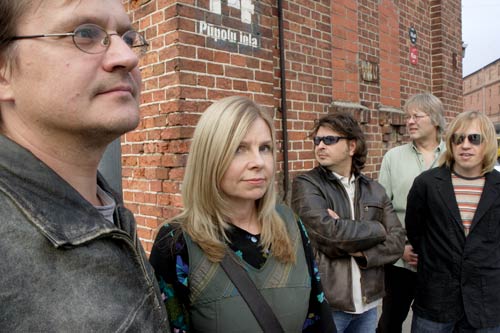
The current lineup of Iļģi includes, from left to right, Māris Muktupāvels, Ilga Reizniece, Vilnis Strods, Gatis Gaujenieks and Egons Kronbergs. (Photo courtesy of Iļģi)
Egils Kaljo is an American-born Latvian from the New York area . Kaljo began listening to Latvian music as soon as he was able to put a record on a record player, and still has old Bellacord 78 rpm records lying around somewhere.