Third album by Double Faced Eels takes a turn toward the serious

Description of image

Vēl patiesāk by the band Double Faced Eels was certainly one of the most unexpected yet pleasant surprises in Latvian rock music in 2010.

My first encounter with Double Faced Eels was their song “Zilais vālis,” which was a moderate hit in Latvia a few years back. Though the song was catchy, it struck me as one of those songs by a group that, for better or worse, do not take themselves all that seriously. It seems like I had the group all wrong.

Double Faced Eels play in a style that meshes rock music with certain funk elements, somewhat vaguely similar to a group like the Red Hot Chili Peppers. Founded in 2004, the group today is made up of Marka (Mārtiņš Gailītis) on vocals and guitar, Ronis (Ronalds Briežkalns) on percussion, Reinis Straume on guitars and backing vocals, and Kristaps Ērglis on bass guitar. Also performing drums on some tracks on the album was Dairis Petrauskis.

Before Vel patiesāk, the band released Zilais valis in 2005 and Kurš gribēja nogalināt Džūliju? Nezinu, bet trāpīja mums in 2007.

Starting with the strong opener, “Tu neesi viens,” on Vel patiesāk the group makes clear that this is meant to be a serious, heavy and even occasionally aggressive record.

To be sure, not all of the album is heavy and aggressive. In fact, one of the standout tracks here is “Ļauj man būt,” a subdued yet beautiful song.

On the whole, the songs on the album do give the impression of sadness and solitude, concluding with the thundering “Vientulība,” featuring Marka howling like a soul in torment. This song, as well as many other songs on the album, features lyrics by Iveta Priede.

Although most of the record is on a quite serious level, the group shows with its last track—a version of the C+C Music Factory song “Everybody Dance Now”—that it still has a sense of humor. Granted, the song is quite out of place with the rest of the album.

Double Faced Eels have made one of the most satisfying Latvian rock records in recent memory. Perhaps in an attempt to prove that they are more than just a band that writes humorous songs, they have chosen to show their “serious” side on Vēl patiesāk. I think it is has worked out quite successfully. The group certainly has a talent for musicianship as well as songwriting. The album was quite the revelation for me, and hopefully for others as well.

Details

Vēl patiesāk

Double Faced Eels

SIA DFE,  2010

Track listing:

Tu neesi viens

Ātrums ir spēks

Labāk bēdz

Ja tā nav

Parafīns

Ļauj man būt

Kas notiek

Laiks ir dzīvs

Mazliet pazaudēts

Vēl patiesāk

Metāla putns

Vientulība

Outro

Everybody Dance Now
Egils Kaljo is an American-born Latvian from the New York area . Kaljo began listening to Latvian music as soon as he was able to put a record on a record player, and still has old Bellacord 78 rpm records lying around somewhere.

A dozen composers’ works combine to honor those hard to silence

De Profundis

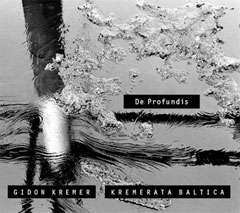
The distinguished and world renowned Baltic string orchestra Kremerata Baltica, led by artistic director and visionary violinist Gidon Kremer, in 2010 released a unique collection of string works entitled De Profundis.

Instead of focusing on a particular composer or style of music, the collection is of works by composers who were inspired to “cry out from the depths.” According to Kremer, they are works that cried out for a better world. The 12 works are by composers from many different centuries and styles—modern and classical, melodic and harsh, positive and negative.

Though Kremer writes in the liner notes that “it is not my intention to make De Profundis a political statement,” it is clear that it is. Kremer names the regimes of Saudi Arabia, Iran, Myanmar and Russia. He dedicates the collection specifically to Russian oligarch Mikhail Khodorkovsky – a political enemy of Vladimir Putin—and broadly to “those who refuse to be silenced,” and also writes about the corruptive power of oil.

That being said, politics is mercifully absent from the works themselves. As Kremer writes in the notes, the collected works “send their own individual message to the listener…appealing to their profoundest emotions.” The varied range of works is masterfully handled by Kremer and the Kremerata Baltica, and though the styles vary rather dramatically throughout the recording, the performances are always compelling and make clear the orchestra’s versatility and ability to successfully interpret works from hundreds of years of musical history.

For example, the earliest work on this album is the “Minuet No. 3 and Trios in D minor” by Franz Schubert, an early Romantic era composer who, in his very brief life, created some truly beautiful music. The prolific Schubert, though better known for his Lieder, also achieved success in other forms of music, as shown by this recording. Schubert’s wonderful sense of melody is brought forth by Kremerata Baltica.

Though many composers in the 19th century were beset with tragedy, one of the most tragic was Robert Schumann, whose promising piano performance career was cut short by a hand injury, and, in later years, mental breakdown. De Profundis contains Schumann’s “Fugue No. 6” from “Six Fugues on the Name B.A.C.H.” Schumann, though known more for piano works, also shows his versatility in the field of orchestral composition, with his Baroque style “Fugue,” interplaying all the instruments of the orchestra to form a rich tapestry.

Baltic composers are represented on this collection as well. Estonian composer Arvo Pärt and his “Passacaglia,” is performed in the composer’s distinctive deliberate, measured minimalist style, with the violins adding a level of tension to the piece. Lithuania’s Raminta Šerkšnytė is represented by the work that gives the album its title, “De Profundis,” an intimate yet ominous composition. Also performed is the picturesque “Flowering Jasmine” by Georgs Pelēcis of Latvia, featuring Andrei Pushkarev on the vibraphone.

Not just European composers are found in the collection. Argentina’s Astor Piazzolla’s “Melodia en La menor (Canto de Octubre), though an orchestral work, clearly displays his tango mastery.

As the works are of a rather varied nature, it would have been interesting to find out more about how Kremer chose them. The jumping back and forth through the centuries can lead to some jarring juxtaposition to the listener. Going from the German early Romantic Schubert to modern Hungarian Stevan Tickmayer and then to Soviet Russian Dmitri Shostakovich makes for a bit of a roller coaster ride. However, the performances are impeccable.

As was Kremer’s intention, all of the works here are intended to appeal to emotions. Although the works are in dramatically different styles, they all have a similar emotional heft. Kremerata Baltica and Kremer provide a truly expressive and vivid journey throughout the centuries.

Details

De Profundis

Kremerata Baltica

Nonesuch,  2010

Nonesuch 287228

Track listing:

Scene with Cranes (Jean Sibelius)

Passacaglia (Arvo Pärt)

De Profundis (Raminta Šerkšnytė)

Fugue No. 6, from Six Fugues on the Name B.A.C.H., Op. 60 (Robert Schumann)

Trysting Fields (Michael Nyman)

Minuet No. 3 and Trios in D Minor, D. 89 (Franz Schubert)

Lasset Uns den Nicht Zerteilen (Stevan Kovacs Tickmayer / J. S. Bach)

Adagio, from Lady Macbeth of the Mtsensk District (Dmitri Shostakovich)

Sogno di Stabat Mater bzw. Dialogues on Stabat Mater (alter Titel) (Lera Auerbach)

Melodía en La menor (Canto de Octubre) (Astor Piazzolla)

Flowering Jasmine (Georgs Pelēcis)

Fragment (from an unfinished cantata) (Alfred Schnittke)

Where to buy

Purchase De Profundis from Amazon.com.

Note: Latvians Online receives a commission on purchases.

Egils Kaljo is an American-born Latvian from the New York area . Kaljo began listening to Latvian music as soon as he was able to put a record on a record player, and still has old Bellacord 78 rpm records lying around somewhere.

Female group Latvian Voices releases album of folk, original compositions

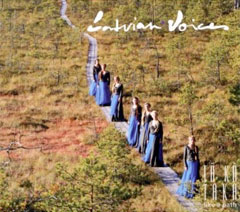
Female a cappella vocal ensemble Latvian Voices has released its third album, Tā kā taka.

Composed of seven young Latvian singers—Laura Jēkabsone, Karīan Kaminska, Nora Vītiņa, Andra Blumberga, Elīna Šmukste, Laura Leontjeva and Zane Stafecka—Latvian Voices perform a wide variety of Latvian songs which they have themselves arranged.

Tracks on the album include folk songs such as “Ej, saulīte, drīz pie Dieva!” and “Zvejnieks mani aicināja”; original works such as “Lietus” and “Tā kā taka”; and “Pasaciņa,” an arrangement of a song with lyrics by Aspazija and music by Zigmārs Liepiņš. The song “Kuto” also features Spanish beatbox artist Lytos.

The full track listing includes:

  1. Ar dziesmiņu ciemos eju
  2. Rūtoj’ saule
  3. Es gulu, gulu
  4. Mēnestiņis nakti brauca
  5. Ej, Saulīte, drīz pie Dieva
  6. Lietus
  7. Saulīt vēlu vakarā
  8. Tā kā taka
  9. Raugies tu
  10. Dindaru dandaru
  11. Zvejnieks mani aicināja
  12. Kuito
  13. Pasaciņa

The compact disc, released on the German MusicArtEmotions label, contains detailed descriptions of each song, as well as each group member, in Latvian, English and German.

This is ensemble’s third album, after Waving World Wide (focused more on sacred and international repertoire) and Seventh Heaven (a collection of Christmas songs), both released in 2010.

The ensemble will officially present Tā kā taka with a performance at the Spīķeri Concert Hall in Rīga on March 15, where Lytos and kokles performer Laima Jansone will also appear. Latvian Voices also plans a brief tour in May of Denmark and Switzerland.

For more on Latvian Voices, visit www.latvianvoices.lv.

Tā kā taka

Tā kā taka is the third album by female ensemble Latvian Voices.

Where to buy

Purchase Tā kā taka from Amazon.com.

Note: Latvians Online receives a commission on purchases.

Egils Kaljo is an American-born Latvian from the New York area . Kaljo began listening to Latvian music as soon as he was able to put a record on a record player, and still has old Bellacord 78 rpm records lying around somewhere.