Garanča’s new solo album features Romantic opera arias

Latvia mezzo-soprano Elīna Garanča has released her latest solo album entitled Romantique (Deutsche Grammophon, 479 0071), containing arias by Romantic era composers.

Backed by the Filarmonica del Teatro Comunale di Bologna, conducted by Yves Abel, the CD features Garanča performing the works of Donizetti, Tchaikovsky, Gounod, among others. The collection features both well-known works as well as less frequently heard arias.

Garanča has become one of the best known Latvian opera singers, and has performed in Frankfurt, Vienna, London, and, in perhaps her most famous performance, the title role in Bizet’s Carmen at the New York Metropolitan Opera House, also available on DVD from Deutsche Grammophon.

The CD booklet contains an essay about Garanča and the chosen works by Manuel Brug (in English, German and French), as well as all the aria texts with translations.

The CD is currently available to purchase in Germany and Latvia, and will be available in the UK in early October, and in the United States in late October.

For more information on Garanča, visit her website at www.elinagaranca.com, and for more information on this CD release, visit www.deutschegrammophon.com/garanca-romantique.

Track listing:

1. Oh! Mon Fernand – La Favorite – Gaetano Donizetti
2. “Mon coeur s’ouvre à ta voix” – Samson et Dalila – Camille Saint-Saëns
3. Farewell you native hills and fields – The Maid of Orléans – Peter Ilyich Tchaikovsky
4. O ma lyre immortelle – Sapho – Charles Gounod
5. “Faites-lui mes aveux” – Faust – Charles Gounod
6. Giulietta! oh! mia Giulietta! – Ah! se tu dormi – Giulietta e Romeo – Nicola Vaccai
7. “D’amour l’ardente flamme” – La Damnation de Faust – Hector Berlioz
8. “De tous cotés – Lorsque je t’ai vu soudain” – Le Roi d’Ys – Edouard Lalo
9. Plus grand, dans son obscurité – La Reine de Saba – Charles Gounod

image

Egils Kaljo is an American-born Latvian from the New York area . Kaljo began listening to Latvian music as soon as he was able to put a record on a record player, and still has old Bellacord 78 rpm records lying around somewhere.

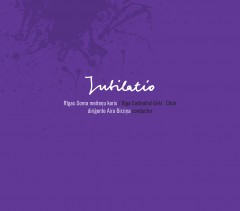
Jubilatio – six centuries of sacred choral works

The Rīga Cathedral Girls’ Choir, conducted by Aira Birziņa, has released their latest CD, Jubilatio, a collection of sacred choral performances. Covering works from a span of almost six centuries, Jubilatio was recorded at the Rīga Cathedral in 2011 and 2012.

The collection also features distinguished organist Vita Kalnciema, playing the legendary organ of the Rīga Cathedral, who performs in a number of the works, and also has a solo performance with “Toccata alla Fantasia” by Pauls Dambis.

The Choir was founded in 1997, and has about 90 singers, from the ages of nine to nineteen. Birziņa has been the conductor since 2000.

Previous releases by the Choir include Gribas drusku pablēņoties (DVD and CD), as well as Kas kaitēja nedzīvoti (2004) and Te Deum (by Rihards Dubra, 2006).

For more information on the Rīga Cathedral Girls’ Choir, please visit their website at www.girlschoir.lv

Track listing:
1. “Hebe deine Augen auf” from the oratorio “Elija”, Felix Mendelssohn-Bartoldi
2. “Sound the Trumpet” from the ode “Come, ye Sons of Art” – Henry Purcell
3. Ave Regina caelorum – Guillaume Du Fay
4. Ecce Maria – Michael Praetorius
5. Laudate Dominum – Rihards Dubra
6. The Lord Bless You and Keep You – John Rutter
7. Laudamus in Domine – Ieva Alenčika and Austriņa
8. Salve Regina – Miklós Kocsár
9. Miserere – Eva Ugalde
10. Gloria – Michael Bojesen
11. Exsultate Deo – Vytautas Miškinis
12. Toccata alla Fantasia – Pauls Dambis
13. O salutaris hostia – Ēriks Ešenvalds
14. Missa de Spiritu Sancto I Kyrie / II Gloria / III Sanctus / IV Agnus Dei – Rihards Dubra

image

Egils Kaljo is an American-born Latvian from the New York area . Kaljo began listening to Latvian music as soon as he was able to put a record on a record player, and still has old Bellacord 78 rpm records lying around somewhere.

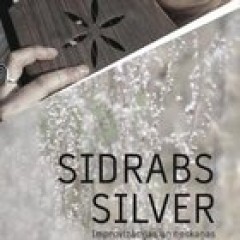
Sidrabs – Laima Jansone’s first solo kokle album

image

The kokle, a Latvian stringed instrument somewhat similar to the zither, has long been part of Latvian folk culture. The instrument has fitted into the stereotypical image of the Latvian folk maiden – in her folk costume, playing the kokle at the Song Festival (when she’s not milking the cows, of course).

Though it is an ancient instrument, and many might consider it a quaint bit of Latvian folklore, the kokle is very much a part of modern Latvian music. For example, there is Māris Muktupāvels of the post-folk group Iļģi, whose kokle playing is an integral part of the ensemble’s sound. Māris’ brother, ethnomusicologist Valdis, is also a renowned kokle performer, and has even written a book about the instrument. Biruta Ozoliņa performs the kokle in her ethno-jazz ensemble Patina. And that’s just to name a few.

Among those that are bringing this ancient instrument into the 21st century is the young musician Laima Jansone. Jansone has already performed with the Latvian Radio Choir – playing the kokle on a number of the songs on the Choir’s album Skaisti dziedi, released in 2008. Jansone has also performed with the vocal ensemble Latvian Voices, as well as Skyforger and Auļi. In 2011, Jansone released her first solo album – Sidrabs, a collection of solo kokle improvisations.

The improvisations are generally on a winter theme. Though they are improvisations, inspiration is drawn from Latvian folk songs and folklore – for example, the song “Sidrabs” quotes from the Latvian folk song “Sidrabiņa lietiņš lija”.
Judging from the song titles, the concepts presented are fairly simple – the works have titles like “Iela” (Street), “Upe” (River) and “Zāle” (Grass), but these are purely the sources of inspiration for the works – the actual performances are quite engrossing and compelling.

“Upe” features Jansone using the kokle as a percussion instrument, striking both the strings and the instrument itself, and then launching into a bravura performance that reminds the listener of a fast flowing river. “Piles”, as its corresponding video reinforces, gives the impression of a slowly melting icicle.

The album is also accompanied by a companion DVD, featuring the same tracks as the CD, each with an associated video, produced by Olafs Okonovs. The videos are, for the most part, fairly simple – for example, the video for “Iela” shows what seem to be headlights in the distance, the video for “Upe” has flowing water, etc. Interestingly, the video for “Atdzimšana” features a shadowy nude female form. Additionally, only Jansone’s fingers appear in the videos – this gives the viewer a better appreciation for how truly nimble and agile her playing is. The DVD is one that could be played in a spa or relaxation center. Otherwise the videos are a bit repetitive, and might not stand up to repeat viewing – except, of course, “Atdzimšana”.

Sidrabs is most certainly a worthy new entry in the Latvian kokle music genre – balancing both the ancient and the modern, the songs on the album provide a picturesque and beautiful winter landscape.  Laima Jansone’s performances are very melodic and almost entrancing at times. Though slightly on the shorter side (under 40 minutes), that brief period of time is riveting and engrossing, both for Jansone’s virtuoso playing as well as the dreamy winter moods it presents. Sidrabs is an exceptional achievement, and we can look forward to hearing the next chapter!

More on the Laima Jansone website.

Details

Sidrabs

Laima Jansone

Kalve Studija,  2011

Track listing:

1. Pirmais (First)

2. Sidrabs (Silver)

3. Iela (Street)

4. Upe (River)

5. Zāle (Grass)

6. Piles (Drops)

7. Ceļš (Road)

8. Putenis (Blizzard)

9. Atdzimšana (Rebirth)

Egils Kaljo is an American-born Latvian from the New York area . Kaljo began listening to Latvian music as soon as he was able to put a record on a record player, and still has old Bellacord 78 rpm records lying around somewhere.