PBLA izsludina Zentas Mauriņas konkursu

Atzīmējot rakstnieces Zentas Mauriņas 110.dzimšanas dienu, izsludināts Pasaules brīvo latviešu apvienības Izglītības padomes konkurss “Zenta Mauriņa un mūsdienas”.

Mauriņa bija pasaulē pazīstama latviešu rakstniece, kura slavena ne tikai starp latviešiem bet arī vāciski runajošās valstīs. Viņa 1969.gadā kļuva par PBLA Tautas balvas laureātu, bet 1971.gadā apbalvota ar Vācijas FR kanclera Konrada Adenauera prēmiju.

Rakstniece dzimusi Latvijā 1897.gadā, dzīvojusi Zviedrijā un Vācija kopš 2. Pasaules kara. Mauriņa nomira 1978.gadā Šveicē, bet ir apbedīta Vācijā.

Mauriņa bija filozofe, rakstniece, esejiste, filozofijas zinātņu doktore. Rakstījusi gan latviski, gan vāciski. Viņas darbi tulkoti angļu, itāliešu, krievu, zviedru, holandiešu, somu un dāņu valodās.

Vairāk informāciju par konkursu var iegūt interneta lapā www.gramata21.lv. Konkurss domāts jauniešiem no 9. klases līdz 25 gadiem. Uz konkursu jāpiesakās līdz 1.martam.

Daina Gross is editor of Latvians Online. An Australian-Latvian she is also a migration researcher at the University of Latvia, PhD from the University of Sussex, formerly a member of the board of the World Federation of Free Latvians, author and translator/ editor/ proofreader from Latvian into English of an eclectic mix of publications of different genres.

Spots for Latvian ski bunnies and powder hounds

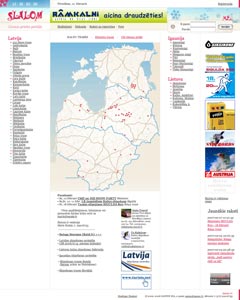
Slalom.lv Web site

The SLALOM.lv Web site is a good starting point for gathering information about Latvia’s ski hills.

Although winter in the Northern Hemisphere technically began in December, it has been a bit slow in actually bringing on the appropriate conditions: falling temperatures and, most importantly, snow! But now that the season has finally arrived, it is fitting to have a look at the options for fanatics of the white stuff.

Where’s the Latvian angle? Our task: to find Latvian skiing options, not just in Latvia but worldwide.

To find Latvians on the slopes the most logical place to look would be Latvia. A long list of hilly districts you can head to is found at SLALOM.lv. Each trase (you can’t call them resorts, the translation would be “run”) has its own Web site, so have a look at each one to get the facts on ski lift working hours, ski rental costs and accommodation options. The site doesn’t only concentrate on downhill ski slopes. Cross-country skiers can also find the best places to go touring on the more level plains. Looking slightly farther afield, if you are looking for a Baltic skiing experience, the slopes of neighboring Estonia and Lithuania have also been included.

Here is a list of the Latvian snowfield Web sites:

If you are interested in more organised ski activities, such as clubs, schools and competitions, the Latvian Skiing Association (Latvijas slēpošanas savienība) site is worth a visit.

Many Latvians are avid skiers, so it’s no surprise those who can afford it head to the Alpine ski resorts in France, Austria, Switzerland and Italy. The central European countries of Slovenia, Croatia, the Czech Republic and Slovakia also offer cheaper skiiing options for those who have a more modest budget. Most Latvian travel agencies offer a wide variety of options to reach the slopes, usually bus tours, but these don’t always need to be exhausting three-day road trips. Travel agencies are happy to organise travel options where you book a cheap flight and combine it with a bus tour to the ski fields. Seems you could head off with other Latvians to any ski slope in Europe.

What about the rest of the world? In the United States, the Chicago Latvian Ski Club organises annual tours to Banff in Canada’s Alberta province. This is all arranged in the fall, but maybe there are still some places left. More information may be found on the Latvian Happy Hour Club site or by sending e-mail to LatvianSkiClub@aol.com

Now for the surprise option. If you’re such a keen skier that you can’t get enough skiing with one winter a year, why not head down under during the Northern Hemisphere’s summer and ski to your heart’s content in Australia.

The Blue Eyes Ski Lodge (Zilās acis) is a Latvian-run facility at Mt. Buller in the Australian Alps of Victoria. There’s just one catch: you need to get the recommendation of a member to stay at the club. But to say hello, just ring the doorbell, there’s always a Latvian or two up at the lodge in winter.

Details

Daina Gross is editor of Latvians Online. An Australian-Latvian she is also a migration researcher at the University of Latvia, PhD from the University of Sussex, formerly a member of the board of the World Federation of Free Latvians, author and translator/ editor/ proofreader from Latvian into English of an eclectic mix of publications of different genres.

Opera’s first DVD aims for child audience

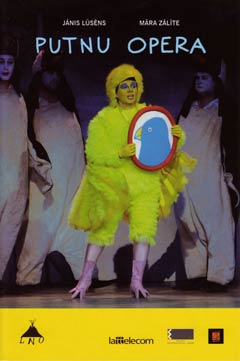
Putnu opera

Opera is a genre not usually equated with children’s entertainment. The usual perception is that opera is for adults with refined musical tastes. To entertain kids you need loud music, bright lights, colour, movement—and as children are not too discerning, you don’t need to worry about quality.

The recently released DVD Putnu opera proves this stereotype wrong. Just as you can get your kids to eat decent food and not live on sub-standard fare, you can also take your ankle-biters to the opera and come home with both parents and children content.

“Putnu opera” has been around for a few years. The premiere was six years ago on Dec. 22, 2000, and every year since the Latvian National Opera schedules a few performances. This is the first performance by the opera that has been digitized and made available on DVD.

The play is the successful collaborative effort of famous Latvian author and playwright Māra Zālīte and composer Jānis Lūsēns. Based on the children’s book characters created by Hugh Lofting—Dr. Dolittle and his loyal bevy of animals—the opera has a simple scenario. Dr. Dolittle and his friends are visited by a distressed opera diva, Pipinella the canary, who is searching for her canary friend Cheep, also an opera singer. During the search and rescue mission, which takes Dr. Dolittle and his entourage all over town and frees some captive birds, the animals decide to put on an opera and begin rehearsals.

The basic plot is enhanced by sub-plots; these are common elements in most operas. The difference here is that these side issues are not too confusing so children can easily follow the storyline without needing to get bogged down trying to understand the details. The beauty of DVDs are the subtitles that weren’t available in pre-DVD times. Even though the opera was in Latvian (not the traditional German or Italian, so theoretically it should be easy to follow), by reading the Latvian subtitles as well made it is much easier to understand the storyline.

The characters (and especially their costumes—kudos to costume designer Kristīne Jurjāne) are so exaggerated but at the same time stylized and easily recognizable that the children in the audience will remain mesmerized for most, if not all, of the performance. We even had a 3-year-old in our family audience of five and he sat through most of the 75-minute DVD without fidgeting, which says something about this opera!

A bonus features section gives a lighthearted behind-the-scenes look at the Latvian National Opera and the way a production is put together. The joint efforts of the various departments (artistic, musical, lighting, costume, stage management) are all mentioned, showing the viewers the complexity involved in staging an opera.

Getting kids to watch an opera is no mean feat.  But it is possible as all the elements of good entertainment are there—colour, movement, high-class opera—all in Latvian!

Details

Putnu opera

Mārā Zālīte and Jānis Lūsēns

Rīga:  Latvijas Nacionālā opera,  2006

Daina Gross is editor of Latvians Online. An Australian-Latvian she is also a migration researcher at the University of Latvia, PhD from the University of Sussex, formerly a member of the board of the World Federation of Free Latvians, author and translator/ editor/ proofreader from Latvian into English of an eclectic mix of publications of different genres.