The exodus to Ireland—and to the Web

Baltic Ireland Web site

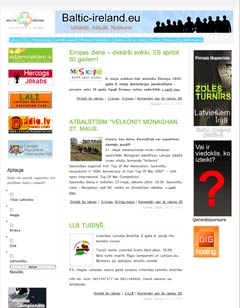
The newest Web site for Latvians living on the Emerald Isle is called Baltic Ireland.

Thousands of Latvians (according to latest Irish census statistics, officially around 14,000) have voted with their feet since Latvia joined the European Union in 2004 and have moved to Ireland, a prosperous nation with numerous opportunities. Many have moved with the intent to only stay for a short while and earn enough for a specific purpose, others are fed up with their life in Latvia and do not plan to return.

The Latvians who have moved to the “Emerald Isle” are scattered throughout the whole of Ireland, with a large proportion now living in Dublin and its surrounds. With such a large number of Latvians living in Ireland it comes as no surprise that they have started to form Latvian organisations and various interest groups—and even have several Web sites. Even though the percentage of Latvians interested in such organised activities is quite minimal, the hope is that the Latvian saying “kur ir, tur rodas” (loosely translated: the more the merrier) will apply in future.

The first Web site worth mentioning is that of the Embassy of Latvia. This would seem the first logical port of call for Latvians in Ireland. But the embassy’s role is purely to represent Latvia in Ireland, so the Web site doesn’t have any further information about Latvian activities in Ireland or offer any further information for those who are planning to relocate there.

Three Latvian societies have been founded in Ireland in the past few years. The first one, founded in 2005, is Latviešu Biedrība Īrijā (Latvian Society in Ireland). LBI’s statutes state that among it’s main aims are maintaining the culture, language and ethnic identity of Latvians living in Ireland. The society’s Web site also acts as an information source for those who need help with relocation to Ireland with a list of links to Irish government information brochures and sites. This is not all the site is concerned with. Visitors also can find out what the newly formed Latvian organisations are up to. Among these are the Latvian mixed choir, the Latvian folk-dance group “Jampadracis,” the Latvian School “Saulgriezīte,” Latvian church services and hockey team Latvian Hawks .

Latvians, as is their nature, are not content to stop with one society. In 2006 another society, Latviešu Apvienība Latviešiem Īrijā (Latvian Society for Latvians in Ireland), was founded in Dublin. Its aims are very similar to those of LBI. According to LALI’s Web site, the society “acts in the interests of Latvians in Ireland and deals with issues that are of interest to Latvians who are living in Ireland for a shorter or longer length of time.”

As Latvian organised activities gain momentum, the Latvians living on the western coast of Ireland (numbering around 2,000) can now also proudly say they have an organisation to represent them—the Limerick Latvian Society, founded in April. The society does not have a Web site yet but news of the organisation’s aims and future plans can be found on the new Baltic Ireland site.

Baltic Ireland, just launched at the beginning of May, wants to incorporate all Latvian activities, not discriminating among those hosted by one society or another. In its introductory comments the Web site states that it is created for “…Latvians in Ireland and their relatives, friends and acquaintances in Latvia. The main aim of the portal is to provide information on what is happening in Ireland…We hope, with your assistance, to create a portal that ‘rocks’ and dispel the myth that all Latvians in Ireland are ‘mushroom-pickers.’”

Latvians in Ireland also have a paper-based source of news and information. The weekly newspaper Sveiks can be purchased in Russian and Polish grocery stores in Dublin, Cork, Galway, Sligo and other towns. The paper is edited in Rīga but printed and distributed by the Russian-language newspaper Nasha Gazeta in Dublin.
Details

Daina Gross is editor of Latvians Online. An Australian-Latvian she is also a migration researcher at the University of Latvia, PhD from the University of Sussex, formerly a member of the board of the World Federation of Free Latvians, author and translator/ editor/ proofreader from Latvian into English of an eclectic mix of publications of different genres.

Web sites help plan summer holiday

notikumi.lv

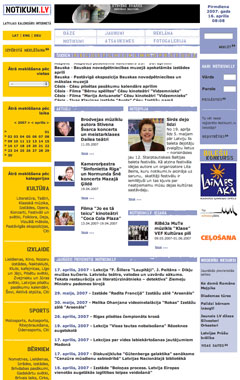
The online events listing notikumi.lv is a comprehensive guide to what’s on in Latvia.

If your holiday plans this year include a trip to Latvia, then read on. Where is the best place to turn to find out what’s happening when you get there? Sure, there are the pocket tourist guides, the local newspapers and good old-fashioned billboards out on the street. But nothing beats the Internet when it comes to information gathering.

The first port of call should be notikumi.lv, a great site as events searches can be made by subject, date, age (with a separate kids’ category) and other criteria so you’re not left sifting through wads of information that is of no interest to you. You will still get the biggest listing in Latvian, but English and German are the two other languages on offer. The site is sometimes lacking; around Easter time we couldn’t find anything on the folkloric Easter celebrations planned in Rīga.

If you’re more of a classical music buff, then Latvijas Koncerti is your site. Elegant design is jam-packed with content, which is interspersed with some great quotes such as the Zimbabwean proverb, “Ja tu vari paiet, tu vari arī padejot. Ja tu vari parunāt, tu vari arī padziedāt” (If you can walk, you can dance. If you can talk, you can sing). The site is a great all-rounder as it includes the latest not just on strictly classical events but also jazz, contemporary music, kids and youth concerts, and even world music.

The Rīga Convention Bureau’s Inspiration Rīga  can give you ideas for exhibitions, concerts, fairs and festivals, while the Latvian Institute has a good list of all main cultural events planned for 2007.

Many venture to the homeland to experience Latvian folkore in its native setting. Ansis Ataols Bērziņš’ Folklora.lv has much information about folklore, including a list of events, but it is by no means comprehensive. The Latvian Open Air Ethnographic Museum (Latvijas Etnogrāfiskais Brīvdabas muzejs) in Rīga, a favorite tourist spot, offers information about activities through its virtual museum as well as through Latvijas Ceļvedis, an online guide to tourist attractions throughout the country.

Two of the main portals in Latvia, Delfi and Apollo, are good for locating events depending on your interests and tastes. Go to notikumi.delfi.lv or Apollo’s Izklaide section to track what’s happening on the club and pub scene. Opera, concert and theatregoers can turn in here, too, as can those in Rīga with young kids desperately trying to locate a restaurant that can accommodate the brood.

If it’s not just Rīga you are interested in, event listings can also be located on regional Web sites such as www.cesis.lv, www.madona.lv, www.kuldiga.lv and so on.

Every summer in Latvia is filled with activities. You don’t have to wait for a Song Festival to come around to experience and taste Latvia. But if you are planning the big trip for next year then www.dziesmusvetki2008.lv will certainly be worth a visit. At the moment, however, the site is still under construction.

Details

Daina Gross is editor of Latvians Online. An Australian-Latvian she is also a migration researcher at the University of Latvia, PhD from the University of Sussex, formerly a member of the board of the World Federation of Free Latvians, author and translator/ editor/ proofreader from Latvian into English of an eclectic mix of publications of different genres.

Projects collect Latvian life stories

Each of us has a life story, each with a different color and texture, with moments of joy and moments of despair or sadness. Older Latvians’ lives in particular are full of trauma and often tragedy as the Latvian people have been subjugated by neighboring forces in the first decades of the 20th century as a result of two world wars. This was followed by even more tragedy as families were torn apart again in the 1950s by mass deportations from Latvia and at the same time emigration of thousands of families to the United States, Canada, Australia and various countries in Europe.

One way of documenting these biographies is by recording the oral histories of individuals. This way a physical recording or written transcription of a person’s life story can be passed on to future generations. Just as Krišjānis Barons recorded Latvian folksongs in the 19th century, there are many researchers continuing his job and adding much more to the documentation of people’s lives.

One project involved in this is Dzīvesstāsts (Lifestory), undertaken by the Institute of Philosophy and Sociology at the University of Latvia. Called the National Oral History project, its aim is to record the life stories of people with a connection to the nation of Latvia “regardless of the ethnicity or nationality of the interviewee who is an inhabitant of Latvia or where—even outside Latvia—this lifestory is recorded.” The material collected via these interviews provides resources to various fields of academic research: sociology, social and cultural anthropology, linguistics, individual and social history, ethnology, and folklore psychology. The Dzīvesstāsts project has a partner, “Dzīvesstāsts – trimdā” (Lifestory – Diaspora), with coordinator Maija Hinkle in the United States organising interviewers who, in contrast to the project in Latvia, work independently, thousands of miles away from one another, according to the Web site.

A similar project homes in on an even more specific group, the refugees from Latvia living in German Displaced Persons’ camps after World War II. The project, called DP Albums, invites people to send in testimonies as well as photographs of life in these camps. The team involved in this project is an eclectic group all too young to remember the events but keen to document them as they are part of their heritage. Funded by various foundations and associations with an interest in supporting Latvian cultural heritage projects, this is one project with a “use-by date,” as those who remember the DP camps age and pass away.

An interactive virtual encyclopedia project is Latvijas ļaudis uz 21. gadsimta sliekšņa (Latvia’s People at the Turn of the 21st Century), where individuals are invited to add biographical data about people who have “contributed to promoting Latvia’s freedom and growth. The people, who are the real wealth of our country, will write a book about themselves, thus creating a collective portrait of the country.” Collating Latvian biographies since 2002, the project is partially funded by the Soros Foundation. The biographies that can be seen there so far are a real cross-section of the community, both those Latvians living in Latvia as well as those who have lived outside Latvia for the past six decades. Many are people with a recognizable name, outstanding each in their particular field, while others have been “quiet achievers” who have made a significant contribution nonetheless.

All these projects have helped to document the personalities, both big and small, that have helped to create the mosaic of Latvia and its people. Each person and family has their own thread to add to the complex tapestry of Latvian history.

Details

Daina Gross is editor of Latvians Online. An Australian-Latvian she is also a migration researcher at the University of Latvia, PhD from the University of Sussex, formerly a member of the board of the World Federation of Free Latvians, author and translator/ editor/ proofreader from Latvian into English of an eclectic mix of publications of different genres.