That wonderful scent from the kitchen

If the word “Latvian” is associated with one certain scent, then first prize would go to the humble pīrāgs. One of the unique Latvian symbols that foreigners discover about Latvians worldwide is the often mispronounced, but never forgotten, little bacon and onion delicacy that smells absolutely divine while baking and tastes like heaven when just out of the oven.

This crescent-shaped mini-pie looks like an Italian calzone and has similar ingredients, but the taste is quite different. The Russians and other Eastern Europeans have similar dumpling or bun variations called perogi, piroghi, pierogi or piroshki. Other variations are boiled dumplings called pelmeņi, originating in Siberia, and varenyky, the Ukrainian version of the same thing. Many of these versions are boiled or boiled and fried, whereas the Latvian pīrāgi are baked using bread dough, hence the resemblance to calzone. The Latvians have also elaborated on the theme and created other savoury fillings as variations on the original: kartupeļu pīrāgi (potato buns), sēņu pīrāgi (mushroom buns), kāpostu pīrāgi (cabbage buns) and the list goes on. Those with a sweet tooth are not left wanting: apple pīrāgi, rhubarb pīrāgi, cottage cheese pīrāgi… the possibilities are endless!

If there’s one way to get someone to remember your nationality, it’s through their stomach, so why not discover the secrets of the ancient Letts in the fine art of the baking of pīrāgi or speķa rauši, as they are also called in Latvia.

For an insight into the myriad recipes that are out there, the recipe portal receptes.lv is the first port of call. It’s important to note these are recipes that have been sent in by people who live in Latvia, so their recipes will mention local brands of flour, margarine and other ingredients. Latvians living elsewhere may need to adapt the recipes after trial-and-error to reveal the best local brands in their part of the world.   

For a pictorial how-to, revealing the basics with easy-to-follow steps, have a look at Cāļa virtuve, part of the family oriented Cālis portal. Another step-by-step guide is found on Handy Home Projects, a blog by a family in Canberra, Australia, that is “trying new things, living naturally and frugally, having fun.” Be sure to review part 1 and part 2.

Elvis Stumbergs, who immigrated to the United States in 1990, describes pīrāgi and associated folklore. Although th site is not as specific in terms of quantities for ingrediants, the author makes one very important point: the joint effort of baking for a specific event stimulates community solidarity. This can be cross-generational (passing the tradition down to the next generation) or simply strengthen individuals’ ties with their heritage.

For a more personal take on the subject have a look at Silvija and Pēters Vecrumba’s Latvians.com, which draws the following conclusion: “Pīrāgi are the Latvian woman’s secret weapon. None can withstand their delightful onslaught!”

Don’t forget Latvians Online has its own Latvian Culture and Cooking Forum, where many of the topics are related to recipes that have been handed down from generation to generation.

Details

Daina Gross is editor of Latvians Online. An Australian-Latvian she is also a migration researcher at the University of Latvia, PhD from the University of Sussex, formerly a member of the board of the World Federation of Free Latvians, author and translator/ editor/ proofreader from Latvian into English of an eclectic mix of publications of different genres.

Latvian churches abroad well represented on the Web

Latvian Ev. Lutheran Church in Sydney

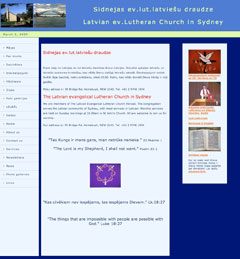
The Web site of the Latvian Ev. Lutheran Church in Sydney provides Bible quotes and the church newsletter.

Latvians who have ended up in other parts of the world, either voluntarily or involuntarily have more often than not established their communities with the focal point being the church. In many cities the church community has founded Latvian schools, camps, folk dancing groups and other organizations. Over the years the role of the church as the hub may have changed slightly but its primary role—as the place for Latvians to be able to go and worship God in the style that they are accustomed to—has remained to this day. Even if congregation numbers are dwindling, the communities will still do their utmost to support a pastor and ensure that regular services are offered to those who wish to attend.

Dozens of Latvian churches are scattered around the world and a sizeable proportion of them have a Web site informing congregation members and the wider community of their work. Quickly skimming through the sites you get a good insight into what each community values and deems important informationwise. But it is important to bear in mind that the flashiest or most professionally designed and structured church Web site does not necessarily mean the congregation is a more caring community and the pastor is far better than others. It just may mean the congregation has steered its funds towards other service-oriented priorities. By the same token, a site that takes pride in mentioning recent christenings, shows plenty of photos featuring happy occasions in the church calendar and provides directions on how to get to the church may be a more outreach-focused church than one that focuses on the history and origins of the congregation. Each bit of information is important but in a balanced way. Nor does it necessarily mean that if the information on a particular church is in English and Latvian that the church is less focused on the Latvian language in services.

Here’s a quick summary of features on some church Web sites. By no means have we tried to list every bit of information available—or every site. Most of the sites are in Latvian, but some provide English content as well.

In Australia, the Web site of the Latvian Ev. Lutheran Church in Sydney provides Bible quotes for certain times of need, as well as a downloadable church newsletter. The site also notes all sermons are recorded on compact disc and can be ordered from the pastor.  The Church of the Holy Cross in Melbourne also has both its newsletter and monthly bulletin available for downloading and informs of the latest events and service calendar.

In Canada, St. Andrew’s Congregation in Toronto, has a few newsletters available for download as well as a video of the African Childrens Choir that recently performed at the church. We experienced some difficulty viewing and downloading these files because we were not using a Windows computer and Microsoft Internet Explorer.

In the United Kingdom, visit the Web site of the United London Latvian Lutheran Church and you won’t have an excuse for missing the next service: A popup message reminds visitors. The site allows vistors to download the latest newsletter and MP3 files of sermons and songs. A link takes visitors to a forum where they can discuss church-related and broader Latvian issues.

In the United States, the New York Latvian Ev. Lutheran Congregation takes pride in its various church properties as well as the summer camp in the Catskill Mountains. The church Web site provides information and photographs of these properties. The site also has MP3 audio files of various services by various pastors in 2007. Visitors also can download a membership application form and a donation form.

The Web site of the Latvian Ev. Lutheran Church of Washington D.C. is in English and Latvian and has instructions on how to get to the church. The local Latvian school founded by the church also gets a mention.

St. John’s Latvian Lutheran Church in Philadelphia wins hands down as the Web site with the most colorful introduction. The site has a service and events calendar followed by the school calendar, showing that school events are coordinated with the church calendar.

We tracked down the Latvian Evangelical Lutheran United Church of Kalamazoo within www.saites.org, a portal for Latvians in Michigan. We found the church pages to be very limited informationwise. The Saginaw Latvian Ev. Lutheran Church had more news but it unfortunately was slightly outdated. The site contains an invitation to pay church dues and to donate money to the congregation’s sister church in Latvia.

The Latvian Ev. Lutheran Church of Indianapolis, which is included in the Indylatvians.com portal, has a brief paragraph informing of its location and services.

The biggest surprise was hearing a Latvian worship song and seeing a scrolling announcement at the top of the site of the Chicago Latvian Zion Ev. Lutheran Church. The availability on the site of the church bulletin, the annual report and dozens of photos of church events all show that this is a community with many helping hands.

The Minneapolis-St. Paul Latvian Ev. Lutheran Church has a well-structured and visually appealing site with information on the church and its school, choir, folk dancing group, ladies auxiliary, library and more. The site also has a personal touch: announcements of latest christenings.

The Boston Latvian Ev. Lutheran “Trimda” Congregation site has plenty of photos of members at various functions and events, showing the community is a fairly active one. The structure and design of the site are easy on the eye. This is the only site that informs visitors how to reach the church by public transport.

Three more broad sites are worth a mention:

  • The Latvian Evangelical Lutheran Church in America (LELBA) is the umbrella organization for all the previously mentioned churches in the United States. LELBA puts out two publications, the magazine Ceļa biedrs and the newsletter LELBA Ziņas. Tables of contents and summaries are available online for Ceļa biedrs, while the newsletter is available as Adobe Acrobat PDF files. LELBA’s Web site also lists the various divisions of the board and the work each division is involved in.
  • The recently unveiled Union of Latvian Baptists in America site provides brief information on the various Latvian Baptist churches in this region.
  • The Latvian Ev. Lutheran Church in Germany site has a church and pastor list and service calendar for the various churches scattered throughout central Europe, including Germany, Belgium, Denmark, the Czech Republic and the Netherlands.

Details

Daina Gross is editor of Latvians Online. An Australian-Latvian she is also a migration researcher at the University of Latvia, PhD from the University of Sussex, formerly a member of the board of the World Federation of Free Latvians, author and translator/ editor/ proofreader from Latvian into English of an eclectic mix of publications of different genres.

Communing with nature in Latvia

Cūkmens sticker

Stickers urging people to clean up after themselves when visiting state forests are part of the Cūkmens campaign.

If you are planning a trip to Latvia—or are already in Latvia—do you have an interest to be at one with nature? Where can you turn to find out the best picnic and fishing spots, childrens’  nature activity parks and other outdoor recreation areas? Mammadaba.lv, a literal translation of the term Mother Nature, is an initiative created by Latvijas valsts meži (Latvian State Forests, www.lvm.lv) that encourages travel to the countryside.

By countryside this state institution means the forests, the rivers, the lakes—not just the towns. The hope here is that locals as well as tourists will find these trips to the countryside enjoyable and will return and pass this information on to others. The Web site is great for ideas for the best spots for all kinds of activities, from the local Latvian favorites of berry picking, mushrooming, fishing, bird-watching and hunting to cycling routes, orienteering and nordic walking routes. So far there are around 300 areas of state-owned forest territory under the stewardship of Latvijas valsts meži that have been cleared for recreational public use.

If you’ve headed out to the woods but want to stay longer than just one day your best bet for accommodation options is Atputa laukos. The Web site is created by the country tourism association Lauku ceļotājs, which also publishes brochures that can be purchased in most bookstores. For more sites on the environment and various options for outdoor recreation have a look at the links page.

Latvijas valsts meži has also for the past two years been involved in a campaign to increase public awareness of the dumping of rubbish in Latvian forests. Cūkmens is the public face of this campaign, a litterer-turned-pig in a superman-style pink pig costume actively urging the public to clean up its act: “Nemēslo mežā! Par cuku pārvērtīsies!” (Don’t dump your rubbish in the forest! You’ll turn into a pig!). This year the campaign has focused on coastal rubbish dumping. Cūkmens has visited local school in coastal regions, educating the children as well as getting the public involved in cleaning up the coastline. Jāņi was another perfect target for a Cūkmens intervention; with so many people heading to the woods to celebrate, there has always been a tendency to leave the post-Jāņi waste behind. Learn more about the Cūkmens campaign and see video and listen to audio from the campaign at www.cukmens.lv.

School-aged children can learn more about the forests of Latvia by taking part in a program, Izzini mezu, a joint initiative of Latvian State Forests, the Foundation for Environmental Education and the Forest Development Fund. The patron of this program is Latvian writer and poet Imants Ziedonis. The aim is to teach kids the importance of the forest habitat from an ecological and cultural perspective in the early years to more complex concepts in the later years of their school life.

Details

Daina Gross is editor of Latvians Online. An Australian-Latvian she is also a migration researcher at the University of Latvia, PhD from the University of Sussex, formerly a member of the board of the World Federation of Free Latvians, author and translator/ editor/ proofreader from Latvian into English of an eclectic mix of publications of different genres.