Publication aims to inform Latvians abroad about parliamentary election

A new online and print publication, aimed at informing Latvians abroad about the upcoming parliamentary election in the homeland, has been unveiled by a group in Sweden.

Titled Desmitnieks—a reference to the Oct. 2 election for the 10th Saeima—the publication is backed by the Latvian Aid Committee of Sweden (Zviedrijas Latviešu palīdzības komiteja) and is edited by Austra Krēsliņa.

Desmitnieks will be short-lived. One issue per week, starting Aug. 16, is promised up to the election, and then one or two issues after to provide analysis of voting results. The publication will appear in print as a supplement to the European exile newspaper Brīvā Latvija and online at www.desmitnieks.lv, Krēsliņa told Latvians Online in an e-mail.

Each edition, she said, will have the same structure: a focus on a specific issue, a short editorial commentary, a column by an independent author, and an explanation why the issue of the week was chosen.

“The idea is to offer Latvians living abroad independent information,” Krēsliņa said, “with the big goal of getting them to participate in this election and not be apathetic.”

In an editorial commentary, Desmitnieks notes that every vote counts, as has been shown in recent elections in the United States and Germany.

The first issue addressed by Desmitnieks is dual citizenship. Since July 1995, Latvia’s citizenship law does not allow people to become dual nationals. The responses of just five of the 13 political parties and coalitions fielding candidates in the Saeima election are included, with commentary by Nils Muižnieks of the University of Latvia.

The Latvian Aid Committee of Sweden is one of the oldest exile Latvian organizations. Formed in 1943, its initial purpose was to assist refugees from war-torn Latvia.
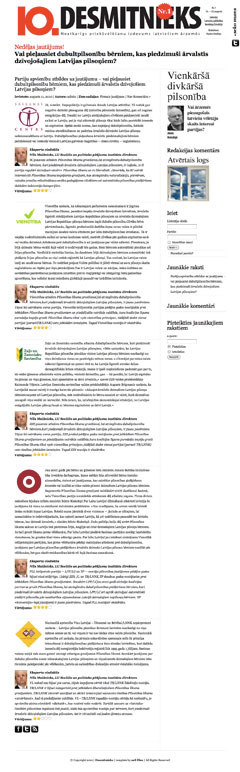
Desmitnieks

The online and print publication Desmitnieks aims to inform Latvians abroad about the Oct. 2 parliamentary election.

Andris Straumanis is a special correspondent for and a co-founder of Latvians Online. From 2000–2012 he was editor of the website.

Commission scratches 5 candidates from election, 7 more may face hook

And then there were 1,234. Latvia’s Central Election Commission has scratched from the Oct. 2 parliamentary election five candidates who have criminal backgrounds and who as a result are not allowed to run for office under the Saeima election law.

Oļegs Posadskovs and Sergejs Špaks of the leftist For Human Rights in a United Latvia (Par cilvēka tiesībām vienotā Latvijā, or PCTVL), Sergejs Simčaks of the pro-business Made in Latvia (Ražots Latvijā) and Andris Grīnis of the Christian Democratic Union (Kristīgi demokrātiskā savienība, or KDS) were dropped from the ballot because they have been sentenced for committing crimes, election commission spokeswoman Kristīne Bērziņa said in an Aug. 11 press release.

KDS candidate Zigfrīds Laicāns, meanwhile, has been dropped for committing a crime while mentally unstable. According to the Saeima election law, among those who may not be elected to the parliament are persons who “have committed a criminal offense in a state of mental incompetency or a state of limited mental competency or who, after committing a crime, have become mentally ill and are incapable of taking conscious action or controlling it and as a result have been subjected to compulsory medical treatment or their cases have been dismissed without applying such a compulsory measure.”

The removal of Posadskovs and Špaks leaves PCTVL with a total of 95 candidates. Ražots Latvijā is now at 85 candidates and the KDS is at 83.

The Central Election Commission took the action after receiving information about the candidates from the Ministry of the Interior. Their removal from the ballot leaves the number of candidates at 1,234. A total of 13 political parties or coalitions are fielding candidates for the 100-seat Saeima.

Meanwhile, seven other candidates are under investigation because evidence suggests they may have worked with the Soviet-era State Security Committee (Valsts drošības komiteja, or VDK). The Saeima election law prohibits anyone with such a record from being a member of parliament.

Under question are the candidacies of Ēriks Didrihsons of Saskaņas centrs, Aivars Saliņš of Par prezidentālu republiku, Ēriks Tīrums of Tautas kontrole, Arvīds Ulme of Zaļo un Zemnieku savienība, Roberts Gobziņš of Pēdējā partija, and Aivars Āķis and Rolands Zagorskis of Daugava-Latvijai.

Information about the candidates’ possible relations with the VDK was provided to the election commission by the Centre for the Documentation of the Consequences of Totalitarianism (Totalitārisma seku dokumentēšanas centrs).

Andris Straumanis is a special correspondent for and a co-founder of Latvians Online. From 2000–2012 he was editor of the website.

Dombrovskis: Economic indicators suggest recession in Latvia is over

The recession in Latvia is over, Prime Minister Valdis Dombrovskis told an Aug. 9 press conference in Rīga called to discuss the latest economic indicators.

The announcement comes less than two months ahead of the Oct. 2 parliamentary election, in which the prime minister’s centrist Vienotība alliance is vying for control of the Saeima against the center-left Harmony Centre.

“The recession is over and on the basis of certain indicators it can be expected that in the second part of the year Latvia’s economy will regain growth in terms of both quarterly and annual indicators,” Dombrovskis said during the press conference, according to his press secretary. “This means a more positive gross domestic product, tax income, employment and other rates.”

Economists say a recession is over when the gross domestic product increases for two consecutive quarters, the prime minister’s office noted.

Statistics cited by Dombrovskis and Economic Minister Artis Kampars included:

  • The GDP grew 0.3 percent in the first three months of this year and 0.1 percent in the second quarter. Dombrovskis and Kampars noted that while the level of growth is small, it cannot be disregarded after Latvia’s heavy economic downturn.
  • Industrial production in the second quarter increased 6 percent compared to the first quarter.
  • Retail production was up 1.7 percent in the second quarter.
  • Unemployment is down and price indices are up.

The prime minister’s office acknowledged that “a small economic downturn still remains,” but added that the numbers compare favorably to the 18 percent drop in the GDP last year.

A Bank of Latvia economics expert suggested that the GDP could turn positive during the third or fourth quarter of this year.

“Several factors are still at play, however, which make us expect an uneven development and remain cautious regarding GDP forecasts for the subsequent quarters,” Igors Kasjanovs said in a commentary posted Aug. 9 on the Bank of Latvia’s website. “The near future developments and risks most important for the Latvian economy are the imminent parliament elections, the adoption of the 2011 state budget and the related undertakings as well as a possibly weaker growth of the European economy at the end of the year and in 2011.”

However, Kasjanovs cautioned that “GDP growth in one or two quarters in itself is no guarantee that the growth will continue in the subsequent quarters.” He noted that both Estonia and Lithuania experienced recent bumps after seeing their economies begin to rebound.

Andris Straumanis is a special correspondent for and a co-founder of Latvians Online. From 2000–2012 he was editor of the website.