Victims of Communism memorial reaches goal

Groundbreaking for a memorial to the 100 million victims of communism is set for September in Washington, D.C., now that the fundraising goal has been reached, the Victims of Communism Memorial Foundation has announced.

The foundation announced July 19 that it has raised USD 825,000 for the construction of the memorial at the junction of Massachusetts Avenue, New Jersey Avenue and G Street, within sight of the U.S. Capitol.

The memorial, designed by San Francisco-based sculptor Thomas Marsh, will feature a bronze replica of the “Goddess of Democracy” statue erected during the 1989 Chinese student protests in Beijing’s Tiananmen Square.

Baltic-American communities of Latvians, Estonians and Lithuanians were singled by the foundation for their support of the memorial, the Joint Baltic American National Committee announced. The governments of Estonia, Latvia and Lithuania contributed nearly USD 11,000 to the cause.

The foundation is awaiting approval of a construction permit from the National Park Service.

The memorial is to be dedicated in June 2007 on the 20th anniversary of former U.S. President Ronald Reagan’s historic speech at the Brandenberg Gate in Berlin, when he challenged Soviet President Mikhail Gorbachev to tear down the Berlin Wall.
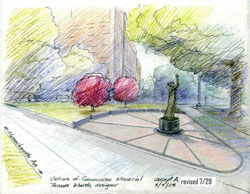
Rendering of memorial

A rendering shows sculptor Thomas Marsh’s design for the Victims of Communism Memorial. (Image courtesy of the Victims of Communism Memorial Foundtion)

Andris Straumanis is a special correspondent for and a co-founder of Latvians Online. From 2000–2012 he was editor of the website.

Court upholds Rīga’s ban of gay pride parade

The Rīga District Administrative Court has upheld a decision by the Rīga City Council to ban a July 22 gay pride parade in the city, according to Latvian media.

Organizers of “Rīga Pride 2006” asked the court to review the council’s July 19 decision. The council denied the permit citing unspecified security concerns.

The court’s July 21 ruling apparently means no public parade will occur in the Old City district of Rīga, but organizers might move the event to private property, the Web portal Apollo reported.

Organizers may also appeal the court’s ruling.

Last year, the city council issued a permit for the first-ever gay pride parade, but the city manager revoked the permit. However, in that case the Rīga District Administrative Court ruled that the city must re-issue the permit.

This year’s parade was scheduled as part of the July 19-23 Friendship Days in support of Latvia’s gay, lesbian, bisexual and transgender community.

Andris Straumanis is a special correspondent for and a co-founder of Latvians Online. From 2000–2012 he was editor of the website.

Amnesty group condemns ban on pride parade

Amnesty International has condemned the decision by the Rīga City Council to ban a gay pride parade that had been scheduled July 22, while parade promoters have taken the matter to court.

The city council, citing security concerns, on July 19 denied a permit for “Riga Pride 2006,” setting in motion a potential repeat of events that occurred last year during the capital city’s first-ever gay pride parade.

Mozaīka, the nonprofit group organizing this year’s gay, lesbian, bisexual and transgender event, has appealed the council’s decision to the Rīga District Administrative Court. The court is scheduled to consider the matter July 21.

The council’s decision was based on unspecified threats of violence from various extremist groups.

But Amnesty International questioned the council’s reasoning.

“The claims of Rīga City Council that security would not be able to be guaranteed to the participants of the march lacks credibility,” the London-based Amnesty Internation said in a press release, “considering that Latvian law enforcement agencies had the capacity to effectively ensure security during previous events of a similar or larger scale such as the 2006 ice hockey World Championships, and are expected to so during the November 2006 NATO summit in Rīga.”

The council also had received a petition signed by about 17,000 people demanding the city forbid the parade.

Last year, the city granted a permit for the parade, but the city manager—citing security concerns—subsequently canceled it. Parade organizers appealed to the administrative court, which ruled the city must re-issue the permit. The July 23, 2005, parade was marked by more anti-gay protestors than marchers.

Both pride event promoters and their opponents appear better organized this year. Mozaīka, a group formed following last year’s pride event, in April unveiled a new Web site, www.mozaika.lv. Meanwhlle, opponents have created a nonprofit group called NoPride and began the Web site www.nopride.lv.

Andris Straumanis is a special correspondent for and a co-founder of Latvians Online. From 2000–2012 he was editor of the website.