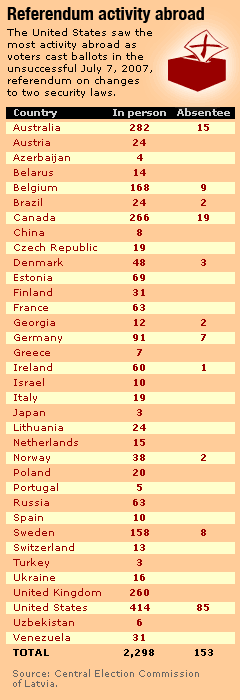
Citizens voting during the 12th National Latvian Song and Dance Festival in Indianapolis made theirs the most active polling station abroad in the July 7 referendum and helped push the United States to the No. 1 spot in terms of ballots cast outside the homeland.
Provisional results from the Central Election Commission in Rīga show 414 citizens cast ballots at polling stations in Indianapolis, New York and Washington, D.C. With an additional 85 absentee ballots, the United States accounted for 499 votes.
In Indianapolis, a total of 308 citizens voted. Many were brought to the polling station from downtown Indianapolis by a minibus provided by the American Latvian Association.
In all, 2,298 ballots were cast abroad on July 7. With an additional 153 absentee ballots, the total number of voters abroad was 2,451. Voters in the United States accounted for 20.3 percent of the total.
The referendum, on whether to annul changes to two national security laws, failed. While 338,765 voters in Latvia and abroad cast ballots, the total fell short of the 453,730 required to make the referendum count. At least half the number of voters in the last parliamentary election had to cast ballots.
The vast majority of those who did vote, however, were in favor of striking the amendments to the National Security Law and the State Law on Security Institutions. In all, 95.95 percent were in favor of striking amendments to the National Security Law, while 96.03 percent were in favor of doing the same for the State Law on Security Institutions.
The amendments, pushed through by the Cabinet of Ministers in an emergency decree in January, would have allowed for greater oversight of security operations in Latvia. Critics of the amendments—including the NATO defense alliance—said the changes allowed politicians access to potentially sensitive information.
The Saeima, Latvia’s parliament, approved the amendments in March, but the action was vetoed by President Vaira Vīķe-Freiberga. The Saeima overrode her veto, so the president took the unusual step of freezing implementation of the amendments. That gave time to gather signatures in favor of a referendum. Just days before the petition drive was to start on April 3, the parliament rescinded the amendments, but the referendum process moved on.
The July 7 referendum was seen by critics as a symbolic test in the confidence voters have in the parliament and in the coalition government led by Prime Minister Aigars Kalvītis. Its failure has bolstered coalition parties.
In addition to the United States, the greatest voting activity abroad was in Australia (a total of 297 in-person and absentee ballots cast), Canada (285) and the United Kingdom (260).
The election commission originally announced 48 polling stations would be open abroad, but closed those in Argentina and Kazakhstan because their operation could not be guaranteed. The polling station in Indianapolis was added because it was expected many Latvian citizens would be attending the song festival, which ran from July 4-8.
On July 7, several polling stations abroad reported voter activity only in the single digits. The station in Kaliningrad reported no voters.
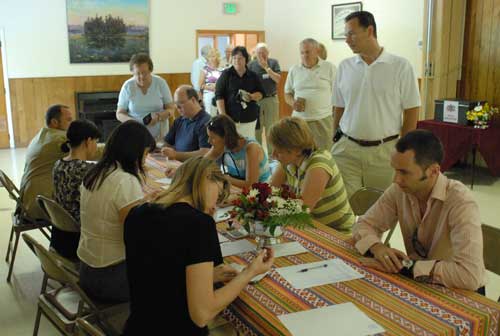
In the Latvian Community Center in Indianapolis, the four-member local election commission processes a group of July 7 voters just arrived by minibus from the song festival. (Photo by Andris Straumanis)

Voters in Indianapolis climb into the minibus provided by the American Latvian Association for the first run of the day to the polling station. (Photo courtesy of American Latvian Association)
Andris Straumanis is a special correspondent for and a co-founder of Latvians Online. From 2000–2012 he was editor of the website.