Latvia offers youths summer work in homeland

Ethnic Latvian youth who want an opportunity to work this summer in the homeland have until June 30 to apply for positions through a government-coordinated program, the Ministry of Welfare has announced.

However, unlike last year’s pilot project that brought seven youths to work in Rīga, the government this year will not cover travel and living costs. Financial support for the program was slashed in a bout of budgetary belt-tightening earlier this year.

Youth ages 18-24 will be able to work from one to two months between June 1 and Aug. 31, the ministry announced in an April 22 press release. The State Employment Agency will find positions for the youths, while the Ministry of Education will help locate living quarters.

Depending on when they arrive in Latvia, those who participate in the program also will be able to attend “Tautiešu mēneša” events organized July 2-18 by the Secretariat for the Special Assignments Minister for Social Integration Affairs as well as the Latvian Song and Dance Festival from July 5–12.

The application form, which must be submitted to the social integration affairs secretariat in Rīga, should be available from local Latvian organizations and from the secretariat’s Web site, www.integracija.gov.lv.

Last summer, seven ethnic Latvian youths from Canada, Russia, Sweden and the United States worked in private business and in the public sector. The pilot program, titled “Vēlies izaicinājumu?” (Want a Challenge?), was proposed by former Prime Minister Aigars Kalvītis. The program had sought 20 participants, but received limited response. The government has acknowledged that the lateness of publicizing the program was in part to blame.

The Latvian government is considering how to again finance the program for summer 2009, a Ministry of Welfare spokesperson told Latvians Online.
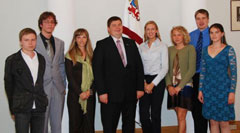
Youths meet with prime minister

Last year’s “Vēlies izaicinājumu?” participants meet Aug. 1 with then Prime Minister Aigars Kalvītis. From left to right, Aleksandrs Perevalovs of Russia, Lukass Milevskis of the United States, Jana Božko of Russia, Prime Minister Aigars Kalvītis, Laura Osvalde of the United States, Rūta Rietuma of Sweden, Dainis Simsons of Canada and Darja Berdņikova of Russia. (Photo courtesy of Aivars Osvalds)

Andris Straumanis is a special correspondent for and a co-founder of Latvians Online. From 2000–2012 he was editor of the website.

Era ends in Leeds as Latvian club goes on sale

The Latvian community in Leeds, a city in northern England, is marking the end of an era with the listing for sale of the Daugavas Vanagi cultural and social club, according to the agent marketing the property.

The 534 square meter building at the corner of Mexborough Avenue and Chapeltown Road already has seen interest from potential buyers. The property could sell for about GBP 400,000 (nearly USD 800,000), said Nigel Tapp of Nigel Tapp & Co. in an April 21 press release.

“The decision to sell has been especially difficult and sad for older members of the Latvian community in Leeds, for whom the center was a lifeline during the dark days of the Cold War,” Tapp said. “However, proceeds from the sale will be invested to help sponsor the Latvian community and its continuing activities.”

The Daugavas Vanagi club was founded in the 1950s and through the 1980s was a hub of cultural and social activity in Leeds. After Latvia regained independence in 1991, the club’s importance and popularity declined, Tapp said.

The property, two miles north of the city center, dates from the late Victorian era. It includes a meeting hall, a bar, a library, offices and a number of rooms once used for the Saturday school.

Daugavas Vanagi club

The Daugavas Vanagi club in Leeds, England, is for sale, marking the end of an era. (Photo courtesy of Nigel Tapp & Co.)

Andris Straumanis is a special correspondent for and a co-founder of Latvians Online. From 2000–2012 he was editor of the website.

Prokopčuka finishes 4th in Boston Marathon

Latvia’s Jeļena Prokopčuka, who took second in the past two runnings of the Boston Marathon, finished fourth in this year’s race, according to results reported by the Boston Athletic Association. Prokopčuka, a two-time winner of the New York City Marathon, finished the April 21 Boston contest in a time of 2 hours, 28 minutes and 12 seconds.

Dire Tune of Ethiopia won the women’s marathon with a time of 2:25:25. She was followed by Alevtina Biktimirova of Russia, 2:25:27, and Rita Jeptoo of Kenya, 2:26:34. It was against Jeptoo that Prokopčuka lost the 2006 Boston Marathon in what organizers describe as “the closest women’s finish in the history of the race.”

The 32-year-old Prokopčuka led the pack early in this year’s race, according to athletic association’s online commentary on the marathon, but by about 90 minutes into the competition had dropped well back behind the top three runners.

Robert K. Cheruiyot of Kenya won the men’s marathon with a time of 2:07:46.

The women’s wheelchair race was won by Wakako Tsuchida of Japan, finishing in a time of 1:48:32. Ernst F. Van Dyk of South Africa won the men’s wheelchair race with a time of 1:26:49.

Andris Straumanis is a special correspondent for and a co-founder of Latvians Online. From 2000–2012 he was editor of the website.