Granddaughter donates Liberts paintings to university

Two paintings by Latvian-American artist Ludolfs Liberts, each valued at about USD 10,000, have been donated by his granddaughter to a new fine arts center opening soon at East Central University in Oklahoma.

The paintings will become part of an exhibit in the new Hallie Brown Ford Fine Arts Center, according to a press release from the university in Ada, Okla.

The paintings—one depicting a scene in Germany and the other apparently Venice, Italy—are a gift to East Central from Melita Long, who works on campus for Chartwell’s Dining Service.

“They were just sitting in my house, so I talked to my mom before I did this and went from there. She was all for it,” Long said in the press release. Long’s mother is Jana Mitchell, a resident of Altus, Okla.

The prolific Liberts was born in 1895 in Latvia and died 1959 in New York. He was especially known for his landscapes and cityscapes, but also did set and costume design, according to the press release. He was married to opera singer Amanda Liberts Rebane. The couple, with their daughter Jana, fled Latvia during World War II to Austria and Germany. In 1950, they moved to New York, where Liberts continued to paint and taught at New York City College.

“Ludolfs Liberts was one of the 20th century’s most notable Latvian artists and influenced mightily our art culture,” Guna S. Mundheim, president of the American Latvian Artists Association, told Latvians Online in an e-mail. “We can be happy that his grandchildren have donated two of his works to East Central University in Oklahoma, where by virtue of being at an educational institution they will continue to speak to future generations about our culture in an international context.”

Long never met her grandfather, according to the press release, but she searched the Internet for background.

“He’s more popular than I thought,” Long said. “He was very talented and very well known.”

Brad Jessop, chairman of the university’s art department, said he appreciated Long’s donation.

“If I hadn’t had the experience before of bumping into people who had a good painting, I would have been more surprised,” he said in the press release. “It’s funny how life takes you on a certain journey and you end up in a certain place. I think it’s great Melita did this.”

Liberts’ work is found in public and private collections in Europe and the U.S., including the Latvian National Museum of Art (Latvijas Nacionālais mākslas muzejs), to which most of his collection was sent after his death. Jana Mitchell and her late husband, Charles W. Mitchell, donated one of her father’s paintings to the Oklahoma City Museum of Art in the 1950s. The painting is titled “Moulin Rouge, Paris – At Night,” Leslie A. Spears, the museum’s communication manager, said in an e-mail.

(Updated with quote from Guna S. Mundheim.)
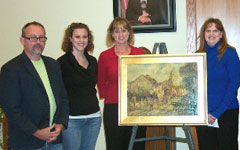
Painting being donated

Melita Long (right) shows off one of two paintings by Ludolfs Liberts that she has donated to East Central University in Oklahoma. Also participating in the presentation were (from left) Brad Jessop, chair of ECU’s Department of Art; and Long’s niece and sister, Kyra Spradling and Mary Spradling. Long and Mary Spradling are granddaughters of the famous painter. (Photo courtesy of East Central University)
Andris Straumanis is a special correspondent for and a co-founder of Latvians Online. From 2000–2012 he was editor of the website.

Restberga-Zalta, former consul in Argentina, dies

Mirdza Restberga-Zalta, an art historian, singer and Latvia’s former honorary consul in Argentina, has died at the age of 78.

Restberga-Zalta (known in Spanish as Mirdza Restbergs de Zalts), died April 26 in Buenos Aires, according to a May 18 report by the World Federation of Free Latvians (Pasaules brīvo latviešu apvienība, or PBLA).

She was born March 30, 1931, in Kuldīga into the Alberts Restbergs family. Restberga-Zalta left Latvia with her family in 1944 to escape the Soviet occupation during World War II. She arrived in Argentina in 1948.

She worked first as a seamstress, then in a medical laboratory and then in a sweets shop, Restberga-Zelta told the Liepāja newspaper Kurzemes Vārds in a 1998 interview. She learned stenography, typing and Spanish, and then became a secretary. At the University of Buenos Aires she earned a degree in art history. Under the stage name of Mirdza Kalve, according to the PBLA, she performed as a singer on the Buenos Aires city radio station and in several operas.

She published a small Spanish-Latvian dictionary to help the non-Latvians in mixed marriages learn something of the Latvian language. Restberga-Zalta also taught at the University of Buenos Aires.

The Latvian Ministry of Foreign Affairs in 1997 appointed Restberga-Zalta as honorary consul in Argentina. Among her duties was organizing polling in the Buenos Aires area during elections in Latvia. She served as honorary consul until 2007 and for her service was awarded Latvia’s Cross of Recognition, Third Class. Restberga-Zalta also was active in the Latvian Association of South America (Dienvidamerikas Latviešu apvienība), serving on its board of directors and representing Argentina.

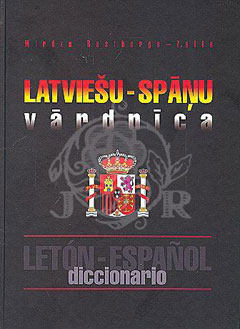
In 2001, she teamed up with Ilgvars Ozols to publish Latvieši Argentīnā, Čīlē un Urugvajā, a history of Latvians in three Latin American countries. Restberga-Zalta also published a 50,000-word Latvian-Spanish dictionary in 2006.

Restberga-Zalta had a son and a daughter from her first marriage and helped raise two daughters with her second husband, according to the PBLA.

Latvian-Spanish dictionary

A Latvian-Spanish dictionary published in 2006 by Mirdza Restberga-Zalta is still available in Rīga bookshops.

Andris Straumanis is a special correspondent for and a co-founder of Latvians Online. From 2000–2012 he was editor of the website.

Norway wins Eurovision Song Contest, Latvia left in dust

Norway has won this year’s Eurovision Song Contest, gaining the right to host next year’s competition. Belarus-born performer Alexander Rybak and the song “Fairytale” earned an amazing 387 points.

Eurovision this year was held in Moscow. A total of 25 countries, including Estonia and Lithuania, competed in the May 16 final in Olimpisky Indoor Arena.

Latvia’s Intars Busulis, who decided to sing the song “Sastrēgums” in Russian rather than Latvian, failed to make it out of the semi-finals held May 14-15. The song, with music by Kārlis Lācis and lyrics by poet Jānis Elsbergs, was turned into “Probka.”

Norway walked away with the contest. Really, it killed, setting a new record for total points. As voting results were announced from the 42 countries participating in Eurovision, the real battle was for second place. Iceland and Azerbaijan exchanged spots at least a couple of times, but in the end the island nation took second with 218 points.

Estonia’s Urban Symphony held up honorably, earning 129 points and sixth place.

Andris Straumanis is a special correspondent for and a co-founder of Latvians Online. From 2000–2012 he was editor of the website.