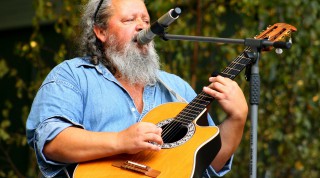
The Latvian bard Haralds Sīmanis, long known for his unique, distinctive voice and performance style, has always been an artist who forges his own path, regardless of what musical trends may be popular at the time.
For more than 30 years now, starting with what is likely his best known song – “Ezers” – released in the early 1980s, Sīmanis has been composing and performing, and has developed into a singular Latvian artist. In fact, on the cover of Sīmanis’ latest album Par zāli, par sāli un Tevi, Sīmanis is described as a ‘putns ar paradīzes balsi, dziesminieks un Cēsu čigāns’ (a bird with the voice of Paradise, a songwriter and a Gypsy from Cēsis’.
Perhaps a drawback of being so particularly eclectic is that his music may not reach a very broad audience – though his career spans decades, there are very few CDs available with his music. That is why any Sīmanis’ CD release is something to be heralded, such as 2013’s Par zāli, par sāli un Tevi, a record where Sīmanis, continuing his unpredictable ways, performs songs of a sacred nature.
Though Sīmanis is known mainly as a singer and guitarist, on this album he replaces the guitar for the organ of the Rīga Cathedral.
Sīmanis is also joined on this album by a number of well-known Latvian singers, including Ieva Akurātere and Zane Šmite. In fact, the first song, ‘67 Psalms. Dziesma dziedātāju vadonim ar cītarām’, based on the Biblical 67th Psalm, features Sīmanis only playing the organ, while vocals are handled by Akurātere (who sings over a church choir in the background). The combination of the singing of the church choir, which repeats the same verse over the course of the song, with Akurātere’s soaring vocals, provides for an engrossing, almost polyphonous experience.
Sīmanis returns on vocals on ‘Ienāciet manā dārzā’ (lyrics for this song, as well as for almost all the tracks on the CD, are by long-time lyrical collaborator Arvīds Ulme), and Sīmanis’ expressive, intense voice sounds particularly resplendent in the confines of the Rīga Cathedral, and is enhanced by the solemn organ sound.
Sīmanis’ duet with folklore singer Zane Šmite on ‘Te esmu es’ is one of the highlights of the album, as Sīmanis’ vocals alternate with Šmite’s rich alto voice. While listening, one gets the sense that Šmite’s calmer, soothing vocals are meant to provide solace in response to Sīmanis’ somewhat agitated singing.
The album concludes much as it began, with the church choir returning, and Akurātere providing the lead vocals, on the song, simply entitled ‘Lūgšana’ (Prayer), lyrics by Māra Zviedre, which provides a fitting closing to this spiritual recording.
A drawback of the release is the very limited packaging, no lyrics or photographs. However, the inside cover does have some words from Gundars Ceipe about the Vidzemes Brāļu draudze (otherwise known as the ‘hernhūtieši’, in German “Herrnhuter Brüdergemeine” and in English “Moravian Church”).
Par zāli, par sāli un Tevi, Sīmanis’ collection of modern-day hymns, continues Sīmanis’ idiosyncratic ways, at once unexpected, but, at the same time, a logical extension of his songwriting and performing talents. The presence of the organ, especially, gives Sīmanis’ songs a weightier and more ethereal feel, with the ambience of the Rīga Cathedral adding an additional rarefied dimension to the performances. Sīmanis’ spiritual journey, presented over the course of Par zāli, par sāli un Tevi, provides for an enthralling, as well as uplifting, listening experience.
For more information, please visit Haralds Sīmanis’ Facebook page at https://lv-lv.facebook.com/pages/Haralds-S%C4%ABmanis/102735743110597
Details

Par zāli, par sāli un Tevi
Haralds Sīmanis
Upe tuviem un tāliem, 2013
UPETT CD076
Track listing:
- 67 Psalms. Dziesma dziedātāju vadonim ar cītarām
- Ienāciet manā dārzā
- Par zāli, par sāli un Tevi
- Dziesminieks
- Mīlestībai
- Te esmu es
- Vārds
- Vēl tevi pavadu
- Zvani pār Raunu
- Lūgšāna
Egils Kaljo is an American-born Latvian from the New York area . Kaljo began listening to Latvian music as soon as he was able to put a record on a record player, and still has old Bellacord 78 rpm records lying around somewhere.