Registration for the World Latvian Economics and Innovations Forum to start in April

Registration for the second World Latvian Economics and Innovations Forum will begin on April 15th. In accordance with the agreement between the Ministry of Foreign Affairs of Latvia and the World Federation of Free Latvians (WFFL) the event will take place in Riga on July 9–10.

The aim of the World Latvian Economics and Innovations Forum is to foster Latvia’s economic growth through cooperation among professionals from various business sectors in Latvia and abroad, and to promotetransfer know-how and expertise as well as attraction of financial capital to Latvia, and strengthening the sense of belonging to Latvia among Latvians living abroad.

Edgars Rinkēvičs, the Minister of Foreign Affairs of Latvia has said that “for Latvia’s national economy, based on the values of liberal economy – openness, competitiveness and attractive investment environment – it is fundamentally important to follow the latest global trends, innovation and business models. The talented and successful Latvian diaspora living and working outside Latvia is a substantial resource for bringing the latest ideas and successful business models to Latvia. At the same time, every Latvian abroad is an informal envoy for the newest products and innovations, and as a result, increases the visibility of Latvia beyond its borders and contributes to its growth.”

Jānis Kukainis, Chairman of the WFFL, indicates that the aims of the first forum – to promote the engagement of Latvian entrepreneurs and experts living abroad in the strengthening of Latvia’s national economy – are even more significant in view of the current geopolitical tensions and their impact on Latvian economic growth.

Jānis Kukainis stresses: “This is the time when Latvian professionals abroad can offer assistance to Latvia in the most direct manner, assist Latvian businesses in finding new export markets, open their production facilities abroad, develop business ideas and help attract foreign investment.”

The second World Latvian Economics and Innovations Forum will take place on July 10, 2015. The day before – on July 9th, the Foreign Entrepreneurs Meeting will welcome business people and professionals of Latvian origin from all over the world.

Taking into consideration Latvia’s most recent economic challenges, the central theme for this year’s forum is the promotion of Latvia’s competitiveness both in attracting investments and entering new export markets, with a special focus on the analysis of various markets worldwide and international marketing for Latvian products.

The second forum is organised by the World Federation of Free Latvians and the Ministry of Foreign Affairs of Latvia in cooperation with the Investment and Development Agency of Latvia, the American Chamber of Commerce in Latvia and the Stockholm School of Economics in Riga. The Ministry of Economics of Latvia and Latvian Institute are contributing to the planning of the forum.

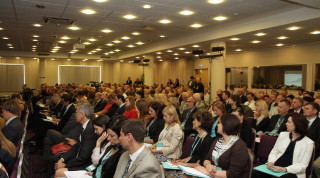
During the XXV Latvian Song and Dance Festival which took place on July 2013, the first World Latvian Economics and Innovations Forum attracted more than 350 participants from 21 countries.

Information and Public Relations Department

Press and Information Division

Ministry of Foreign Affairs of the Republic of Latvia
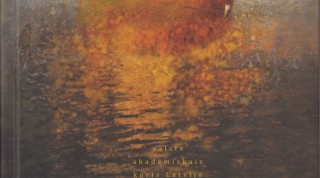
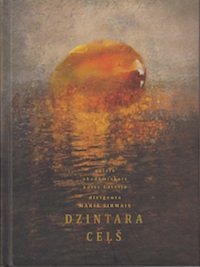
Dzintara ceļš – a collection of 12 compositions featuring Amber Road

Riga was one of the European Capitals of Culture in 2014, and one of the most ambitious projects during that time was Dzintara ceļš, a collection of new choir works performed by the State Academic Choir Latvija, conducted by Māris Sirmais. The theme of this collection is the Amber Road, a trading route, dating from Roman times, where amber from Latvia (and other places) would make its way all the way south to the Adriatic Sea. This collection follows the Amber Road through modern day Europe, with a composition from each nation along the way (compositions are all by Latvian composers). The twelve compositions on this collection begin with Latvia, then move south through Lithuania, Russia, Poland, Ukraine, the Czech Republic, Austria, Hungary, Montenegro, Italy, Turkey, and finally Greece. The text for each composition is from a poet of that particular nation, and they are all sung in their native languages.

This is not the first choir project with amber at the center of its theme – it follows Amber Songs by the Youth Choir Kamēr… released in 2014, though that collection had international composers arranging Latvian folksongs. These two projects being performed almost consecutively is perhaps a coincidence, or perhaps not at all – Māris Sirmais was the longtime conductor of Kamēr… and left an indelible impression while he was there.

Composer Ēriks Ešenvalds provides the music for the Kārlis Vērdiņš poem ‘Dzintara acis’ (Amber Eyes), a work that is uncharacteristially dark and disturbing for the composer. Vērdiņš’ poem reflects on Assyrian king Ashurnasirpal II (who supposedly had a statue of Baltic amber among his possessions). The poem is full of violent imagery, as the king was well known for his cruelty. The music is equally tormented, with eerie whistling over the ominous male voices, singing about the building of his capital city Kalhu, from where he views the Baltics through his amber eyes.

One of the most encouraging aspects of this collection is that so many works were entrusted to younger composers. Latvija has always been in the forefront of working with new composers and providing a stage for their works to be heard, and these compositions are no exception. One young composer who has begun to make a name for himself in Latvian choir music is Jēkabs Jančevskis, and his contribution is the Polish ‘Odpływ’ (poetry by Tadeusz Dąbrowski). Featuring the soaring soprano solos of Irīna Rebhūna and Sanita Sinkēviča, with the rest of the choir providing ocean sounds, Jančevskis forms an impressive musical tapestry that provides both a mysterious and unearthly aura to the Polish poetry.

Among the many veteran Latvian composers represented here is Juris Vaivods, and his contribution is the music for ‘Ruka’, a poem by Petr Borkovec from the Czech Republic. The supernatural poem paints an image of the narrator’s arm and hand turning to amber when returning to the table of a dying friend. The horror of this is reflected in the music, with ‘Ruka’ reaching a cataclysmic crescendo at that point. However, the work then begins to resemble a canon, where the voices begin at different times to repeatedly sing about needing to see the doctor about the amber arm. The work closes with the soothing words ‘těším se’ (I am looking forward to it).

Composer Juris Ābols considers himself a ‘Dadaist’, and his compositions are almost always quite strange and bizarre. Ābols’ music for Salut au Monde! (based on the poem ‘Providna porodica’ by Montenegrin poet Dragana Tripkovič) is no exception. The work mixes English, French and Serbian texts, and over all of it is a spoken word narration (barked in military style by Uģis Meņģelis) based on writings of Russian astronaut Yuri Gagarin (though, oddly, and for Juris Ābols – appropriately, the narration is in English). The singing and narration give the song an other-worldly feel, like a vision from outer space.

Undertaking such an ambitious project, fraught with potential difficulty (composing music for poetry that is not in the composer’s native language, and potentially in a language the composer does not understand at all, is a particularly daunting challenge). In the hands of anyone else besides conductor Māris Sirmais and the State Academic Choir Latvija it may have resulted in a confusing mess. It is true that this collection features some very modern and difficult choir music, which demands a world class choir like Latvija to be able to perform it (and to sing in twelve different languages). However, the Latvian composers, both young and veterans alike, have risen to this challenge and have produced a collection of choir compositions that are unique and memorable, and, in most cases, true to the spirit of the text. It will remain one of the most memorable musical projects from Riga’s time as European Capital of Culture.

For further information, please visit Latvija’s website.

Dzintara cels

Details

Dzintara ceļš

State Academic Choir Latvija
Produced by Māris Ošlejs, 2014

Track listing

1. Dzintara acis – Ēriks Ešenvalds (text – Kārlis Vērdiņš) – Latvia
2. Didieji mainai – Mārtiņš Viļums (text – Donatas Petrošius) – Lithuania
3. Нe опасная подводная лодка – Georgs Pelēcis (text – Andrei Sen-Senkov) – Russia
4. Odpływ – Jēkabs Jančevskis (text – Tadeusz Dąbrowski) – Poland
5. Скажи – Līga Celma (text – Ostap Sliwinski) – Ukraine
6. Ruka – Juris Vaivoids (text Petr Borkovec) – The Czech Republic
7. Schatten/Licht – Selga Mence (text – Wolfgang Hermann) – Austria
8. Nyári – Raimonds Tiguls (text – Dénes Krusovszky) – Hungary
9. Salut au Monde (Providna porodica) – Juris Ābols (text – Dragana Tripkovič) – Montenegro
10. Elektron, resinosa lacrima di luce – Imants Zemzaris (text – Tiziana Colusso) – Italy
11. Löröpötisyo – Jānis Aišpurs (text – Efe Duyan) – Turkey
12. Λόγια κεχριμπάρι – Gundega Šmite (text – Angeliki Dimouli) – Greece

Egils Kaljo is an American-born Latvian from the New York area . Kaljo began listening to Latvian music as soon as he was able to put a record on a record player, and still has old Bellacord 78 rpm records lying around somewhere.

Is this the dawn of Latvian e-services?

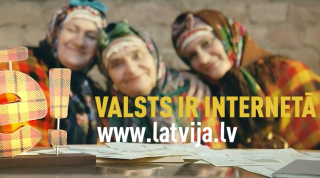
The e-signature was officially introduced in Latvia more than 8 years ago (see Is Latvia ready for e-signatures?), but has remained stagnant for most of these years. Recent developments including the major redesign of the Latvija.lv government services portal as well as a recent video campaign featuring “Suitu sievas” (which has already gone viral in the social networks) to promote more than 200 e-services may be a sign that things are about to change.

My first experience with e-services about a month ago was totally unexpected. As a Latvian citizen currently residing in Australia I had to track down a bill which was supposedly mailed to a Riga address, but got lost in the process. Dreading the reaction that I would receive from ringing yet another bureaucrat at the Riga City Council I was instead greeted by a helpful person who not only provided all the necessary details, but also suggested that I go to e-pakalpojumi.lv to retrieve all future bills electronically. Hesitant at first, I decided to give it a go. Five minutes later I was already finalizing the payment of the bill on my computer many thousands of kilometers away from any of the Riga City Council offices.

If you are a Latvian citizen you may be curious as to what data is being held about you by the various government agencies. Go to Latvija.lv and search for “mani dati” (or click on the English version and search for “my data”) and choose from a host of databases including individual and passport details, property ownership, registered pets, outstanding fines as well as a list of application forms. Over a 100 more e-services will be introduced in the coming months. In order to access these services you will need to authenticate yourself within the system using your Latvian bank details or by using the eID (electronic ID card).

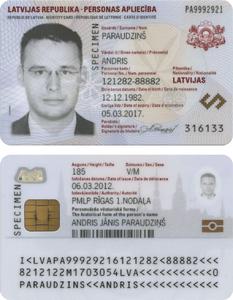
If you have had to renew your Latvian passport in recent years you would also have been offered the eID card. Estonians have had these cards for a number of years and being the size of a credit card they are a convenient alternative to carrying your passport when travelling within the EU or if you require further identification at various government institutions and service providers.

eID

The eID also comes with 120 free e-signatures. What this means is that you can digitally sign a document from wherever in the world and avoid the hassles and expense of a notary lawyer. In practice however, it is still not quite there in the usability stakes. First off you will need a card reader. Secondly you need a Windows, Macintosh, or Unix computer to download the “eParakstītājs 3.0” software. Thirdly you will need to dig out both the PIN1 and PIN2 codes that were issued with your eID card. And lastly you need to ensure that the receiving party accepts a digitally signed document. A new virtual e-signature option has become available, but then you no longer need your eID card, as authentication occurs via your bank login details.

My eID card was issued nearly two years ago and the e-signature facility is about to expire in June. I am still trying to find out how to extend this, but I keep going around in circles when visiting the website.

With the relaunch of Latvija.lv and the Latvian Presidency of the Council of the EU highlighting e-government and e-Europe as a priority we should see more widespread adoption of the eID card. But we have some catching up to do: 90% of Estonia’s 1.3 million residents have active eID cards and they are already using their eID in new and innovative ways: as a national health insurance card, a pre-paid public transport ticket in Tallinn and Tartu, for digital document signing, internet voting that allows voters to cast their ballots from any internet-connected computer and for picking up e-prescriptions.