Latgalian weddings are the stuff of legend. Normally lasting at least three days, if not longer, these celebrations in Latgale, in the eastern area of Latvia, are usually huge affairs, with guests numbering in the hundreds (Latgalians often have large extended families), and often raucous celebrations. This demands quite a bit of endurance from the bride and groom, guests, and, most of all, the musicians, who not only have to perform this entire time, but also have to have a large repertoire of songs (and, ideally, songs with many verses).
One such group who are known for their broad Latgalian repertoire and extensive experience performing at Latgalian weddings and other events are the Maskačkas spēlmaņi (Maskačkys spieļmani in the Latgalian dialect) who have been performing now for two decades, perfecting their craft at events all over Latvia.
Though currently residing in the ‘Maskačka’ (Moscow) region of Rīga, the group are originally from the Latgale area, and that is why such a large amount of their repertoire are songs from this region. The group has recorded multiple albums of songs and dances, including Ļipa kust (Latvian dances) in 2009, Pāri jumtam (instrumental dances) in 2003, and Zirnīšiem skaisti ziedi (folk songs) in 2001.
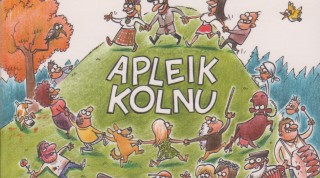
In 2015, the group released their latest album – Apleik kolnu, a two CD release collecting just about every popular folk song from Latgale. Striving for authenticity and thoroughness, this is one of the most comprehensive albums of songs from Latgale to have been released.
The group, led by Aņss Ataols Bērziņš (vocals, accordion), also includes Juoņs Barons (vocals, stabule and other instruments), Zane Kryumane (vocals), Oskars Pačanka (bass and contrabass), Pauļs Paulīns (zither and vocals), Juris Ukrins (violin) and Muora Vucyna-Bierzeņa (vocals).
To preserve authenticity, the group recorded just about every known verse for these folksongs. As a result, some of the songs run to more than ten minutes in lengths – for example “Apleik kolnu ar leikumu”, a song about a girl who, when walking with a potential suitor, makes a wide detour around the hill, so that nobody will see them (and start gossiping). The song runs a full 27 verses, telling a long story about the girl and her experiences (including getting shot at). Some listeners may find it taxing to listen to these long, occasionally repetitive songs, but other listeners may find it a rewarding, immersive experience.
Just about every popular Latgalian folksong is included here – “Auga, auga rūžeņa”, “Tuoli dzeivoj muna meiluo”, “Lobs bej puika”, “Zīdi, zīdi, rudzu vuorpa”, and “Nadūd, Dīvs, veitulam”, among many others. Still, with their many verses, even those that are well familiar with these songs will hear something new. And among the twenty-six songs on the collection, there are some songs that are heard less often, making for a balanced record of the familiar and the obscure.
Also, for the purposes of authenticity, the group was recorded as a whole (that is, instruments and vocals were not recorded separately). While this also makes for an authentic Latgalian experience, the drawback is that often the vocals get lost in the mix and are, at times, inarticulate.
The CD package contains the full lyrics to all the songs, as well as some notes on the album (which are entirely in the Latgalian dialect, which may not be easy for all readers to understand!), but the glued-in accordion style foldout booklet is a bit unwieldy to read.
Apleik kolnu is an exhaustive, and perhaps for some, an exhausting listen. It may, however, simulate the experience of being at a Latgalian wedding or other such celebratory event. Encapsulating the spirit of Latgale in each song, the Maskačkys spieļmani, through this two CD collection, offer a thorough and traditional musical journey through this unique and singular area of Latvia. With decades of practice playing these songs, Apleik kolnu is a tour de force of Latgalian folk songs, performed both traditionally and expertly, and is a standout collection.
For further information, please visit the Maskačkys spieļmani website.
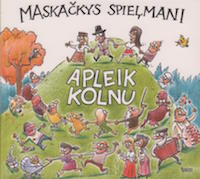
Apleik kolnu
Masckačkys spieļmani
MS04, 2015
Track listing
CD1
- Eima, eima, muosenis
- Auga, auga rūžeņa
- Aiz azari maļni meži
- Tuoli dzeivoj muna meiluo
- Jau mani vad
- Tymseņš guoja
- Ai, gaļdeni
- Lobs bej puika
- Aiz azara boļti bārzi
- Kur gaismeņa zyla ausa
- Mīdzeņš īt
- Gaška, aj da sātai
- Apleik kolnu ar leikumu
CD2
- Zīdi, zīdi, rudzu vuorpa
- Treis vosoras saturieju
- Nadūd, Dīvs, veitulam
- Šudiņ mes dzaram
- Dzer, buoba, nabādoj
- Guoju pa mežu
- As beju mameņai
- Jau rudiņs tyvojās
- Pluovova laiveņa
- Oi, agri, agri
- Seņ jau, seņ jau
- Sveicynojam, vielejam
- Muzyka spieļoj