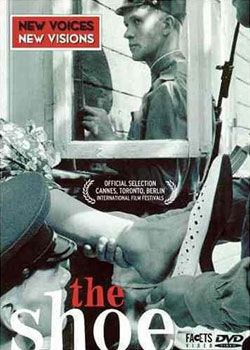
‘Kurpe’ studies absurdity of Soviet Latvian life

Kurpe

Three young soldiers discover a woman’s shoe on a sandy beach and chaos breaks out. Sirens go off, officers appear and hurried orders are shouted out. Welcome to Liepaja, Latvia, 1950. The new frontier. A time of paranoid suspicion, absurd reality and good old fashioned Latvian stoicism.

The story of Laila Pakalniņa’s Kurpe (The Shoe) reflects the absurdities of Latvian life in the early days of the Soviet occupation. This was the period in which the sand of Liepāja’s coastline was dredged each night by a tractor, like a conscientious golfer would a sand trap, and the following morning checked for fresh footprints.

When a pair of border guards discovers a woman’s shoe in the sand that wasn’t there the previous night, it could only mean one thing: a saboteur must have landed. It is the only possible explanation.

The commander of the border guards orders them, in classic Soviet fashion, to find the woman to whom the shoe belongs in the most direct manner possible. They are to traverse the city and to see whom the shoe will fit. A bit of Soviet Cochranism: “If the shoe will fit, you must convict.”

What ensues is an absurd tale that reflects the absurdities of Soviet life. Pakalniņa’s direction and cinematography perfectly complements the realities of the time. The film is an “art” film and as such might not appeal to those who are used to more traditional forms. There is very little dialogue and the plot assumes that the viewer understands the backstory. The shot selections often will often have the characters shot in silouethes or as reflections. The cinematography is in high contrast black and white.

However, for what it tries to be it is a nearly perfect film. The pacing and the style perfectly capture the helplessness and pragmatism of Soviet Latvian life. The ability of people to persevere with stoic resignation, all the while never quite submitting to their fate.

Pakalniņa’s background is in experimental and documentary films and it shows in the best possible way in this film. Kurpe resists the temptation to judge the period, but presents it in a straightforward manner allowing the audience to reach their own conclusions. Often films like this tend to be a bit heavy, but Kurpe never crosses the line.

Pakalniņa is greatly helped by the actors’ ability to appear natural. Their understated performances make the film’s absurd tone even more poignant.

In many ways this film shows how to accomplish a lot with a little. According to Pakalniņa, the story and the style were driven by the fact that she could not find the funding for some other projects and in the meantime decided to film a story with what she had available.

(Editor’s note: This review originally appeared on author Andrejs Makwitz’s Web site, The Latvian Film Page, and is republished with permission.)

Details

Kurpe

Laila Pakalniņa

Schlemmer Film GmbH,  1998

Notes: In Latvian and Russian. Drama, black and white, 83 minutes. Screenplay: Laila Pakalniņa; director of photography: Gints Bērziņš; editor: Sandra Alksne; producer: Christoph Meyer-Wiel; principal cast: Igors Buraks, Vadims Grossmans and Jaan Tatte.
‘Baiga vasara’ aims high, but misses mark

Baiga vasara

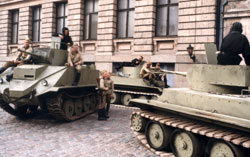
Soviet tanks and soldiers appear on the streets of Rīga in a scene from the film.

Director Aigars Grauba’s Baiga vasara (Dangerous Summer) reaches high, but never quite attains its lofty goals. It is technically a great-looking movie with a Dolby soundtrack, but is hampered by a weak script, uneven acting and spotty direction.

Part of the problem is that Grauba is never quite sure which story he wants to tell. On the one hand it is a romantic story about a wartime love triangle between Izolde (Inese Caune), a young Baltic German student caught between the powerful Vilhelms Munters (Uldis Dumpis), the real life Latvian foreign minister, and Roberts (Artūrs Skrastiņš), a powerless but idealistic radio reporter. On the other hand it is the story of the Latvian nation caught between Nazi Germany and Soviet Russia. If that wasn’t enough, it also adds two subplots. One deals with Munters’ efforts to steal some overseas Latvian funds. The other deals with the role of journalists in a democratic society and the obstacles that they face. All of these are supposed to complement each other, but unfortunately merely get in each others way. The screenplay had five co-authors, seldom a good sign.

Baiga vasara is at its best when it focuses on the journalists. This is mainly due to the performances of Skrastins and, as Roberts’ reporting partner Karlis, Jānis Reinis. They both bring a realism to their roles that takes their characters beyond the mostly two dimensional performances of the other cast members. There is a genuine chemistry between the two. Grauba seems most comfortable when telling the story of what it takes to be a reporter and the obstacles that they have to face. Grauba, who also had a hand at the screenplay, and the other writers—Pauls Bankovskis, Gabis, Jānis Leja and Andrejs Ēķis,—have all, in one way or another, actually worked in broadcasting and are intimately familiar with the subject matter. The first rule of writing is write about what you know and, in this case, it shows on the screen.

Baiga vasara is at its weakest when it tries to tell the story of the Latvian nation. Partly this is due to the performances of the two leading actors, Dumpis as Munters and Uldis Vazdiks as Kārlis Ulmanis. Their acting styles reflect the Social Realism style that was popular in the Soviet Union and the fact their craft was developed mostly on theater stages. Their performances lack the emotional depth needed for film. Their characters come across as two dimensional caricatures. This is something that might have worked on the stage where actors have to reach the cheap seats, but on screen it seems unnatural and forced.

There has been quite a bit of criticism of the historical accuracy of the film and the roles of Munters and Ulmanis. However, it is important to remember that this is a work of fiction and history is always a matter of interpretation. I cannot vouch for the historical accuracy, but from a historical perspective the film’s major weakness is that the historical story simply falls flat and never progresses beyond its two dimensional presentation. I doubt that this was by design. It was due to flawed execution.

The other major problem is that history requires scale. You basically have two cinematic choices when dealing with history. You can either choose to tell it as an epic, for example Lawrence of Arabia, and have a lot of sweeping wide angle shots and a cast of thousands to show the overwhelming obstacles and stakes, or you can choose to shoot it tight, for example The Manchurian Candidate, and concentrate on the emotional and psychological obstacles and stakes. Grauba tried the first approach, settled for the second, but succeeds at neither. Of course, not all of this is Grauba’s fault. This particular story almost demands an epic approach, but that costs money, which Latvian filmmakers simply do not have access to. Then again, scale can be demonstrated in many ways. Grauba, for example, could have used newsreel footage to show the insurmountable odds that the Latvian nation faced. Instead he tries to fake it by shooting tight shots with epic implications.

The only place where this stylistic approach seems to work is in the central plot line of the triangle between Izolde, Roberts and Vilhelms. Izolde is torn between her love for Roberts and Vilhelms’ offer of security and the chance to escape Latvia for Germany just ahead of the rolling Russian tanks. The only weakness in this portion of the film is that there is very little chemistry between Izolde and Roberts, or even Izolde and Vilhelms. Caune is a good and capable actress, but she seems to be in a tug of war between the stylistic choices of the two actors. Skrastiņš with his naturalistic approach and Dumpis with his theatrical emoting place Caune in a tough spot. She tries to respond by adopting the style of whichever character she shares the screen with, but never really makes a connection with either.

Overall, Baiga vasara is not a bad film. Had it concentrated on telling just one of the stories it could have been a great film. It spreads itself too thin and tries to accomplish something which is just slightly beyond its reach, but in doing so it does have its moments of cinematic glory when the screen comes alive with the story of the Latvian people and the hardships that they had to endure during a period of history that seldom is dealt with from a Latvian perspective.

(Editor’s note: This review originally appeared on author Andrejs Makwitz’s Web site, The Latvian Film Page, and is republished with permission.)

Details

Baiga vasara

Aigars Grauba

Platforma Filma,  1999

Notes: In Latvian (with English subtitles). Drama, color, 110 minutes. Screenplay: Pauls Bankovskis, Gabis, Jānis Leja, Andrejs Ēķis, Aigars Grauba; director of photography: Gints Bērziņš; producer: National Film Center of Latvia; principal cast: Inese Caune, Uldis Dumpis, Jānis Reinis, Artūrs Skrastiņš, Uldis Vazdiks.

A fresh glimpse of folk songs a la Dārziņš

“In order to become universal, one must first become national…To study, to immerse oneself in the spirit of one’s own people until you feel a part of the whole—that is my goal.” So spoke Hungarian composer Bela Bartok, who redefined how the elements and character of a folk tradition could be internalized to inspire music universal in expression.

Volfgangs Dārziņš (1906-1962), son of beloved Latvian Romantic composer Emīls Dārziņš, shared that belief. His volume of 200 Latvian folk song arrangements stands as a testament to his conviction. Written as a vocal line with accompaniment, they can be performed either by solo voice with piano accompaniment or as piano solos. However, the brevity of these settings (generally a single stanza, often only a few measures) requires some imagination for a satisfactory presentation in performance.

On Volfgangs Dārziņš: 100 latviešu tautasdziesmas Latvian composer and pianist Imants Zemzaris has selected 100 of these arrangements. He has arrived at a very satisfying solution by grouping them into sets by subject to highlight their similarities and differences in a way that presents them as little suites—lullabies, burial songs, sun songs, everyday life, etc. In the past, many singers and pianists have performed and recorded them in strophic fashion, simply repeating each setting depending on the number of verses in the text, with variation achieved through dynamics, tempo and nuance.

So what are they like? Brief, even fleeting bits of mood, established through very personal, highly varied settings. Dārziņš did not elaborate or develop these melodies, nor did he set individual verses to reflect the textual character of each verse. He did make more than one arrangement of some tunes, but these are alternative views of the music, rather than unified variations. In all, they are his personal reaction to the character of each melody, the message of the text. Aphoristic as they may be, Dārziņš packs a world of emotion and power into each few seconds through allusion and suggestion, often in dense, highly chromatic visions. His view of each tune brings out unique colors and often unsuspected characteristics in these mini-suites, much like gazing at facets of a gem from different angles.

It’s often difficult to point to a specifically Latvian character here. Bartok, the Spaniard Federico Mompou, and the “Russian” period of Igor Stravinsky come to mind at times, with the postimpressionism of Maurice Ravel often close by. Some even hear the influence of Carl Orff. If you’re expecting the tonal beauty and tame dissonances of Jāzeps Vītols (who also set 200 Latvian folk songs in a similar format) or Emīlis Melngailis, this music will surprise you at times. But repeated listenings reinforce the feeling that Dārziņš’ more modern, laconic and individual approach is just as valid and rewarding. If not for his status as an exiled “nonperson” during Latvia’s Soviet occupation and premature death at the age of 56 he would certainly be more widely known on the world music scene.

Imants Zemzaris obviously loves and admires these miniatures and his fine technique allows him to effortlessly toss off technically demanding passages with a well-judged palette of tonal color, variety and fantasy. Compared to a private archival tape of the composer playing some of these same arrangements, Zemzaris’ approach is remarkably similar, but more technically assured and vastly better sonically. However, this recording is very close and emphasizes the brightness of the piano. A more mellow instrument might have taken the edge off the clanginess of some very percussive sections. But this is a personal preference and is in no way meant as a criticism of Zemzaris’ playing or musicianship.

An important release, providing a fresh glimpse into the music of a modern Latvian master. Now, how about Dārziņš’ other solo piano music, and the two piano concertos?

Details

Volfgangs Dārziņš: 100 latviešu tautasdziesmas

Volfgangs Dārziņš

BaltAsia Foundation,  2000

Notes: Performed by Imants Zemzaris.