As compilations go, this one is super

The compilation album has long been a part of Latvian music history. In earlier years, very few groups were able to record full-length albums. In fact, unless you had the clout (and not to mention the Soviet sympathy) of someone like Raimonds Pauls, putting out an entire album was next to impossible. However, many compilation records were being released during Soviet times, the most well known being the long running Mikrofons yearly release. These would allow many bands that would normally not be able to get their music heard on a record to do just that, even if only one song.

Those days have passed, and now most any band that has a bit of money, a few songs and maybe a moderate amount of talent can release an album—visit your local šlāgermūzikas section to see this in action. So where does this leave the compilations? As record executives in the United States have recently realized, and as their counterparts in Western Europe have long since known, a compilation can be a good marketing tool. Put together a bunch of songs from many different artists on one album and maybe people will buy it for the selection… and then continue to buy albums of specific artists they like.

This idea is not lost on Latvian record executives either. SuperIzlase, released late last year, contains recent hits from the entire spectrum of Latvian artists from three of the major labels—UPE, Platforma and Mikrofona ieraksti. The executives realize that by working together they can promote their own artists with little cost but ideally with high return. Because compact discs in Latvia are expensive, few consumers will throw down their hard-earned money on a CD from which they haven’t heard any songs.

Reviewing such compilations is a difficult task, however, mainly due to the incredibly varied nature of the songs contained on one. Though I like to think of myself as a fairly open-minded music listener, there are certain styles of music that are simply not for me. So instead of critiquing the music contained on this record, I will do my best to describe what I hear and you can make your own informed decision about what you might like.

Many of the songs on this record I had known before even purchasing this record, probably due to the fact that in marketing terms, I fall into the category of “loyal rock fan.” In other words, if I have been a fan of a rock band for a while, and they release a new record, I am likely to purchase it, sound unheard, simply because I am loyal. Established rock groups are well represented on this record, with groups like Līvi (“Mana vienīgā ziņģe”), Prāta Vētra (”Īssavienojums,”  the Latvian version of their Eurovision hit “My Star,” but with different lyrics), Credo (“Dzīvē gadās arī tā”), Labvelīgais tips (“Es nav redzējis Tevi jau sen”), Bet Bet (“Es vaicāju mātei”) and Ainars Mielavs (“Labradors”). Igo also checks in with an uncharacteristically (at least compared to his newer material) hard rocking song, “Cerību laiks”.

Though already well-schooled in the subject of Latvian rock, I did learn a few things from this record, as there were groups that I was unfamiliar with, but enjoyed their songs. These included Tumsa (“Lietus dārzs”), Autobuss debesīs (“Sitiet bungas, mani mīļie”) and The Hobos (“Midnight Lover”). All three of these groups are now on my shopping list for the next time I return to Latvia.

But of course, it is not only rock. Dance and pop make up a bulk of this record as well. The album starts off with the A-Eiropa (or Austrum Eiropa) dance hit “Tuvumā, tālumā.” The group Braithouse contribute their dance song, “So Much Fun,” while Lilita Ozoliņa and Viesturs Dūle offer “Tu mans mīļais čipendeils.”

If “diva pop” (such Mariah Carey or Whitney Houston) is your bag, then you will most likely like Linda Leen and her song “Let’s Go Insane.” She is an amazing singer and has learned how to sing in English remarkably well. Dāmu pops also have a new version of their older song, “Varbūt rīt,” on this record, complete with new dancable beat and thumping bass line. However, I prefer the original version on the Mikrofons 1990 rokaptauja.

“Kiddie” or “bubblegum” pop (such Backstreet Boys or Britney Spears) is also alive and well in Latvia, evidenced by the Gunārs Kalniņš and Kristena duet “Baltā dziesma.” This song also proves the existence of some requirement that every compilation ever released in Latvia has to have a Raimonds Pauls song on it (which is not necessarily a bad thing sometimes).

Songs in a more humorous vein also are here: from Savādi gan there’s “Dzīve ir skaista,” while Reigani, Prata Vētra’s Estonian alter egos, have their song “Tere, tere traktors” (which also includes the lyric, “Bulle, bulle, buldozers”).

The only complaint I have about this release is that we are never told what album these songs can be found on. Knowing that would make shopping for further releases from these artists slightly easier.

Of the very many compilations released in Latvia throughout the years, I would count this as one of the better ones. The range and diversity of the artists makes this a good investment for anyone, even if you don’t know a thing about what music is popular in Latvia these days or are a dyed-in-the-wool, long-time music fan. Thankfully, the music companies got together for this compilation and even promise there will be another SuperIzlase in 2001. If it is as good as this one, then we have something to really look forward to.

Details

SuperIzlase

Various artists

MICREC,  2000
Egils Kaljo is an American-born Latvian from the New York area . Kaljo began listening to Latvian music as soon as he was able to put a record on a record player, and still has old Bellacord 78 rpm records lying around somewhere.

Choir muffs chance to reach new audiences

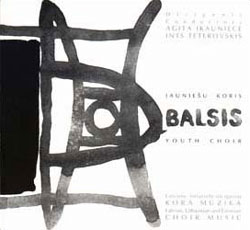
Jauniešu koris Balsis

Now that the World Wide Web has made it possible for independent musicians and ensembles to internationally promote and sell their music and recordings more easily and effectively, any new release has a great deal of competition for potential buyers’ attention. As Latvian music becomes more recognized and popular on an increasingly crowded world stage, effective presentation of its heritage and artistry is vital in reaching out to listeners.

A recent album from the Latvian youth choir Balsis is musically excellent and well-recorded, but despite its professional appearance and attractive packaging, I wonder if the producers were not entirely certain of their intended audience, or perhaps the idea of marketing to other than Latvian buyers was an afterthought?

Formed in 1987, Balsis have garnered numerous prizes at choral competitions. Their current directors, Agita Ikauniece and Ints Teterovskis, are highly skilled choral professionals who have successfully maintained a high standard in their group’s level of performance, vocal technique and skill. The 40 singers produce a clean, supple sound and the youthfulness of their voices is not excessively shaded to produce an artificially mature sound. Perhaps due to the recording, the sopranos seem a little harsh in louder passages, but elsewhere the group maintains a pleasing blend.

The program is a varied one: 14 Latvian composers from several generations represented by 10 original compositions and six folksong arrangements, and three Estonians and a Lithuanian for good measure.

Some works are very familiar or widely recorded, such as Jānis Cimze’s arrangement of “Raven in the Oak Tree,” Lūcija Garūta’s version of the “Lord’s Prayer,” and Estonian Arvo Part’s setting of the Latin “Magnificat.” Works of several younger composers comprise a substantial portion of the program: Latvian-American Anita Kuprisa’s arrangement of “Sun, Attire Yourself in Silver” has become a Latvian classic on both sides of the Atlantic (with some added vocal effects in this version), and Jānis Lūsēns’ “Latvian Lullaby” is surely destined to become one as well. Other works are less frequently encountered. I was especially taken with Jāzeps Mediņš’ rarely-heard “Summer Evening” and Lithuanian Vytautas Barkauskas’ dazzlingly virtuosic “Kommedia dell arte.”

While there is obvious structure in the ordering of the music (original Latvian compositions followed by other Baltic composers’ works and concluding with folksong arrangements), a lack of contrast in mood during the first half of the program creates an overall effect that could be characterized by some as contemplative and by others as soporific. On the other hand, the concluding folksongs are generally more upbeat and vigorous. More overall variety in the pacing of the program would have been welcome.

Some introduction to the composers would have been helpful in the booklet, too, especially when the bilingual packaging makes this disc more than a commemorative souvenir for a limited audience. Perhaps as an afterthought or supplement, there is a more extended general commentary on the group and this album on the choir’s well-designed Web site, though the English version could be more idiomatic. I also wonder which conductor conducts which piece? Neither the album nor the Web site offers any clue.

More annoying is the listing of composers’ first names with only an initial or abbreviation, and the lack of birthdates for folksong arrangers. Composers deserve to have their full names listed, and respected musicians whose shaping and enhancement of folk melodies and texts is often equivalent to the creation of entirely new compositions shouldn’t be looked upon as second-class musical citizens. There is no good reason for perpetuating such Soviet-era practices, familiar to collectors of old Melodiya LPs.

This is a well-sung, sensitively interpreted program of fine music and these criticisms are not intended as a condemnation of the album—I have no hesitation in recommending it on musical grounds. But skimpy or incomplete information can lead to a lost opportunity to cultivate listeners who might otherwise be enticed into further exploration of Latvian music. Sometimes we Latvians can be our own worst enemies in the way we present ourselves and our artistry to the world at large, which is much more eager and willing to honor and embrace us than we may suspect.

Details

Latviešu, lietuviešu un igauņu kora mūzika

Jauniešu koris Balsis

AIIT,  1999

Baltic activists in Washington focus on NATO

The second round of NATO enlargement, with possible invitations to Estonia, Latvia and Lithuania to join the alliance, is expected to be one of the main issues occupying the minds of Baltic activists in Washington, D.C., during the next couple of years.

But some say more cooperation among the Baltic activists is needed.

Optimism stirred by the May 2000 "Vilnius statement," in which representatives of the nine NATO candidates called for their simultaneous entry, has somewhat dwindled. During a recent press briefing at Radio Free Europe in Washington, the three Baltic ambassadors to the United States agreed on the principle "one is better than none, two is better than one," though they didn’t abandon the possibility of all three neighbors joining NATO together. Ensuring at least a minimum Baltic presence in the next expansion round is what the embassies and the Baltic community activists are working for at this stage.

Baltic-American organizations have been trying for many years to promote Baltic interests in Washington. Although they have established a certain level of cooperation and operate under the umbrella of the Central and East European Coalition (CEEC), some say there is no coordinated strategy to secure the support of the U.S. Congress for the Baltic states’ admission to NATO.

Some community activists feel a need for a more coherent and integrated plan of action in order to achieve the enlargement goals. Except short annual meetings at the Joint Baltic American National Committee (JBANC), there is no event that would bring together all the organizations, Valdis V. Pavlovskis, president of the Baltic American Freedom League, told Latvians Online.

"The coordination could be much much better," he said, but added that "some organizations don’t consider it important to come together." More cooperation among the various groups is needed, with annual conferences that would discuss strategies for several days in a row, said Pavlovskis, who has tried to initiate such meetings.

Ilmārs Dambergs, representative of the American Latvian Association (ALA) at the new CEEC NATO Enlargement Task Force, said there doesn’t seem to be central coordinator that could publish the results of the meetings held among the three embassies, or the nine aspirant countries’ ambassadors, or different Baltic American organizations.

Coordination is sometimes missing on the grassroots level, too. The valuable NATO enlargement support groups in Eastern and Midwestern states, created during last year’s tour by ALA President Jānis Kukainis and the Latvian Embassy’s counselor on congressional affairs, Jānis Eihmanis, are now lacking coordination, Dambergs told Latvians Online.

Still, grassroots work is the best way to get legislators involved in the Baltic issues, everyone agrees. Baltic constituents can be very influential if they contact their representatives in Congress and explain their concerns, said Karl Altau, managing director of JBANC.

Baltic voters can be particularly effective in states with large Baltic populations, such as New York, New Jersey, Michigan, Illinois and California, Altau said. Organizations such as the JBANC and BAFL help to organize grassroots efforts by sending out e-mails, faxes and letters to Baltic voters asking them to contact their congressional representatives.

Also helping in the NATO expansion debate is the Web site ExpandNato.org, sponsored by American Latvian Association and World Federation of Free Latvians. ExpandNato posts all the NATO enlargement-related information on its Web site and sometimes sends out printed news updates. It follows the response from readers and answers their questions. The Web site, which now has an average of 500 hits a day, is planning to run interactive conferences in cooperation with JBANC, according to the site’s editor, Roy Dauburs. The number of visitors has tripled in the past few months, he said.

Although quite small, the Baltic electorate is regarded by many as one of the best organized in terms of ability to exert influence in Congress. "Baltic Americans are ‘rabid,’" Rep. John Shimkus (R-Ill.), co-chair of the House Baltic Caucus, said in a telephone interview.

A fourth-generation Lithuanian-American, Shimkus said the strongest way to enlarge the House Baltic Caucus is for Baltic-Americans to lobby their congressional representatives to join the interest group.

In Congress, the House Baltic Caucus and the Senate Baltic Freedom Caucus are the main channels through which the NATO enlargement and other Baltic interests are championed. Instead of talking to numerous congressmen, Baltic organizations more often contact just the members of the Baltic caucuses, who can then spread the message to other colleagues in Congress, said BAFL’s Pavlovskis. Baltic caucuses educate congressional representatives about the Baltic nations, distribute information and try to get support for Baltic causes. The House caucus had 69 members and the Senate caucus 7 members in the 106th Congress.

Baltic caucuses are likely to play a big role in securing Balts a strong voice during NATO expansion debates.

"The challenge of the Baltic Caucus is to make sure that the Baltic states are up-front in the enlargement process," Shimkus said. This year, Baltic organizations will use the help of Baltic caucuses to promote NATO-related legislative initiatives as well as the ongoing U.S. foreign aid and funding programs: Support for East European Democracies (SEED), Foreign Military (FMF) Funding and its subordinate, the International Military and Education program (IMET).

Though Baltic-American organizations enjoy good relations with the Baltic embassies, a result of which is frequent exchange of information and consultations, the local activists don’t want to be viewed as lobbyists for the Baltic states. "We’re lobbying for the interests of the United States," said JBANC’s Altau. "Our main idea is that the enlargement of NATO would be important for the U.S. security interests."

When the NATO debate approaches, Balts can hope for quid pro quo support of other Central and East European-American groups. The second enlargement road is a sequence in the process, which started some years ago and brought Hungary, the Czech Republic and Poland into NATO, said Altau. JBANC testified at the Senate Foreign Relations Committee hearings, lending its support to the first countries to join, and now groups such as the Polish American Congress are very supportive, he added.

Enthusiastic support is seen from Poles and Hungarians as well as Czechs, agreed Dambergs of the CEEC NATO Enlargement Task Force. These groups are active members of the task force, which plans a major campaign to support NATO enlargement. The campaign will start with a series of letters to the U.S. president, vice president, state and defense departments, Senate, House and the National Security Council. The letters are to state the objectives of NATO aspirants and asking for meetings with officials, according to Dambergs. The working group, which among others includes also Balts, Romanians, Slovaks and Bulgarians, plans to concurrently assess the potential support from constituents in areas with Central and East European ethnic concentration, Dambergs said. It also plans to identify allies and friends among labor unions, veterans groups, NATO committees, think tanks and media—and enlist their support.

Baltic diplomats and local organizations don’t have to start anew in Congress and the Bush Administration. They stress long-time relationships and a lasting support that won’t vanish with the change of cabinet and legislators. And in terms of NATO enlargement, there is not much difference between Bill Clinton and George W. Bush’s administrations. Secretary of State Colin L. Powell stressed in his confirmation hearings that, although the administration would listen to Russia’s objections to the inclusion of the Baltic states in NATO, Russia’s protests shouldn’t determine the enlargement decisions.

"America is not a country who cleans the desk and starts from the beginning (after the elections)," said Stasys Sakalauskas, Lithuania’s ambassador to the United States. "You have the policies, you have the Baltic charter (the Charter of Partnership among the United States of America and Latvia, Estonia, and Lithuania), you have all the middle-level officials who have been working for some time on the Baltic issues…We have developed good relations with some Republicans, now they’re going to take higher and lower posts. They will be there, so we won’t talk to people we don’t know."

As for supporters of Balts, Sakalauskas wouldn’t call it a "lobby," but "friends, people who really understand our aspirations." According to the Lithuanian ambassador, "The Baltic case is really clean and clear: We are freedom-loving nations who were deprived of it for 50 years. Therefore, it’s much easier to bring our case to the administration, to Congress, to activist groups. We have a lot of support."