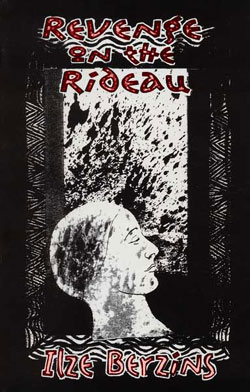
Portrait of the artist as amateur sleuth

Revenge on the Rideau

The wife of a respected Canadian judge, Leah Holm leads a pampered life. She spends her days having lunch and rejuvenating in an exclusive spa. In her diary and in her memory, however, she’s Leah Nusbaum, a 10-year-old Jewish girl who escaped the slaughter of her family and community when German authorities cleaned out the ghetto in occupied Liepāja, Latvia.

And then one day, decades and leagues removed from her past, she spies the Monster of Liepāja in Ottawa. Her mission becomes bringing the man she suspects to justice. But a fifth of the way into Ilze Berzins’ newest book, Revenge on the Rideau, Leah Holm is dead, floating face down in a hot tub at the My Lady Spa.

Who killed her—and why? Was it Clairelise Leowen, daughter of Erich von Leowen, the Baltic German baron Leah Holm suspects of ordering the extermination of her family? Was it Wilma Sprott, the mentally disturbed cleaning woman at the spa, a friend to Clairelise and who doesn’t like Leah? Or was it Judge Ken Holm, who is nearing retirement and pondering life with his sexy mistress, Ginette Ladouceur? Or was it one of several other characters?

Revenge on the Rideau takes place one winter near Ottawa’s famed Rideau Canal, billed by tourism promoters as the world’s longest skating rink. Berzins knows Ottawa and used the setting already in her 1999 murder mystery, Death in the Glebe. And Berzins also knows the broad outlines of Latvian history. Her autobiographical skewering of contemporary Latvian society, 1997’s Happy Girl, also gave readers a taste of who Berzins is—and we find plenty of her in this novel.

In a review of Death in the Glebe, Diana Kiesners made comparison to the "moral relativism" of that story’s fictional characters and the real people Berzins encountered in Happy Girl. We find that in Revenge in the Rideau, too. Few of the characters are outright lovable or off-putting.

But we also find similarity between Death and Revenge. Doreen Bell, the artist and amateur sleuth, is key in both tales, and she still is the romantic interest of a detective working on the case (in fact, Revenge alludes to Death at one point). Doreen in both murder mysteries and Berzins in Happy Girl also are dog lovers. And in Revenge, as in Death, women are victims of various kinds and most of the men can’t be trusted ("How come you’re so sure it’s a man?," Doreen asks her detective boyfriend, Barry Mullins, as they consider who might be the murderer. "Well, isn’t it always," Barry answers.).

Revenge is a relatively well-fashioned story, containing enough twists to keep the tale moving along at a comfortable pace. But few of the characters have engaging depth, perhaps a function of having too large a cast. As in Death, it’s Doreen who appears the most interesting and best-developed. Readers may hope that Berzins’ next work clearly becomes a Doreen Bell Mystery, more confidently using the character the author seems to know best. And while Revenge certainly makes use of Berzins’ artistic experience to describe places, people and the effects of light, it often seems a hasty job.

No publication is immune from technical errors. Berzins has worked to make Revenge cleaner than her previous efforts, but several of the final chapters are peppered with typographical errors, almost as if the rush to finish caused the author to drop her guard. And given its similarity to a made-for-TV movie (and that’s not necessarily a bad thing), a reader may be struck by a glaring continuity problem: is the name of the place Leah Holm dies My Lady Spa or Milady Spa?

At the same time, Berzins makes good use of the English language. A number of phrases are turned so well that they bring a smile to the reader. The overall flow of the story—particularly its resolution—is satisfying, especially for readers familiar with Berzins’ work so far. In the closing moments of the story, Doreen thinks to herself that "[s]he had always believed in happy. People were meant to be happy. She had always known that." Has Doreen found that which Berzins could not?

Dealing with the sensitive question of the Holocaust in Latvia and the process of Nazi-hunting as a backdrop for Revenge may be perceived by some readers as a risky move. But the novel doesn’t shock and perhaps could have gone out even farther onto the limb. As Berzins further explores her own background and develops the character of Doreen Bell, perhaps readers will be treated to an increasingly complex world.

(Corrected 12 APR 2001)

Details

Revenge on the Rideau

Ilze Berzins

Halifax, Nova Scotia:  Albert Street Press,  2000
Andris Straumanis is a special correspondent for and a co-founder of Latvians Online. From 2000–2012 he was editor of the website.

Songs about love, babies and much more

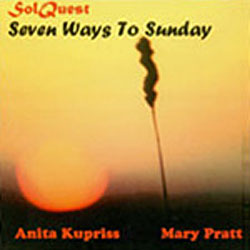
I am normally not a fan of folk rock, especially not women’s folk rock. I guess I haven’t been in touch with my feminine side for a while, or perhaps decades of listening to rock music have taken their toll on me, but it seems that hearing women sing songs about love, flowers and babies (and other such girly things) usually leaves me rolling my eyes and getting sleepy. So much to my surprise I really liked Seven Ways to Sunday, the debut album from SolQuest, two women singers and songwriters from Boston.

The reason I even have this album is due to my participation in a Latvian music camp in Ogre, Latvia, in the summer of 2000. In one of my more daring moves, I decided to take part in the choir there, although I wasn’t much of a singer. My singing remained mediocre, but the choir experience was particularly memorable because one of the choir directors was Anita Kupriss, a Latvian from Boston. Besides being a great instructor and having a tremendous voice, the one thing I will always remember about Kupriss was her incomparable enthusiasm—she had the energy of a dozen people (or one person with a dozen cups of coffee). This energy was infectious and was one of the main reasons why in just a few short days the choir was able to perform a number of pieces successfully. Kupriss also has been a member of Kolibri, the Latvian vocal and instrumental ensemble, and has more than a dozen recordings to her credit.

In the group SolQuest, Kupriss teams up with Mary Pratt, who has been singing in selective choral groups large and small since her youth. A vocalist, guitarist and songwriter she has appeared at coffee houses and clubs, weddings, parties and church-related functions. Pratt combines her classical voice training with years of experience in folk, jazz and popular genres, and this all comes together in SolQuest’s album.

One of my favorite songs on the record is the opening number, “I’ve Changed,” a soulful song sung by Kupriss about a woman who’s no longer “that girl you knew” and whose “soul wants to move on.” I particularly like the jazzy guitar introduction to the song. This song also shows that even though it is folk music, that doesn’t mean it cant have attitude.

A reason I like this recording so much is the ease by which Kupriss and Pratt move between styles and genres. From the bluesy “Why Cats are Like Men” (featuring some great slide guitar by Pratt), to the more traditional-sounding “Out in the Fields of God” (lyrics by Elizabeth Browning) and “The Journey,” Pratt’s and Kupriss’s voices adapt to the new styles without any difficulty. No surprise then when they describe their music as “eclectic acoustic.”

Another favorite is “Sing with Joy, Delight and Grace,” a very beautiful song by Pratt that is based upon a Latvian funeral song, and is a “positive perspective on death.” This song features Kurpiss playing the kokle. Particularly touching is the final line of the song, “I have sung my evensong, I will see this world no more.”

“Winter Solstice” is another beautiful song based on two Latvian folk melodies—“Pūti, pūti ziemelīti” and “Sudrabiņa lietiņš līja”—but in an interesting variation the refrain “Kaladū” has been replaced with “This I know.”

The blues are also present in “Managed Care Blues,” a song about the wonders of managed care in the United States. Pratt tells a story about seeing her feet turn blue, and then her troubles getting to the hospital (which include not being able to get through because of an answering service maze, not being able to afford an ambulance, and a rather disasterous attempt to get there by bicycle).

And, of course, there are songs about love and babies. A folk record without songs about them is like a western movie without a cowboy riding off into the sunset. I especially like “Bittersweet Love,” due to the very pretty piano part. The appropriately titled “Lullaby (for Anne)” is a simple melody, yet it is effective through its simplicity. This is a song that could very well be sung to a small child.

Traditional in certain ways, non-traditional in others, Seven Ways to Sunday is a record full of great songs and performances. Even though there are many different styles represented on this release, the songs flow very well together to produce the truly eclectic and distinct picture that is SolQuest. Folk fans will find this a refreshing twist on the genre, and even non-folk fans (like myself) can find much to enjoy on this well-crafted work, as you can tell that Pratt and Kupriss had a blast making this album. If you are ever in Boston, you can see them play at open mike nights at Moonshadow Cafe, Acton Jazz Cafe and Passims. I’m looking forward to hearing more from this very talented duo.

Details

Seven Ways to Sunday

SolQuest

SolQuest,  2000

Egils Kaljo is an American-born Latvian from the New York area . Kaljo began listening to Latvian music as soon as he was able to put a record on a record player, and still has old Bellacord 78 rpm records lying around somewhere.

Tumsa offers memorable hooks and melodies

Katram savu Atlantīdu

Looking over the handful of reviews that I have done for Latvians Online, one thing that seems to be in common is that almost all the groups are old. Most of the groups I review have been around since the 1970s or 1980s. Groups such as Līvi, Jumprava, Credo and Bumerangs have all enjoyed lengthy careers in the Latvian music world. This troubled me considerably. It made me feel much older than I am and I began to wonder if there were any new groups that would carry the flag of rock music. Or has the slow creep of mass-produced pop infected Latvia the same way it has infected most of the world?

One of the reasons that I liked the recent SuperIzlase compilation so much is that it provided a good balance of old and new and of pop and rock, and I bought it not for the all the groups that I already knew, but in search of new faces and sounds. One of the songs I liked the most from that compilation was the tune “Lietus dārzs” by a band called Tumsa. Though a melancholy song, it was very catchy and I really liked the lyrics: “Un saulē izdeg viss Tavs lietus dārzs” (Your entire garden of rain dried in the sun). I liked the song so much that I picked up the album, Katram savu Atlantīdu, and I can safely say that Tumsa is well-equipped to carry on the mantle of rock well into the future.

Actually, the full name of the group is “Mārtiņš Freimanis un grupa Tumsa.” Freimanis wrote all the lyrics and most of the music, sings and plays guitar, so I suppose he deserves top billing. The rest of the group includes Jānis Daugalis on bass guitar and vocals, Haralds Drekslers on rhythm and lead guitar, Kaspars Boroduško on drums and Einars Kokins on “skaņa” (which I guess means he’s the one doing the sound effects on the record).

Tumsa is based out of Liepāja. Katram savu Atlantīdu is the group’s second album, the first being Putni.

My favorite track on the album is the opening song, “Viņš (ir mazliet savādāks),” a great, uptempo introduction to the album. An infectious song, it practically begs for the listener to sing along on the “Hei la la” part.

Most of the album has a melancholy feel, but thankfully it never descends into the whiny, mopey, “woe is me” style that is in a lot of music today. “Klauns” is a sad song that is criticial of the phoniness that people adopt sometimes: “Tu esi tikai klauns, tavs mūžs deg cauri smiekliem, tu neesi nekas daudz” (You are only a clown, your future burns through laughter, you are not much of anything).

Other favorite songs on the album are “Vēlreiz, nekad vairs” and “Katram sava Atlantīda,” both catchy songs that encourage me to hit the “back” button on my CD player—and both songs I think would go over well live in concert.

The album hits a few rough spots in the home stretch. That’s where Freimanis exercises his English language ability, and the results are about what you would expect. A few awkward lyrics here, a few unusually pronounced words there, but otherwise solid efforts. You would think by now MICREC would have hired an English language consultant (I’ll do it!) to polish up stuff like this. But no matter, as writing songs in English is something I would still encourage these guys to do. It can only get better from here. However, with four songs in a row in English (“Lucky,” “I’m in Love,” “Someone” and “Freak”) it might be one or two too many.

Overall, a great album, full of memorable hooks and melodies, and an album I’d recommend to anyone looking for something new in the Latvian music world. Tumsa is currently in the studio working on their third record, so I expect big things from these guys in the future.

Details

Katram savu Atlantīdu

Tumsa

MICREC,  2000

MRCD 137

On the Web

Tumsa

The Liepāja-based group’s official Web site. LV

Egils Kaljo is an American-born Latvian from the New York area . Kaljo began listening to Latvian music as soon as he was able to put a record on a record player, and still has old Bellacord 78 rpm records lying around somewhere.