Ellis Island online records include Latvians

A new online resource promises to aid Latvians searching for ancestors who came to the United States during the late 19th and early 20th centuries.

The American Family Immigration History Center has made available passenger lists of ships entering the port of New York from 1892 to 1924. In all, more than 22 million immigrants, passengers and crew members came to America during this period.

The records became available April 17 at www.ellisislandrecords.org.

Perhaps hundreds of Latvian immigrants passed through New York on their way to new homes throughout America. Family history researchers wanting to review ship passenger lists previously had to travel to New York to view the original documents. Now searching may be done from a home computer, although the popularity of the site may try one’s patience.

Searching is simple, but at least a couple rules must be kept in mind.

First, during the time period covered by the records, many Latvians would have spelled their names using the old Gothic orthography. Thus, Ozols could very well appear in the records as Ohsols. A search for the surname “Ozols” found three individuals, but “Ohsols” returned nothing. The shorter version “Ozol” returned 18 names, while “Ohsol” yielded eight.

Second, Latvian immigrants who arrived in the years immediatedly following the 1905 Revolution may well have traveled with forged documents or under pseudonyms. For example, just because the family name was Kalniņš back in Latvia doesn’t mean that was the name used by a revolutionary trying to find a temporary home in the United States.

Once a user has completed the free registration with the center, detailed ship records may be viewed. Even these, however, only provide basic information: Nineteen-year-old Juris Ohsol, for example, arrived in New York on Sept. 30, 1922, on the Cunard ship Aquitania, which had set sail from Southampton, England. Additional features include information on the ship and its manifest, so users may learn with whom an ancestor traveled. The online system also allows annotation if users want to add additional information that may be viewed by others.

Search results may be refined, but users searching for Latvian ancestors may face problems here. “Latvian” or “Lettish” are not listed as ethnicities which can be used to tweak results, which is not surprising because for much of the period covered by these records Latvia was a region of the Russian Empire. In additional, “Libau” (Liepāja) is not listed as a port of departure, because for the voyage westward to America many Latvians changed ships at European ports such as Hamburg or Southampton.

Users of these records should keep in mind that they only cover the Ellis Island immigration center and the port of New York. However, immigrants from Latvia also arrived at other ports. For example, among the earliest arrivals in the late 19th century were Jēkabs Zībergs and handful of other Latvians who disembarked at Boston. Others may have first arrived in Canada and only later moved to the United States.

The records were put on line with the help of volunteers from The Church of Jesus Christ of Latter-day Saints. The church has as one of its missions the cataloguing of all people. Others involved in the project are Compaq, FamilyTree Magazine and Hostcentric.

The popularity of the site overwhelmed the history center’s server, according to news reports. Millions of users tried to gain access to the site on its first day of operation. The history center now limits access.
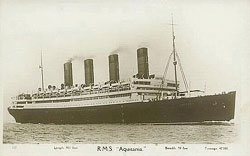
Aquitania postcard

A postcard shows the Cunard Line ship Aquitania, on which many immigrants came to the United States.

Andris Straumanis is a special correspondent for and a co-founder of Latvians Online. From 2000–2012 he was editor of the website.

Verdict on latest Streičs film still a mystery

Vecās pagastmājas mistērijas

Magda (Aurēlija Anužīte) and Juziks (Renārs Kaupers) spend a quiet moment on Midsummer’s Eve, hours after an ex-KGB agent nails Juziks’ hands to a cross. (Photo by Atis Ieviņš)

It is not often that I feel I have to watch a film more than once. Not because I missed some important plot point, but because I am not sure I liked or disliked the film. In the case of Vecās pagastmājas mistērija, I am still not sure. The films of Jānis Streičs have that effect on me.

Vecās pagastmājas mistērija (The Mystery of the Old Parish House) is loosely based on real life events that took place in Krimulda, Latvia. It tells the story of an aging KGB agent (Eduards Pāvuls) who is forced to live the rest of his life in a house in whose basement he had tortured and murdered people during the summer of 1941. Yet, the film itself is really about much more than that. It is about filmmaking and contemporary life and the notions of guilt and responsibility.

The film is told in three parts. The first, "Mea Culpa," is a film within a film. It is about the screening of the KGB agent’s story. In the film within the film, the KGB agent hires two construction workers (Renārs Kaupers and Andris Bērziņš) to brick up the door to the basement to prevent the ghosts of all those he had killed from coming after him. As the two workers discover the true nature of the job they resolve to avenge all those who had died by killing the Chekist, but eventually end up saving him from killing himself. Unfortunately, no one, other than the director (Artūrs Skrastiņš), likes the finished film and it is decided that additional scenes need to be shot to improve it.

The second part, "Agnus Dei," is about the shooting of an additional horror scene in which the ghosts, accompanied by a spectre of Jesus nailed to a cross, chase the Chekist. Unbeknownst to anyone, one of the people hanging around the shoot—a filthy, drunken bum looking for a free drink—is the real-life KGB agent. During a break in the filming, while no one is watching, he nails the actor (Kaupers) playing Jesus to the cross.

The last part of the film, "Tuba Mirum," is about the relationship between the young actor Juziks (Kaupers), the film’s producer, Hugo (Ivars Kalniņš), and Magda, the woman they both love (Aurēlija Anužīte).

It all comes to a head as the sadistic producer tries to rape Magda, Juziks comes to her rescue and—with the help of the ghosts of the victims of the old parish house—they triumph over all.

The major flaw of Vecās pagastmājas mistērija is that so much of the story is dependent on the fact that the film within the film is supposed to be flawed and we spend too much time watching a bad movie being made. It’s not that this is a bad idea. Films about bad films are not a new genre. I can think of two examples, Ed Wood and Living in Oblivion, that worked. However, neither of those films tried to focus on anything other than the basic premise. Streičs tries to reach far beyond that by also making Vecās pagastmājas mistērija about the true-life events of what happened to Latvia under Soviet occupation and all of the real and imagined scars that they left on the Latvian psyche. If he had focused on either story the film would have been much stronger. By trying to combine the two he succeeds in telling neither.

This is not to say that Vecās pagastmājas mistērija is a bad film. Many parts of it work and others are downright profound. Streičs’ combination of mysticism with realistic themes and execution show a great deal of talent and depth. The three parts all complement each other. You have layers upon layers of symbolism here. The real-life events are often more absurd and surreal than their celluloid representation. Reality and fantasy blur and complement each other to the point where you can’t tell them apart. All in all, while some of the parts might not work, the sum is greater than the whole.

Details

Vecās pagastmājas mistērija

Jānis Štreics

Rīgas kinostudija,  2000

Notes: In Latvian with English subtitles. Drama, color, 110 minutes. Screenplay: Jānis Streičs; director of photography: Harijs Kukels; music: Mārtiņš Brauns; set design: Ieva Romānova; principal cast: Aurēlija Anužīte, Andris Bērziņš, Olga Dreģe, Ivars Kalniņš, Renārs Kaupers, Eduards Pāvuls, Inese Saulīte and Artūrs Skrastiņš.

Common ground in a sea of diversity

Labvakar! Labas vakaras! Head ööd! God afton! Guten Abend! Dobry wieczór! Hyvää iltaa! Gu kvell! Добрый вечер! Good evening!

What you have just heard are 10 of the most popular ways for people to say hello to each other in the Baltic Sea region. Those of us who live around this region have been using those same words for thousands of years. That was just 10 phrases, but we know that there are hundreds and maybe even thousands of others.

If we go back far enough in our history and deep enough into our forests, we know that many different cultures have come and gone through this region, each saying hello and goodbye in their own unique tongues. Some came as traders, others as invaders. Some built up castles and cities, and others came in and tore them down. Everyone who has ever ridden around, sailed to, or walked through the lands that surround the Baltic Sea has left their mark on this region in some way.

As a result, this region has no shortage of diversity. For that, we can thank the millions who have lived and shaped these lands before us. But many of us who live here suspect we have a great deal in common as well. Despite our various languages, cultures and histories, there is something about the Baltic Sea that draws us together.

If there is something that draws us together, could it give us a common regional identity? And if it could, do we really want it?

Today identity is a marketing tool, so then when we debate whether our region wants or needs a common identity, we need to take this into account. An identity establishes the nature of your relations with others. Each of us individually establishes an identity, companies and organisations actively establish identities to promote themselves and countries are polishing their identities for the global political marketplace.

Do we want the Baltic Sea region to have a marketable identity in the world?

A thousand years ago the Baltic Sea region had a clear and vivid identity for potential visitors. It was the place you stayed away from if you didn’t want to be attacked by Vikings. It was that chilly northern sea where the Danes fought the Swedes, the Swedes fought the Couronians, the Couronians fought the Livs and Livs looked around for some Estonians to fight. And when they could, the Baltic Vikings all got together and fought the Celts. Some of them even took time out from fighting to help the Norwegians discover America.

Then came the Germans, who brought the Hanseatic League, the Teutonic Order, the stone castle and the fiery cross. Exactly 800 years ago, a German Bishop came here, stood not too far from this site and established a city. With the help of German Crusaders, this bishop named Albert built a fortress, a church, a castle and then called it all Rīga.

Only a statue of Bishop Albert remains, but the city seems to have done quite well over the last 800 years without him. He was clearly a clergyman who understood the value of prime real estate.

If this region has a common cultural identity, Rīga is its creation, reflection and continuation. All the languages that I greeted you with earlier, have been spoken in this city for 800 years. All, at various times, have been used to either rule it, do business here or create art.

Language helps determine identity and it has always played that role in Rīga. Since the earliest settlers on this land were Liv and Latvian tribes, Latvian as a language has always been part of this city. But over the years those who have ruled and run this city have done so in German, Swedish, Polish and Russian, depending who was in power at any given time.

You can find this changing identity personified in a street in the very heart of Rīga. In 1818, while under czarist rule, Rīga’s main boulevard was named Aleksandra boulevard. One hundred years later, when Latvia achieved its independence in 1918, it became Brīvības iela—Freedom Street. When Rīga was occupied by the Soviets in 1940, it became Lenin Boulevard; when the Germans came in one year later it became Hitler Strasse, and when the Soviets came back in 1945, it became Lenin Boulevard again. Ten years ago, in 1991, when Latvia re-established its independence again, Rīga’s main thoroughfare—Aleksandra/Brīvība/Lenin/Hitler/Lenin boulevard/street—became Freedom Street once again.

Rīga is clearly a city of multicultural diversity, and yet it has survived and thrived for 800 years because at least some of the people who have lived here have found—or created—common ground. They say that common ground is a place where common interests can use common values to deal with common concerns.

Diverse peoples originating from different cultures speaking different languages, can live together and cooperate if they can share common interests. We are all living in a globalised world where the factors that once kept us apart—geographic distance and information isolation—are no longer a barrier to communication and cooperation.

In fact, some believe the pendulum has swung too far in the opposite direction—local and regional identities are being superseded by global identities. McDonald’s, Coca Cola, Mercedes Benz, Volvo, Nokia and Champagne are all products of distinct national origins—yet today, they are globally recognised names that can be found anywhere in the world. Many who use these products no longer know where in the world they come from.

The Vikings navigated the fjords and rivers of this region and eventually found gateways to other societies, as far away as Byzantium and the Black Sea. Today anyone of us can navigate the global networks of cyberspace and make contact with anyone in the world, any time we want. The moment we go online, we get connected to the rest of the world.

In a globalised world, regional and national identity take on whole new dimension. But even in cyberspace, one needs to identify one’s self. We have to log on as someone, from somewhere. You could say that one of the goals of the Baltic Sea Region Identity Workshop is to discuss how we log on when we wish to make contact with the rest of the world—and whether it matters. Are we Rīgans, Latvians, Balts, Scandinavians, Northern Europeans, European Unionists—or merely global citizens speaking English with regional accents?

This year the city of Rīga is celebrating its 800th anniversary, and the marketing people responsible for promoting Riga’s identity have called it the City of Inspiration. In the next four days we will find out whether that is true or not.