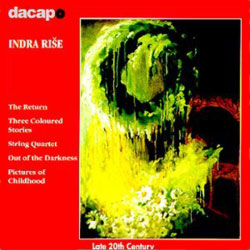
Riše’s music uses memories to challenge

The Return

A couple of years ago while surfing the Web for stray recordings of Latvian music, I came upon an obscure Danish compact disc of music by a Latvian-born composer who was completely unknown to me at the time—Indra Riše. Born in Latvia in 1961, where she studied piano and composition, she left for Denmark in 1993 for advanced study on a state scholarship and has lived there since. This second release of her music, The Return, has afforded me a welcome opportunity to get to know her music, and I’ve recently seen an announcement for a third release from Sweden, so she is clearly a rising star.

The Return has tremendous variety and begins with "The Return," written for the piquant combination of mezzo-soprano, flute, cello and accordion. The work presents an interesting paradox: while I did not find it particularly compelling as I listened to it, the impression left by the music is oddly haunting and effective in retrospect. Certainly, one usually has to hear an unfamiliar work several times before having a clear sense of it, but somehow this music felt so fragmented every time I listened to it that I didn’t sense a logical progression of events.

However, repeated listenings have enhanced the effect of the music in my memory, so perhaps the logic of this music is less obvious. Sometimes vaguely Mahlerian, gently nostalgic and wistful, occasionally bittersweet, there is an overall feeling of disjointed and fractured memory. The text by Kārlis Skalbe, one of the most beloved of Latvian poets, is powerful enough to withstand such an unusual adaptation with no loss of impact, but this is a very different way of treating his poetry than I can recall any other composer having done.

Some of these characteristics of experience versus memory are shared by "Pictures of Childhood," but in a more unusual way. The work consists exclusively of electronically distorted or morphed vocalizations, sounds and words from a solo singer, resulting in an often bizarre variety of effects, evocations and reflections on childhood memories. The first movement, with clever and often amusing chugging and hissing, seems to recall a train ride. The second is filled with the sound of barking dogs, but I was hard put to detect the fear that the composer claimed to evoke. The third consists of a chittering, chirping background with an aimlessly meandering vocal line. Perhaps a very young child listening distractedly to an improvised lullaby amid everyday sounds?

The earliest work in this program is "Three Colored Stories," for solo piano. Brilliantly played by the composer herself, its three movements sound rather French at times, though by no means derivative.

A more spiky and abstract work, the "String Quartet" is somewhat Stravinskyish at times, and occasionally reminscent of Pēteris Vasks’ music, in a laconic way.

Finally, the very emotive and sometimes raucous "Out of Darkness" is for solo saxophone, using a variety of techniques and playing styles, and progressing through a series of moods. The subtlety of mood and timbre is probably quite challenging and interesting to the player, but this piece did not draw me in like the other works on this album and I didn’t find it very appealing, either as I listened to it or recalling it afterward. Perhaps it wasn’t meant to be, since it is about "unresolved conflict."

This is a splendidly produced, generously filled album with stellar performers and a superb recording, with program notes in four languages. Not aggressively avant-garde, much of this music still requires mental involvement and a readiness to approach it on the composer’s terms, not as mood music or mindless ambience. After an initial listening, I didn’t think I would come back to this disc very often, but some of it is so unexpectedly intriguing and haunting that I find myself being drawn to it more than I expected. Much of Riše’s music deals with memory, moving musicologist Ilze Liepiņa to write, "allusions to childhood and fairy tales are always important to the composer: being childish means for her being emotionally genuine and wise." Challenging as it may be at times, this is certainly sincere music. If you are moderately adventurous you should give it a try.

Details

The Return

Indra Riše

Dacapo Records,  2000

CD 8.224142

Setting the limits of free expression

Latvians Online censors its discussion forums. And in the past several days, the responsibilities and repercussions of that censorship have hit some of our staff—and several of our readers—hard.

So now we offer you, our readers, an opportunity to determine the degree to which we should limit expression in our discussion forums.

But first some background.

We won’t go into details of the case here, but suffice it to say that as a result of our efforts to remove or prohibit certain objectionable material during two weeks in mid-May, we have had to edit or delete dozens of messages, have had to answer angry notes from irate forum participants and have had to mount a defense against one aggrieved reader’s libelous "anti-defamation campaign" that spread to at least one other online service.

Anyone who uses our forums should know what we mean by objectionable material. Every forum page states, "No foul language, attacks on individual people or companies, or advertising of any kind is permitted (non-profit organizations excluded) in these discussion forums." Since launching Latvians Online, we have edited or deleted messages that contained foul language and that were outright attacks on individuals. We have on several occasions expanded the rules to include attacks on ethnic groups, removing posts that were blatant examples of ethnic or racial prejudice.

But should we? What are the limits of free speech, especially given this still young medium of the Internet? And where do you, our readers, want to draw the line?

The Englishman John Milton, writing in the 17th century, suggested that people should be able to express their opinions in what is now frequently called the "free marketplace of ideas." The theory behind this marketplace is that truth can compete—and rise above—falsehood. This is a notion that has been adopted, in differing degrees, in many Western democracies. It’s a notion, we believe, that should be the standard for political speech.

The marketplace, however, is nothing like what it was in Milton’s day. Global communication technology allows readers of our forums to post messages from Canada, the United States, Australia, the United Kingdom, Latvia and plenty of other locations.

One issue now before legal experts around the world is how to deal with expression on the Internet. Laws about expression that are specific to one territory may find little sway in another.

In the United States, the First Amendment to the Constitution (ratified in 1791) forbids the Congress from making laws that abridge freedom of expression. However, legislative bodies have not always held to that restriction. At times, the courts have stepped in to remind lawmakers about the First Amendment. In the course of two centuries of case law, we now know that the right to free expression is not absolute. Obscenity, for example, is not protected by the First Amendment. Neither is expression that threatens national security.

In Latvia, the Law on the Press and Other Mass Media (adopted in 1990) states that everyone has the right to freely express their opinions. Censorship by the government is forbidden. But Paragraph 7 of that same law outlines what is not allowed to be published. The list includes items such as state secrets; expression that argues for racial, nationalistic or religious superiority, and information about the health of a citizen without that person’s agreement.

If Latvians Online adopted a hands-off policy to expression in its forums, letting every message stand without editing or deletion, we might find ourselves in violation of some law somewhere. And we’re sure that many readers would agree that certain expression should not be allowed, regardless of whether there are laws that forbid it. Child pornography would be the prime example.

As we step away from that extreme, how far should we go before declaring that we’ve reached an acceptable point? Should expressions of ethnic or racial hatred be tolerated? Will Latvians ever come to terms with the Holocaust and with 50 years of Soviet occupation by forbidding online attacks on Jews and Russians? Does denying hatred a channel for its expression do anything to reduce that hatred?

What about foul language? Is a well-placed expletive in a forum message only meant for dramatic effect, or does it encase a political opinion? Should we protect our young readers from foul language, stuff they hear anyway at school, on the playground and at Latvian summer camp?

Is it all right to allow attacks on individuals? If a Kļaviņš accuses an Ozoliņš of being an idiot, should Ozoliņš return the favor or call his attorney? If the former, does it serve any purpose to allow two individuals to sully the forums with personal attacks? If the latter, wouldn’t it make sense for us to step in to avert a possible lawsuit? No one has a right to hurt another individual, and we know that individual readers of our forums have been hurt by verbal attacks. Shouldn’t we police that kind of behavior?

One of our regular forum participants has likened Latvians Online to a house. We’ve invited you in and you are welcome to stay as long as you follow the house rules.

But we want this to also be your house. Over the coming weeks, we invite you to use our Open Forum to discuss what standards Latvians Online should have for the forums. Are our current rules good enough? Too strict? Not strong enough?

Let us know.

Andris Straumanis is a special correspondent for and a co-founder of Latvians Online. From 2000–2012 he was editor of the website.

ALA celebrates 50 years, looks to future

Fifty years may seem a short span in human history, but it’s momentous for an emigre organization. As the American Latvian Association (ALA) turned 50 recently, its leaders and members took time to look back and, more importantly, forward.

The past and present

What next? The question seems so natural at a time when Latvia is an independent and rapidly developing democracy that doesn’t directly depend on political support of emigre organizations in the West, as was the case during Soviet rule. In the last 10 years, exile communities have been confronted with the need to “reinvent” their causes, leaving some members skeptical about their future.

However, no such doubts could be heard from ALA leaders during the organization’s 50th anniversary congress April 27-29 in Arlington, Va.

ALA members agree that among the issues that will keep them as well as other Baltic-American organizations preoccupied is enlargement of the North Atlantic Treaty Organization to include the Baltic states.

As NATO’s 2002 Prague summit approaches, the Baltic community will devote much of its efforts to fortifying U.S. commitment to NATO enlargement. As Ints Rupners, who served as ALA chairman from 1992 to 1996, put it humorously, that will be the “last cry—last hurrah” of ALA before it turns into a typical emigre organization.

Rupners said the political work on the NATO issue should be finished in the next six months. “We have to persuade the U.S president and two thirds of Senate to vote for NATO enlargement,” Rupners said. “This is our last big political task.” After that, ALA’s main interests will be culture, schools and language, and much less the political questions, he said.

An active participant in the Joint Baltic American National Committee and a partner to the Latvian embassy in Washington, D.C., ALA is no newcomer to the battle for Baltic causes in Washington.

Current and former leaders of the organization say ALA has to be given credit for maintaining contacts with the U.S. administration and legislature, which in turn helped the United States play a role in the run-up to Latvia’s independence. “We were like thorns under the arms of the Communist bear,” ALA chairman Jānis Kukainis said in his opening speech during the congress.

“When Latvia joins the NATO, it will be to a large extent due to ALA’s efforts,” Uldis Grava, who chaired ALA from 1970 to 1972, told Latvians Online. He said the Latvian lobby has always had strong influence in the U.S. Congress.

Grava was echoed by his colleague Aristīds Lambergs. Under Lambergs’ chairmanship from 1986 to 1988, the Latvian lobby gained impressive political clout in Washington, including close relations with Reagan Administration as well as good contacts in the Congress. In fact, during the 1980s, “we were considered the second most influential lobby after Israel,” Lambergs recalled in an interview with Latvians Online. “Taking into account the relatively small number of Latvians in America, we have done a very good job,” he said.

The effective cooperation reached its peak in 1986 when seven young American Latvians were included in the high-level U.S. delegation to the Chautauqua conference in Jūrmala, which marked the perestroika thaw in the Soviet Union and provided an excellent opportunity for American Latvians to exchange information with supporters of independence in Latvia.

The future

While it’s clear that the Latvian community has to remain strong in its push for a positive NATO result, American Latvians don’t see their work ending after that.

“ALA’s goals have changed, but the organization can still be of great help to Latvia,” said Lambergs.

The Latvian community could work to attract private investments into Latvia and secure the political and financial support of the U.S. government, according to Lambergs. Former ALA chairman Valdis Pavlovskis (1988-1992) agreed that U.S. financing programs would be particularly useful.

Lambergs suggested American Latvians could also expand educational cooperation that would provide students from Latvia with more opportunities to study in the United States.

One of the most promising ways of cooperation would be active business contacts between Latvians in Latvia and their counterparts in America, said Ilgvars Spilners, ALA chairman from 1972 to 1975.

In addition, ALA could cooperate with the Rīga-based Latvian Institute in distributing information on Latvia as a nice tourist attraction and thus give boost to the country’s tourism industry, Spilners said.

Rupners said ALA would continue establishing and widening contacts with different non-governmental groups in Latvia. ALA has done quite a lot through different U.S. government agencies to help build the Latvian nongovernmental organization sector, Rupners added.

But he added that the NGO culture has yet to take root in Latvia. “You can’t learn it from books… People are still not used to it,” Rupners said. “They will get used to it, because that’s how civil society works.”

Some activists pointed out that that many prominent Latvian Americans are serving in high positions in the United States, and Latvia could use them as influential messengers to promote its interests.

Grava said Rīga should set priorities and see where and how—and for what goals—such highly devoted Latvians could be used.

Both Grava and Spilners emphasized that being Latvian and at the same time American citizens is not incompatible. “The concept of being a Latvian shouldn’t be tied to geographical borders,” Grava said.

The main future task of ALA will undoubtedly be keeping alive the Latvian language and passing the interest in Latvia over to younger generations who, in the words of Kukainis, could be the “future CEOs of General Motors or even U.S. presidents,” capable of lending great support to the country of their ancestors.

“You are not a Latvian if you don’t know the Latvian language,” Kukainis said. “We are a small nation, so we need to preserve our language and our culture. Our task is to preserve our Education Division, Saturday schools, and summer schools to teach our children Latvian and tell them about our culture.”

ALA members may be convinced that gradual assimilation is inevitable, but they are not ready to give up their efforts. During the congress, the speech of American American Youth Association President Ingrīda Erdmane may have given some hope. Erdmane spoke about the Baltic studies program at the University of Washington in Seattle, which has already proved its effectiveness in helping the younger generation learn the Latvian language.

It seems that those young people who get involved in the community activities don’t lose their liking for things Latvian. Those young American Latvians, who have returned for permanent life in Latvia, can serve as a good proof.

As Lambergs put it, “I don’t think we’re running short of (Latvian) people and I don’t think we will.”

Grava was even more confident: “This nation will definitely live on as it has proved in many other hard moments.”