Skip the Song Festival and go watch hockey

In the end it came down to an aging team and lack of depth. The offensive spark that Sandis Ozoliņš had provided in the upset against Slovakia was missing. Latvia went down 1-4 against Germany. The dream of moving in among the final eight Olympic hockey contenders died Feb. 12. Latvia had to settle for ninth place after beating Ukraine 9-2 two days later.

But in the preceding days Latvia’s hockey team captured the hearts of Latvians around the world, including many newfound fans in North America. Finally it was our turn to get pumped up and wave the flag in homes and bars around the continent, to experience the hockey fever that in recent years has swept Latvia.

Thanks to the inanities of the National Hockey League’s deal with the International Olympic Committee that saw only some players released for the preliminary round, Latvia’s team—particularly star goaltender Artūrs Irbe—were front and centre in sympathetic North American media. NHL Commissioner Gary Bettman, in a tense exchange with Irbe, threatened to impose fines and suspensions if he dared play against the Slovaks even though the Carolina Hurricanes had given their permission.

Ozoliņš and Kārlis Skrastiņš, Latvia’s two NHL blueliners, were forced to return after the tie with Slovakia and ironically, play against each other in a meaningless NHL game between two teams out of the play-off race. That same night, Latvia was being shut down by Germany. They were sorely missed.

Anyone in Canada or the United States who follows hockey now knows about the Latvian hockey team. A high-priced PR team couldn’t have done better, although the doping scandal surrounding Latvian bobsleigher Sandis Prūsis threatens to undo the gains.

The Olympics are over for Latvia’s hockey players, but what now? Hockey in Latvia collapsed with the Soviet Union and lost several years. As a result, there are few new faces on the Latvian squad, whose average age is 30. New rinks are sprouting in Latvia, minor hockey is taking off and half a dozen top juniors are playing at the highest level in Canada and the United States, but there is a lot of catching up to do. The national team will be hard-pressed to replace veterans who will retire over the next few years. At the same time, veterans have to step aside to give younger players experience—even if there aren’t many of them and even if some want to keep soldiering on. The trick will be to keep Latvia in the A pool at the international level until a new generation of hockey players grows up and matures.

Latvia’s goaltending situation is critical. Irbe, who has done much to gain recognition for Latvian hockey, only has a few years left in his career. In any case, the team has become too reliant on his annual dashes across the Atlantic from the NHL play-offs to the World Championships. Vancouver Canucks NHL goaltender Pēteris Skudra hasn’t been on speaking terms with the Latvian Hockey Federation and media since the Worlds in Norway. There is patching up to do. Sergejs Naumovs, who now plays in the Swedish Elite League and has played in Long Beach and San Diego in the minor pros, is better than the shaky start against the Slovaks would attest, but he’s no NHLer. He needs more ice time with the national team in key games. Coach Curt Lindstrom’s decision to do just that and start Naumovs against the Ukrainians created more off-ice drama with an angry Irbe being benched. But given Carolina’s play this year, it’s very likely that Irbe won’t be available in this year’s World Championships in Sweden and Naumovs will have to start.

Even though hockey fever has gripped Latvia since 1997 when Latvia made it to the top international tier, many Latvians abroad have been ambivalent. Some complain that there are too many Russian surnames on the team, although most of the players can speak Latvian and some are in fact at least part Latvian or descend from pre-War Russian families who lived in Latvia. Others say the sport is too rough, or it’s not part of our heritage, or it’s not cultural. Why, one writer in the Latvian newspaper Laiks a year or so ago even claimed hockey in Latvia is a Russian plot because only the Russians can afford to buy equipment for their kids. As a result, Latvians were supposedly being pushed out of the sports scene.

Nonsense! Hockey is part of a Latvia that is real, a Latvia that exists today in the year 2002, a Latvia that can hold its own against the world’s hockey superpowers.

When Latvia plays hockey the country comes to a standstill. Bars are packed, Parliament goes into recess, everyone is glued to their television set. While older generation Latvians abroad bemoan the lack of national pride in Latvia, they ignore the thousands of fans from Latvia who, decked out in face paint, flags and team jerseys, descend on European cities to cheer their team and belt out the national anthem after victories. Is this not national pride? In different eras, the same fans would have sailed on marauding kurši Viking ships, battled against German crusaders, marched in Czarist armies, fought for Latvian independence or battled on the Eastern front. Today it’s hockey.

And I for one say we skip the next Song Festival and instead head over to the World Hockey Championships and go crazy. Let(t)‘s go!

Berzins hits her stride with latest mystery

A Tear in God's Eye

It takes a while before Doreen Bell, the main character of Ilze Berzins’ latest crime thriller, is introduced to the reader. And it takes an even longer time before someone is found dead. Combined, they are among the elements that make A Tear in God’s Eye the author’s best work so far.

Readers familiar with her earlier mysteries—1999’s Death in the Glebe and 2000’s Revenge on the Rideau—will recognize certain Berzins trademarks. Bell, the middle-aged Ottawa artist who becomes amateur sleuth, of course figures prominently, as does her cop boyfriend, Barry Mullins. And Berzins soon had better provide a map to Canada’s capital city; she’s using more of the geography of Ottawa now.

Men, as they did in the earlier novels, are mostly cast as disagreeable characters, although their rough edges are softening. "Men need to feel powerful and in control," Bell tells her neighbor, Constable Julie Barnes. “And when they feel they’re losing it, they lash out—attack, even kill.”

But there the similarity ends. A Tear in God’s Eye is more layered and complex than the earlier crime novels. I kept expecting Doreen Bell to jump out at ever turn of the page, but it wasn’t until about a quarter of the way through that the story finally got to her. Along the way, the author had already introduced and developed several characters, among them the two-bit criminal Ivan Pavnick and his wheelchair-bound sister, Val Pavnick, the owner of a women’s shelter.

Berzins also has developed a much more intricate plot, one that she slowly unwinds before getting to the key element in a murder mystery: a body.

When death finally comes—to Linda Pedersen, wife of policeman Carl Pedersen—we are just past the halfway point in the book’s 315 pages.

The novel offers the reader a view of a grittier Ottawa, complete with corrupt cops and the drug underworld, not just the artsy Glebe or the fashionable Rideau districts that were featured in Berzins’ previous works. A Tear in God’s Eye also has a sexual tension that was lacking earlier.

Berzins also is funnier here. Sometimes the turn of a phrase seems a bit overplayed, but at other times the irony and weird humor work well. Linda Petersen, for example, is killed in a parking lot. "The killer had left a signature," Berzins writes. "The V from a Pontiac Aztek was found lodged in the dead woman’s torso." I had to laugh, because Pontiac Azteks really are disagreeable-looking vehicles.

Without the benefits of a large publishing house that might advise against going to press before an author is ready, Berzins in a few short years has churned out three crime mysteries, plus her recently re-released memoir of trying to start a new life in Latvia, Happy Girl. She’s received both accolades and criticism, of course, but has also matured as a writer. With A Tear in God’s Eye, Berzins has hit her stride.

Details

A Tear in God’s Eye

Ilze Berzins

Halifax, Nova Scotia:  Albert Street Press,  2001

Andris Straumanis is a special correspondent for and a co-founder of Latvians Online. From 2000–2012 he was editor of the website.

Urā! Latvia live on NBC!

“Well, it’s our five seconds of fame,” said Pēteris Stāks. Speaking to a reporter via his mobile phone Friday night, Feb. 8, Stāks had not yet heard of his and others’ success in convincing the NBC network to air the Latvian team’s appearance in the opening ceremony of the Salt Lake City Olympics.

Stāks was standing outside Rice-Eccles Olympic Stadium, watching a direct feed (rather than the NBC broadcast) of the ceremony on a large television screen.

He was the spark behind Salt Lake City broadcaster KSL-TV’s “adopting” Latvia as its team, an effort that was rewarded by a promise from NBC Sports Chairman Dick Ebersol that this year the network would indeed show the team. In all other Olympic Games since the country regained independence, Latvia’s appearance on U.S. television screens has been preempted by commercials.

According to KSL news anchor Bruce Lindsay, Ebersol said that NBC would still cut to commercials before Latvia’s appearance, but that the network would record the moment and show the team’s entrance right after the commercial break.

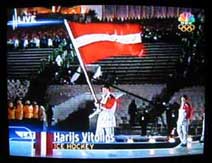
Instead, NBC waited until the team had started its entrance, long enough to see a live broadcast of hockey player Harijs Vītoliņš carrying his country’s flag and leading the rest of Team Latvia into the stadium. Meanwhile, NBC’s co-host for the opening ceremony, sportscaster Bob Costas, noted the significance of the moment.

“They score points with an effective campaign to appear on television during this opening ceremony after years of being relegated to commercial oblivion,” Costas said.

According to reports posted to the Latvians Online forum and the SVEIKS discussion list, television viewers in Australia, Canada and Germany (and, of course, Latvia) saw the entire Latvian team during the opening ceremony. Television commentators in Canada and Germany noted the Latvian effort to convince NBC to broadcast the team’s appearance.

What U.S. television viewers didn’t get to hear was the cheer that went up when the Latvian team entered the stadium, Stāks said.

“It was definitely above average,” he said.

Latvia on NBC

Millions of television viewers in the United States saw Latvian hockey player Harijs Vītoliņš carry his country’s flag in the Parade of Nations during the opening ceremony of the Olympics broadcast on the NBC network. (Photo by Andris Straumanis)

Andris Straumanis is a special correspondent for and a co-founder of Latvians Online. From 2000–2012 he was editor of the website.