
The good, the bad and the satirical

Pre-World War II Latvian industrial leaders, politicians and bankers—and the lives they lead—are studied in Ceplis.

It is impossible to view Ceplis, directed by Rolands Kalniņš and starring Eduards Pāvuls, without putting it in the context of the time and place it was made. The year was 1972 and the place was Soviet Latvia. There is good and bad here.

The good part is that this is a great-looking film. The cinematography jumps right off the screen. Looking at the film with the sound off you could imagine that this was a film from Hollywood or Western Europe, circa 1970. The lighting is just right, the composition of shots shows attention to detail, the costumes and actors are all just so. One of the advantages of working in the Soviet system was that filmmakers had access to equipment, although it was usually quite a few notches below what was available in the West. But they had crews and talent to milk that equipment. They also had time to film without the usual budget constraints that present day productions have to deal with.

Unfortunately, watching a film with the sound off stopped being a true option since The Jazz Singer premiered in 1927. It’s not that the acting in Ceplis is bad or that the technical quality of the sound is that bad. (The movie seems to have been shot without sync sound and the dialogue added at post-production, but I am discovering that is more of a pet peeve of mine that doesn’t bother most. Fellini shot most of his films this way and few complain about his work.)

The bad part is that because the film was made in Soviet Latvia in 1972, it couldn’t just focus on telling a story without also, none too subtly, having to impart some ideological message. It is this need to drive home an ideological message that ultimately sinks the film.

Ceplis is the story of the ultimate survivor. It tells the adventures, or misadventures, of a 1930s businessman who will do anything to survive and prosper. Ceplis (Pāvuls) establishes a joint stock company that will make bricks from Latvian clay (brūnais zelts, or brown gold) and sell them overseas. There is no shortage of those who are lured by the promise that the phrase "Made in Latvia" will soon ring across the world. The possibility of becoming rich beyond their wildest dreams doesn’t hurt either. Soon everyone is scheming to acquire as much stock as they can. Alas, the clay used for the bricks contains too much chalk, the bricks themselves are worthless, and as fast as they tried to get in on the deal everyone soon wants out.

This is not a subtle film. Not a single character is motivated by anything other than greed. All of them—from the mighty captain of industry to the lowliest office clerk, from the highest politician to the local police officer, and even their wives and paramours—are tainted by either their proximity to, or desire for, wealth. And it is this greed, of course, that leads to their eventual downfall.

The film’s screenplay is based on a novel, written by Pāvils Rozītis in the 1930s, that was intended as a satire of contemporary times. But the film comes across as a heavy-handed attempt at illustrating the evils of capitalism and, by extension, Latvian nationalism. Greed is bad. Nationalism is merely a tool to justify greed.

Ironically, this same stereotypical presentation of Latvian business people and politicians can be found in the present. Let’s hope that if anyone ever thinks of remaking Ceplis they will remember that satire works best when it is subtle.

Details

Ceplis

Rolands Kalniņš, director

Rīgas Kinostudija,  1972

Notes: In Latvian. Drama, monochrome, 72 minutes. Screenplay by Viktors Lorencs, based on a novel by Pāvils Rozītis; camera: Gvido Skulte; music: M. Zariņš; principal cast: Gunārs Cilinskis, Helga Dancberga, Eduards Pāvuls, Regīna Razuma, Aivars Siliņš, Velta Straume and Rolands Zagorskis.
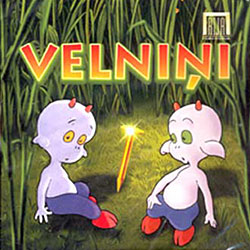

Play around with these little devils

Velniņi

In a Microsoft world where Latvian multimedia titles are few and far between, the CD-ROM Velniņi (The Little Devils) stands up to the test of time. Released in 2000, the disk was touted as Latvia’s first computer game. Enthusiasts, myself included, rushed to purchase a copy and check it out.

Surprisingly, the focus of the CD-ROM is not a game, but a 26-minute animated film based on a story by Latvian author Rūdolfs Blaumanis. The three games—Medus, Pāris and Labirints—use characters and objects to supplement the story, but don’t make for an interactive journey in and of themselves.

Velniņi revolves around two mischievous devils who make their way up from hell to a farmhouse in Latvia. The devils start pulling devilish pranks, such as putting the farmer to bed in the barn, and the bull to bed beside the farmer’s wife. When two thieves enter the scene, chaos ensues as they discover "the farmer" is a monster and "the bull" can talk.

When the devils transform themselves into purple and pink lambs, they end up being sold to a princess. Trapped in her castle, the devils’ final, unintentional prank saves them and the princess from destruction.

The film studio Rija has created other animated shorts, some of which can be previewed on the disk. Velniņi takes a fairly typical Latvian story and builds on its dark side. In fact, the entire first half of the film takes place in the black depths of hell and at night, and there are quite a few incidents of screaming, swearing and wild chases—but nothing worse than your kids see on TV.

The thieves, two punkish men from the 21st century, have the voices of Latvia’s popular radio personalities, Fredis and Ufo, morning disc jockeys for Radio SWH. The devils look like weird little infants with horns. That works well, given that at the end they turn into bratty kids. Other characters, like the princess, haven’t been given quite as much thought, but she’s the "nicest" of the characters and appeals most to kids.

As you watch the video, you’ll probably come up with all kinds of game scenarios. How about having players create their own pranks? Why not let users morph the devils into various characters? Even my 4-year-old had a suggestion: let the big, bad monster-devil chase the devils, and have players help them escape.

Instead, Rija chose to add three interactive board-like games playable by one or two players. All three are built around the characters and objects unique to the story, but don’t actually enhance it.

Medus (Honey) has players jumping spaces to fill the board with their icon. If you’re playing the computer, you can pick your opponents and label them weak or strong. Pāris (Pairs) is found in many PC games and involves matching cards. This one is fun to play against the computer, because the computer does have a better memory, and you won’t start winning unless you really work at it.

If you’re helplessly trying to access Labrints (Labyrinth), but just can’t get it going, you’re not alone. This game seems to have been programmed entirely differently: instead of clicking the mouse, you have to hit the "enter" key to activate on-screen commands. So much for kid’s play! For each game you get about two minutes to try to guide one of the little devils from one gate to another. If you pick up special items along the way, you gain extra points. But it’s not an easy game and I’m not sure how many hours it will take to beat the top scores.

The disc also contains a unique collection of 109 backdrops from the film, which can either be printed out or coloured on the computer. Colouring pages from a multimedia title in Latvian—now that’s definitely a first!

My biggest concern with Velniņi is that you end up spending way too much time navigating the screens to make it all work. That said, it’s a great start for Latvian gaming, and I can’t wait for the next title.

Details

Velniņi

Vilnis Kalnaellis and others

Filmu studija “Rija”,  2000

Notes: Minimum requirements are Windows 95 running on a Pentium-based computer at 90 MHz, 16 MB of RAM and 2 MB video RAM.

Mara Gulens is an editor and writer based in Toronto.

Love him or hate him, but Pauls is still a legend

Tev, mana labā

Raimonds Pauls. The name alone has a great meaning to just about every Latvian, whether they are living in Latvia or elsewhere. Ask a Latvian what their opinion of the man is and you are bound to get a full spectrum of responses. Beloved by many, detested by just as many, Pauls has been by far the most famous figure in Latvian music in the past 50 years.

Pauls is also probably the most prolific composer of the time as well, having released albums by the boatload throughout the years. And in all styles as well: film music, jazz music, music for theatre, Christmas music and just about everything else you could think of. Of course, with that kind of output, there was bound to be some material of lower quality. (The Sapņu pīpe record, anyone? I get bad memories just thinking of that one.) One of the main reasons Pauls was able to release so much material was his good standing with the government at the time, something that few other artists had.

Tev, mana labā was released in 1969, and was Pauls’ very first record. The album had long been out of print, but MICREC—recognizing Pauls’ very large fan base and the historical significance of this record—re-released it on compact disc at the beginning of 2001. And, as a bonus, this CD includes four additional tracks that weren’t on the original album, but had been separately released on a 7-inch vinyl record.

The first time I sat down to listen to this CD I didn’t know what to expect. I knew many of these songs, but didn’t know what they would sound like, as I hadn’t heard them in years. However, as soon as the first track, the song "Tev, mana labā," started playing, a wave of memories started flowing back. My parents had this record when I was much younger and I listened to it constantly. Although I have since aged (but maybe not matured) and my musical tastes have changed, there are still many great songs on this album.

Pauls’ music can be hard to classify at times. "Lounge music" seems to be the most common description, and it fits many of the songs here. Most of the songs are backed up by the REO (Rīgas estrādes orķestris), and feature Pauls’ usual suspects on vocals, including Ojārs Grīnbergs, Nora Bumbiere and Margarita Vilcāne. Pauls had a great interest in jazz as well, a rather different sound in Latvian music of that day.

This release contains many of Pauls’ best-known songs. Among fans, "Mežrozīte" remains his most beloved song. MICREC’s Web site ran a poll on the public’s favorite Pauls song and "Mežrozīte" won hands down. And it is a really beautiful song, with lyrics by A. Krūklis, about a forest rose that continues to grow and bloom throughout the years.

Another favorite of mine and of the general public is the song “Papu, saki mammai pats." It is a song about a conversation between a father and his daughter, who wants to get married to some guy. Of course, both father and daughter are deathly afraid of Mom, so neither wants to talk to her about this (sounds like a typical Latvian mother!). But there are wedding bells at the end of the song, so presumably Mom was okay with the whole thing. The song is infuriatingly catchy, and you will find yourself singing it for a week after hearing it.

Other famous songs include "Kur tu esi" and "Dziesma nenosalst." The latter is a song about wishing to hear the old cradle songs that had been sung in distant childhood, and features some very pretty harpsichord work and backing vocals by a women’s ensemble.

The sound quality of the CD is exceptional. MICREC has done a great job restoring the audio to the highest CD quality. The packaging is also very well done, with very interesting commentary and history about the recording of this album, as well as pictures. The only disappointment is the fact that the lyrics were not included.

Some songs are too “lounge” for me and make me reach for the CD remote so I can skip those tracks. A good example is "Cik labi, ja Tu blakus man." Even as a 7-year-old kid, I couldn’t listen to it the whole way through. It’s a song best left for hotel bars.

One thing struck me as particularly odd. With Pauls having the clout that he does, you would figure he would have had at least a better picture of himself on the front cover! The picture is truly dreadful, with Pauls adopting his best "I am a very serious socialist" pose.

If you’re going to have one Raimonds Pauls album in your collection, this would be the one. It has some of his best work on it, as well as some of his most famous songs. At times the record does show its age, but there are many timeless classics here that will undoubtedly remain popular in the Latvian world for years to come. Love him or hate him, you have to respect the man for his musical ability, and Tev, mana labā is one of the best examples of Raimonds Pauls’ ability to make music.

Details

Tev, mana labā

Raimonds Pauls

MICREC,  2001

Egils Kaljo is an American-born Latvian from the New York area . Kaljo began listening to Latvian music as soon as he was able to put a record on a record player, and still has old Bellacord 78 rpm records lying around somewhere.