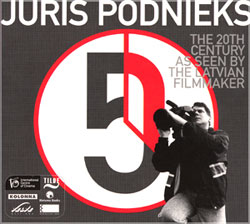
CD-ROM reminds us of Podnieks’ greatness

Juris Podnieks was one of Latvia’s best-known and most successful filmmakers. His accidental death in 1992 was a tremendous loss to Latvian film. Podnieks’ unique combination of talent, determination, skill, courage and incredible ability to motivate others to exceed their limits allowed him to create films that transcended their subject matter. His films are comparable to similar works by such notable documentary filmmakers as Errol Morris and Ken Burns.

In celebration of what would have been his 50th birthday the Latvian film forum Arsenāls put together a CD-ROM in his honor titled Juris Podnieks: The 20th Century As Seen by the Latvian Filmmaker. It is a must-have for all those with an interest in Latvian film and Latvian and Soviet history.

Podnieks and his crew were on the front lines as Latvia and many others nations emerged from the yoke of Soviet occupation. His films captured the tenor of the times and the courage and determination of a people who would not be denied. Is It Easy to be Young? played to packed movie houses all across the Soviet Union and won numerous international awards. It captured the alienation of youth and the banalities of the Soviet Union at a time when to even raise the specter of such issues still carried a great deal of risk. Homeland captured the unraveling of the Soviet Union in vivid detail while chronicling the "singing revolution" in the resurgent Baltic republics. Homeland. Postscript chronicled the nightmarish crackdown by Soviet authorities. Two of his closest friends and collaborators, cameramen Gvīdo Zvaigzne and Andris Slapiņš, were killed in Rīga during filming by OMON troops.

The CD-ROM is full of details about Podnieks the filmmaker and the person, as well as general Latvian history. However, the true standouts are the bits and pieces from Podnieks’ various films. It is impossible to watch them without being affected, both by their strength of vision, and powerful message, and by feeling a profound sense of loss at the death of the man who made them. His death at the age of 42, an age when filmmakers enter their best and most productive years, is still being felt across the Latvian film industry.

You can’t help but be affected by footage of a young man, in Is It Easy to be Young? breaking down in a court room, while a passive monotone voice reads the judgment of the court that sentences him to three years in prison for getting carried away during a rock concert. In We, a series of documentaries on the Soviet Union made by Podnieks for England’s Channel 4, the audience gets a glimpse of the incredible courage that it took to stand up to the Soviets.

In what was either an intentional or unintentional homage to the Odessa steps sequence in Sergei Eisenstein’s The Battleship Potemkin and is eerily similar to a similar event that took place in Tianamen Square years later, a woman runs into the frame and tries to stop armed soldiers from getting down an outdoor staircase to break up a protest in Armenia. In Homeland. PostScript you watch with horror the footage of both Zvaigzne and Slapiņš getting shot as Slapiņš, despite being mortally wounded, exclaims, "Keep filming!"

The only flaws of the CD-ROM are that the text, most likely written by a non-native English speaker, seems stilted and ackward at spots, and that there isn’t more footage of Podnieks’ works. It’s ironic in a way. Podnieks was known for almost never using narration in his films. He allowed the subjects to speak for themselves. It’s a shame that we couldn’t have more of his films on this CD-ROM, and in the future, to do his speaking for him.

Details

Juris Podnieks: The 20th Century As Seen by the Latvian Filmmaker

Augusts Sukuts et al.

Rīga:  International Centre for Cinema Arsenāls,  2000

Notes: Minimum requirements are a Windows 95 Pentium-based computer computer at 166 MHz, 32 MB of RAM, 2X CD-ROM, 256-color monitor with 800×600 resolution, sound card, QuickTime 3.0.
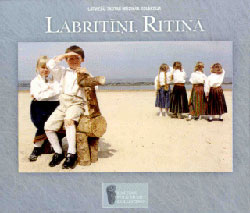
Recording helps kids live Latvian folklore

Labrītiņi, rītiņā

The best advertisement for Labrītiņi, rītiņā is our 4-year-old son. He just loves it! He’s fascinated by the songs and rhymes and the children who sing them. Right away he recognized the couple of pieces that were already in our family’s repertoire, and he has since picked up several more. In fact, when the compact disc comes to an end and I go to put in another one, he protests. Every time. Need any more reason to get this recording?

The children singing on Labrītiņi, rītiņā are plain, regular kids, aged about three to six, from a school in Jūrmala, Latvia. Actually, they are all pupils of Ilga Reizniece of the world music band Iļģi. On this recording Reizniece also provides many of the accompaniments, as well as a vocal motherly nudge here and there.

The CD doesn’t sound so much as a performance as it sounds like walking into a room of preschoolers going about their daily activities. They sing songs and tell rhymes, sometimes giggling in between: jājam, jājam mēs ar zirgu… cepu, cepu kukulīti… ar vilciņu Rīgā braucu… dop, dop Rīgā… vāru, vāru putriņu… sitam plaukstiņas… sīkas, mazas meitenītes… kur tad tu nu biji, āzīti manu?… Dievs nosvieda bumbuli zemē… etc.

Labrītiņi, rītiņā does not try to make recording artists out of young children. Just the opposite: the idea behind this project is to have the children and their performance of the songs sound as natural as possible. So, no synthesizers and drum sets. Out-of-tune notes and changes in tempo are forgiven. The shy child is helped along by the teacher. This is not the Rīga Dome Boys’ Choir or the poppy Neparastie rīdzinieki, nor does it try to compare with them.

Instead of the elaborate (and often annoying) arrangements so common on many Latvian children’s recordings, the arrangements on Labrītiņi, rītiņā are appropriately simple and unobtrusive. A kokle here, a guitar there, a quiet whistle or drum is all. The words can be understood fairly well, but all the texts are written in the liner notes so that it’s easy to follow along and learn the songs. The translations are good, with the exception of a couple of odd words. For those who do not know Latvian, the texts will probably often sound silly or senseless. But keep in mind that many of the rhymes are actually little finger or lap games with accompanying motions, kind of like "This little piggy went to market."

Reizniece stresses that folklore is inseparable from everyday life, that folklore is life. She writes: "Folklore has never been a school subject; it’s the very life of our ancestors simply given a foreign name. And if it is not lived daily, but once or twice a week for half an hour, it can remain incomprehensible and unloved." With this recording parents can help to make traditional Latvian songs and rhymes a part of their children’s—and their own—everyday lives.

Although it’s the perfect thing for young children, I honestly don’t know whether I would listen to this CD much if I had no children. That’s probably because I’m just not one of those people who finds young children irresistably cute (except my own, of course!). But, even though I’m not a "cute" person, the cuteness of several of the tracks has really grown on me.

Labrītiņi, rītiņā definitely has children’s appeal. A former Latvian school director I recently spoke to suggested that every Latvian school and family with young children ought to have this CD.

Details

Labrītiņi, rītiņā

Latviešu tautas mūzikas kolekcija

UPE Recording Co.,  2002

UPE CD 028

Where to buy

Purchase Labrītiņi, rītiņā from BalticMall.

Purchase Labrītiņi, rītiņā from BalticShop.

Note: Latvians Online receives a commission on purchases.

Survivor eulogizes Jews who died in Latvia

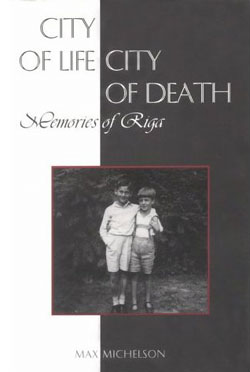
City of Life, City of Death

Max Michelson was born in 1924 into a large and loving Jewish family in Rīga. By the end of World War II most of his family and friends were dead, murdered during the Nazi occupation of Latvia. City of Life, City of Death is his eulogy to those who perished, and an account of his own rather miraculous survival.

In 1939, Jews comprised 5 percent of the population of Latvia. About half of these lived in Rīga and made up 12 percent of its population. Latvian Jews did not for the most part speak Latvian and this meant that social contact and friendships with the Latvian population were minimal. This contributed to the lack of understanding between the two groups.

The Michelsons were a talented and intellectual family. Max’s Aunt Clara was an accomplished writer who lived in Paris. His Uncle Leo was a successful painter, while his Uncle Eduard was a mechanical engineer and intellectual. The family plywood factory, run by his father, also provided an income to the artists of the family.

With the Soviet invasion of 1940, the family’s factory and home were nationalized and the Michelsons moved to a two-bedroom apartment in the suburb of Mežaparks. Then came the mass deportations of 1941, of which Jews formed a large proportion. Michelson writes that the Jews blamed Latvian Communists for the high proportion of Jews deported, while Latvians blamed the deportations on Jewish Communists. In 1941, the invading Nazis disseminated propaganda that all Latvian Jews were Communists and were responsible for the Soviet occupation and particularly the deportations.

The occupation began with a series of vicious attacks on Jews in which many were dragged from their homes and either imprisoned or murdered. These attacks were encouraged by the German Nazis but, Michelson says, were enthusiastically carried out by local Latvians—members of Pērkonkrusts (Latvian Nazis), the Aizsargi (paramilitary groups) and others. He insists on the complicity of all Latvians, stating that "the persecution of the Jews (in Latvia) was approved and accepted by the majority of the local population" and that "the willingness of Latvians to act as hired killers is well-documented." He is bitter about the lack of help offered his family by Latvians, particularly blaming his Uncle Leo’s friends in the artistic community for not coming forward.

One day Max came home to find that his mother had been taken away by the police. They had come for his father, but as he was ill Max’s mother had somehow persuaded them to take her instead. Max never saw her again. Later, when all Jews were required to move into the Rīga ghetto, Max’s father insisted on including in their meagre belongings some of his wife’s clothing. "When they took Mama away," he insisted, "she wore just a light dress. She will need her warm clothes when she comes back from prison."

On Oct. 25, 1941, the Rīga ghetto was sealed off. When it was clear that Jews in the Large Ghetto were being exterminated, Max dragged his father to the work camp, or Little Ghetto. There they found a temporary reprieve from death, but nevertheless his father disappeared one day. The majority of Max’s relatives and friends were killed during the liquidation of the ghetto, or Large Aktion as it was called.

When the tide of the war turned against the Germans, Max and other prisoners were transported by boat to Stutthof, Poland, and then by train to Polte-Werke at Magdeberg, Germany. On April 11, 1945, he and some others suddenly found their camp unguarded. They immediately left and, though their trials were not yet over, this was the beginning of their freedom.

After the liberation came the terrible news that no member of his family who had been trapped in the Nazi occupation had survived. There seemed no reason to return to Latvia: "All of Europe seemed like one vast cemetery, hardly a place in which to start a new life." Max Michelson eventually found his way to New York. He married and became an electrical engineer, settling in the Boston area.

Michelson recounts that, after the destruction of the Large Ghetto in Rīga, an old Latvian woman, a stranger, said to him: "Soon they are going to kill you all." After the fall of Germany, during Max’s first night in a Red Army Hospital, a fellow patient told him, "You will be dead by morning." Both predictions proved wrong. Max Michelson survived, "by happenstance" he says, but with unthinkable losses.

Details

City of Life, City of Death: Memories of Riga

Max Michelson

Boulder, Colo.:  University Press of Colorado,  2001

ISBN 0-87081-788-4

Where to buy

Purchase City of Life, City of Death: Memories of Riga from Amazon.com.

Note: Latvians Online receives a commission on purchases.