Story of self-discovery has simple view of Latvia

In July 1994, Bill Clinton became the first American president to visit an independent Latvia. As he spoke near the Freedom Monument, thousands of Latvians thronged to hear his words. Many more listened on radio or watched on television. Among them was Kevin, then a young midwestern American who had come to Latvia to visit his penpal. Jeff Keenan tells the story of that first visit in his book, The Main.

The following month we traveled to Latvia for the first time. The trip was hectic, requiring visit after visit to new and old relatives, excursions around Rīga and throughout Latvia to places we had only read about, and occasional jaunts to various institutions for business and research purposes. In short, we were busy.

Kevin wasn’t.

His first trip was made specifically to visit his penpal Māra and her family. The Main describes his two weeks with the family and his growing need to “find himself.”

Kevin comes across naive—and I’m trying to use that word objectively, without attaching to it the negativity that we often do. Here he is, a young man of 25 from northeast Iowa who is making his first voyage beyond the Midwest. Even before he’s out of the country, he is apprehensive and amazed by New York, where he has to change planes and airports.

I went to Latvia for the first time with baggage. Besides the overstuffed suitcase, there were three decades of accumulated history, family lore and black-and-white photographs etched in memory. I don’t think I went with a romanticized vision of what Latvia might be like, but I’m sure that what I saw was quite different from what Kevin did.

Kevin, without that baggage, also doesn’t find a romanticized—or even a romantic—Latvia. What he does find is simplicity, so much so that at times it begins to grate the reader: The home in Rīga where he stays is simple. The meals are simple. The people are simple.

But sprinkled through the book are hints that things are not so simple in Latvia:

Amazed by the simplicity he was experiencing, he questioned Mara about her everyday life.

“Everything seems very peaceful here in Latvia,” he said. “Is life always this simple?”

Māra explains about the lack of heat in her family’s apartment, about the loneliness and depression that some people experience. Still, Kevin continues to see Latvia as a peaceful and simple place. Perhaps it is, but The Main begs for Kevin to dig a bit deeper, to seek what the country and the people are really like. He has several opportunities to do so, but is reluctant to ask questions when they may reveal much to him.

At one point in this short book of 110 pages, Kevin puts aside a travel guide, realizing that it provided inadequate preparation for the Latvia he finds. It’s a telling moment, one that shows the effect of being placed in a different culture, even if for a while. Nothing you read is like the real thing.

Keenan’s book about a journey of self-discovery allows us to see Latvia through fresh eyes. I only wish he had looked a bit harder.

Details

The Main

Jeff Keenan

Minneapolis:  Peace River Publishing,  2001

ISBN 1930209002

Andris Straumanis is a special correspondent for and a co-founder of Latvians Online. From 2000–2012 he was editor of the website.

Compilation captures the nineties

The nineties saw a tremendous musical output in Latvia. Free of the oppressive Soviet system and rules, artists and groups were free to play whatever they wanted to and sing whatever lyrics they wanted to. To celebrate this memorable decade, Mikrofona ieraksti has released a compilation of the most popular songs of these years, Desmitgades top dziesmas.

The compact disc as an impressive list of artists, including Līvi, Pērkons, Jauns mēness and even Raimonds Pauls, not to mention a number of others.

Now, if you are like me, you most likely already had most of these songs anyway, but there are a few I had not heard before. Also, it is very convenient to have all these great songs on one CD, providing a great introduction for those who are not as familiar with Latvian music.

Jauns mēness has two songs on the album, the early hits “Piekūns skrien debesīs” and “Kad mēness jūrā krīt” (which is probably my favorite Jauns mēness song of all time). It also shows how Jauns mēness could easily move between a melodic song like “Piekīns” and a hard-driving song like “Mēness.”

Jumprava is represented by its quirky hit “Peldētājs.” Upon first listen of this song many years ago, I could not believe that this could have been a hit, but hearing it now reminds me of its individuality.

One thing that left me a bit confused is that the band Pērkons is represented by the song “Gandrīz tautas dziesma.” Not that I doubt the greatness of this song, but in the liner notes, it is listed as being from 1992 when it originally was released in 1987. I surely will not argue with its inclusion here; it is truly one of the great Latvian rock songs.

Another Latvian folk-rock institution is Bet Bet. The band also get two songs on this collection: “Vakara vējā” and “Kapēc man nav sarkans mersedes.” The former is also one of my favorites, due to the beautiful lyrics and guitar melody that opens the song.

Though most of the songs on the CD are in rock style, pop and dance also put in appearances. The sentimental ballad “Kad man vairs nebūs 16,” performed by Olga and Bāze-7, is a song I had not heard before. I guess it is likeable in its own way, but perhaps a bit heavy on the syrup. Latvian dance duo 100. debija is represented with its version of the Jumprava classic “Vēlreiz.” I think that this is a very excellent reworking of the song. Also included is the slick 2000 hit “Baltā dziesma” by Raimonds Pauls, performed by Gunārs Kalniņš and Kristena. This song is very well produced, but is surely not for me—I skip it every time I listen to the album!

Hard rock fans will also rejoice, since hard rock stalwarts Linga and Līvi are included as well. Linga’s song “Spēle” (which took a few listens before I began to appreciate it) is a great heavy song, with a very catchy chorus. Līvi is represented by the big hit “Piedod man” (again with a simple but memorable chorus) and the appropriately titled “2001.”

Satirists and irreverent commentators Labvēligais tips also get two songs. These are “Alumūnijas cūka” (the original version, not the one from the band’s “best of” collection), and the tale of an out-of-control bus, “Omnibuss” (which has the last minute hacked off, probably due to time constraints).

No Latvian compilation would be complete without the music of Imants Kalniņš. The group Menuets performs “Alvas zaldātiņi” and Jauns mēness performs the hauntingly beautiful “Es redzēju sapnī,” highlighted by the textured keyboard part.

Veteran Latvian singer Igo also gets a song on this collection, “Bet dzīvē viss ir savadāk,” once again showing why he is remains one of the most popular singers.

And, of course, who could forget the biggest Latvian rock band at this time, Prāta Vētra? The band’s megahits “Tavas majas manā azotē” (probably my favorite Prāta Vētra song) and “Brīvdienas nav manas laimīgās dienas” add to the already bright star power of this record.

The liner notes on this record stink, however. You would figure that besides having the music of the 1990s, maybe MICREC could have had some commentary from some of the bands, giving their opinion of the decade. But what we get is two pages of advertisements for gasoline and hardware, among other things. I suppose I can’t complain too much, since it was these companies that made this record possible.

Summarizing all of the 1990s on one CD is an impossible task. However, this collection does an admirable job. Listeners could argue for hours on end about what should have been here, what should not have been here and so on, but if you are looking for a great introduction to Latvian music, look no further.

Details

Desmitgades top dziesmas

Various artists

MICREC,  2001

Egils Kaljo is an American-born Latvian from the New York area . Kaljo began listening to Latvian music as soon as he was able to put a record on a record player, and still has old Bellacord 78 rpm records lying around somewhere.

Two films about real people in extraordinary times

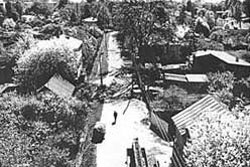
A bird’s-eye view of Crossroad Street opens the original documentary, Šķērsiela.

The best fiction films are the ones that manage to capture some element of real life. It doesn’t matter if they are set in a galaxy far, far away or taken straight from today’s headlines. They feel real no matter how contrived.

The best documentary films work in reverse. They take real life and give it scale and resonance that makes one forget that what we are watching is the mundane and common. They take things and events in life that most of us don’t pay too much attention to or take for granted and elevate them to epic status.

Ivars Seleckis’ documentaries Šķērsiela (Crossroad Street) and Jaunie laiki Šķērsielā (New Times at Crossroad Street) accomplish this with such effortless ease that one forgets that these are documentaries. They feel real and surreal at the same time. Both films take place in a small street in the Pārdaugava section of Rīga. The first was filmed in 1988 and the second a decade later in 1999.

The first film slowly introduces us to the residents of Crossroad Street.

There’s Julis the cab driver and his arch-enemy and neighbor, Aldis, a stone mason and part-time preacher, who has set up a what seems to be a major monument-making factory in his backyard. It’s a noisy undertaking and a constant source of irritation to straight-laced Julis.

There’s poor Daiga, pregnant and abandoned by her lover. She lives as an unregistered guest of her cousin in the same house as Julis, his wife and his daughter. She fears that any moment she will be kicked out into the street. The house itself was built by and belonged to her grandfather, a famous Latvian writer, during Latvia’s independence. It has been turned into communal housing by the Soviets. Daiga is now nothing more than a squatter.

There’s Osis, feeble-minded but gentle, who lives with his 80-year-old mother. There’s Tolik, the son of a Latvian mother who was deported to Siberia and a German father whom she met and fell in love with there. He speaks only Russian and can barely move because of an untreated childhood disease he contracted in Siberia. There’s Pēteris and Olga, a bickering but loving, easy-going old couple who grind horseradish in their backyard for sale in the market. There’s even a glimpse of the mysterious Casino Plūmiņš tooling around in his žigulis.

There are many more, but they all present a cross-section of Latvia and, as the title suggests, find themselves at the crossroads as a dying empire takes its last gasps. Their lives are filled with chaos and pathos. Aldis, the stone mason preacher, keeps mouthing homilies about the spiritual life while in constant pursuit of earthly rewards. Julis finds himself lost in this new chaotic world, not nostalgic for the past, but resentful at having to live in a world in which a taxi driver no longer has the same status as his enterprising stonemason neighbor. Then there is poor Daiga who, despite it all, keeps smiling through the tears.

Jaunie laiki Šķērsielā revisits the neighborhood 10 years later. Nothing is the same and at the same time it all seems strangely familiar.

Daiga, the helpless young woman, is now a mother with a 10-year-old son. The house from which she was kicked out is now entirely hers and she is busy making it into her little safe haven. She has a job and a man and a healthy and happy son. She is strong and vibrant and in full control of her life.

Aldis is still as devout as ever, if not more so, but his business has fallen on hard times. Racketeers have burned down his modern workshop and he now has to fight for control over his property with Gaļina, his father’s second wife. Daiga has just turned off his water, water which he has been poaching off her pipes for his workshop all of those years.

Pēteris and Olga are still making horseradish in the back yard and bickering in loving fashion. And Casino Plūmiņš is now tooling around in a brand new Mercedes and living in a house right out of the pages of Architecture Digest with his beautiful artist wife.

A lot of old shacks on Crossroad Street are being torn down or remodeled and rebuilt. There is also a huge new addition to Crossroad Street: a mansion built by a mysterious and wealthy Gypsy. Side by side we see modest, well-kept family homes with tidy gardens and run-down buildings with junk-filled yards. Times have changed mostly for the better, but in some ways for the worse. Latvia is independent and people have freedom to take control of their lives. But there is still chaos and uncertainty. People are rebuilding, but the first thing everyone seems to put around their property is a sturdy fence.

An abandoned freight train rests on the nearby railroad tracks. Everyone has to duck and walk under it if they want to get to the store. Osis now receives his disability pension in lats and not rubles, but it is still barely enough to get by and perhaps even less than it was before. Tolik’s health has taken a turn for the worse. And Casino Plūmiņš, despite all of his wealth, seems sad and lost and hungry for something that he just can’t reach.

The magic of Šķērsiela and Jaunie laiki Šķērsielā is that they allow us an entry into these peoples’ lives. It’s an honest look that neither glamorizes nor minimizes real life—real life as lived by real people in extraordinary times.

Details

Šķērsiela & Jaunie laiki Šķērsielā

Ivars Seleckis, director

European Documentary Film Symposiums,  1988 and 1999

Notes: Šķērsiela: Documentary, black-and-white, 85 minutes. In Latvian. Script: Tālivaldis Margēvičs; camera: Ivars Seleckis; music: Ivars Vīgners. Jaunie laiki Šķērsielā: Documentary, color, 85 minutes. In Latvian. Script: Tālivaldis Margēvičs; director of photography: Ivars Seleckis; editing director: Maija Selecka; music: Ivars Vīgners; producer: Leonīds Bērziņš.