For Paul, who wanted to learn Latvian

Talk Now! Learn Latvian

When I got a hold of the CD-ROM Talk Now! Learn Latvian, my first response was “It’s about time!”, followed by “How come it took so long?”

If you know someone who has ever had even the slightest urge to learn Latvian, you’ll understand why.

My brother-in-law Paul is first on my list. He struggled through a Latvian language course and finally gave up because, well, naming the planets was not exactly what he needed to make dinner conversation.

We all wanted to help him, but you have to admit teaching a language takes more than desire. And even though Toronto has the largest Latvian population outside Latvia (and hence the largest number of non-Latvian speaking community members), Latvian-as-a-second-language courses are few and far between. (The exception is the “Mēs mācamies latviski” stream for children at the Latvian school Valodiņa for three hours a week).

Talk Now! is a straightforward language learning program that teaches “essential words and phrases for absolute beginners.” What a perfect solution for anyone who wants to learn basic Latvian—and not even have to leave the comfort of their own home to do so.

The program is built on the same template that’s used to teach 80 other languages, and which allows speakers of 80 other languages to learn Latvian. This means that all spoken words, with the exception of the introductory remarks, are in Latvian. In fact, a more appropriate title for the program would be Learn Latvian in Latvian, which is not as intimidating as it sounds, because the teaching is all done through images and the spoken word. A colour print picture dictionary is available for off-screen practice.

Because the program is template-based, it also means the words taught are all globally usable, as determined by the program’s U.K.-based creators, EuroTalk Interactive Ltd. Hence you won’t learn anything uniquely Latvian, such as “pīrags” or “tēvzeme,” but you’ll know how to identify a necktie and chopsticks. And for those griping about the lack of uniquely Latvian aspects, be forewarned that because Latvian is one of the later titles to be added to the Talk Now! series, Latvia is even missing from the lineup of national flags.

After logging in, choose one of nine areas to explore. To make it more fun, and not bring back flashbacks of boring class time, Talk Now! is set up like a game, where your goal is to score 1,800 points. Each area includes word and speaking practice, as well as both easy and hard games. The language areas include First Words, Food, Colours, Phrases, Body, Numbers, Time, Shopping and Countries.

One of the most impressive things about this multimedia product is that it seeks to avoid repetition by teaching language in more than one way. In the Body game, for example, two skulls iterate body parts. Click on an identified part and assemble a Frankenstein looking cadaver that comes to life when you’re finished. In the Food game, click on the right food and it pops into a shelf.

Because of this and the various levels within each section, users will find themselves making a mental list of all the people Talk Now! might appeal to. My four-and-a-half year old gets a kick out of the Colour section where clicking on the right colour alters black-and-white images. My two-and-a-half year old, who is working on basic language concepts, loves clicking on the right item in Shopping just to hear the male speaker belt out a resounding “jā!” (although his abrupt “nē!” is just as inspiring).

But most of all, Talk Now! gets me thinking about all the people this program could really benefit: Norm, Judy, Katherine, Joe, Anne, Dainis… Perhaps a Latvian organization could purchase a zillion copies and ship one to every non-speaker who wants or needs it, before they’ve totally given up on Latvian?

One section that can be a bit problematic—even for fluent speakers—is Phrases, because this relies on students matching up spoken sentences with crudely drawn images. Even I had problems figuring out which picture referred to “Es vēlos vietu pie loga, lēdzu!”

Latvian speakers who will want to have some fun and brush up on their Latvian will find the game occasionally has trouble keeping up if they move along too quickly. They’ll also be irritated by occasional errors (for example, in Latvian plums and bananas are only recognized in the plural form), and what’s with the voice confusing times of day in the opening sequence?

Overall, however, Talk Now! Learn Latvian is an excellent way to start learning Latvian. Now, if only Paul still has the desire to give it one more try…

Details

Talk Now! Learn Latvian

EuroTalk Interactive

London:  EuroTalk Interactive Ltd.,  2000

Notes: Minimum requirements are Windows 95/98/NT/2000 or Macintosh OS 7 or above, a color monitor, CD-ROM drive and a microphone (recommended).
Mara Gulens is an editor and writer based in Toronto.

Compilation offers taste of music in 2001

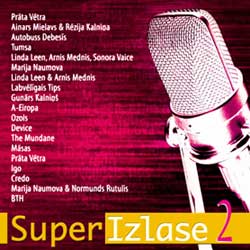
For Latvian popular music, 2001 was another memorable year. Old faces returned (such as Prāta Vētra, Credo and Labvēligais Tips), new faces emerged (for example, The Mundane and Māsas). Autobuss debesīs released their first record, rap music continued to develop in Latvia, and dance music became more diverse. Where should the uneducated listener start? Now that broadcasters such Radio SWH and Latvijas Radio 2 are available on the Internet, a listener anywhere in the world can hear the newest sounds in Latvian music. That, or they could purchase the latest summary of Latvian music, the second installment of the SuperIzlase series, SuperIzlase 2.

As they did in 2000, the record companies of Latvia came together with a common goal: to sell more records. How better to do this than with a compilation of all the hits of 2001 on one compact disc? Participants in the 19-track SuperIzlase 2 include MICREC, UPE Recording Co., Baltic Records Group, Platforma Records and Rīga Records.

As always with these kinds of compilations, you get a widely divergent group of songs. It is doubtful that there will be one listener who likes all the tracks, but ideally all listeners should like at least one. Though there are many performers who are alumni of the first SuperIzlase release, about 10 see their first appearance in the series.

Rock fans should have their appetite sated with this collection, as there is plenty on here that could appeal to them. Even if you are like me and had already heard (and bought) most of the rock releases that are represented on here, there is still a good chance that there will be something new on here for you.

Prāta Vētra (BrainStorm) contributes two tracks from their 2001 release, Kaķēns, kurš atteicās no jūras skolas. There is the English-language “Maybe” (oftentimes the English language tracks make me cringe, but this I like). There is also the “acoustic version” of their song “Visskumjākā parāde uz mūsu ielas,” which is different than the version on the album. What’s nice about this version is that it is played on guitar, an instrument not heard often on Kaķēns.

Other rock releases include two songs with music by Imants Kalniņš: a duet betwen Ainars Mielavs and Rēzija Kalniņa, “Apturi mani,” and the Autobuss debesīs song “Ir tikai tveice.” From Tumsa’s latest release, we get the song “Lai būtu tā” (probably the most “listener-friendly” song from their latest album). Labvēlīgais tips’ lyrics continue to become even stranger. The group is represented by the song “Koka klucis Konstantīns”—guaranteed to cause puzzled faces on listeners everywhere. Credo also provide their most “accessible” track, “Tur aiz mākoņiem ir saule,” from their latest album.

Because these kinds of compilations are usually geared towards younger listeners, there is plenty of pop and dance and other such things. Latvian Eurovision representative Marija Naumova appears on two tracks. The first is “Hey Boy, Follow Me,” a catchy, somewhat Latin-sounding song. The secong is a duet with Normunds Rutulis, “Kūko, kūko dzeguzīte,” which strikes me as being a song for the particularly young listener. “Kūko” also features the music of Raimonds Pauls.

Latvia’s own Mariah Carey, Linda Leen, appears on two duets with Arnis “Spaceman” Mednis. The first is “Noktirne,” the music for which I was very surprised to find out was not written by Raimonds Pauls, although it sounds very much like him. Famous Latvian soprano Sonora Vaice also adds some vocal melodies to “Noktirne.” Leen and Mednis ditch Vaice for their next song, the super-slick ballad, “Not to Fall Again.”

Heartthrob Gunārs Kalniņš’ entry for this album is the song, “Pērles un dimanti,” another super-slick pop song that should keep his legions of pre-teen female fans happy.

Dance group A-Eiropa perform the song “Meitenes Rīgā,” while Igo also submits a super-poppy song, “Ir labi kopā būt,” that sounds more like it belongs in the 1970s than the 21st century. Another favorite of the younger crowd is Latvian rapper Ozols, who performs “Bokss.” Also in the rap vein is the song “Rītdiena” by the group Device. BTH, formerly known as Braithouse, also provides a dance song, “Last Christmas.”

One reason anyone buys these kinds of collections is to find out if there is anything new that they had not heard before. In my case, though I had already heard most of the music that I would have liked, there were a couple of things that got my interest. I had not heard of the rock group The Mundane, but I really liked their song “Nav viegli būt tev.” I also like the more poppy group Māsas and their song “Dāvā laimi.” I will have to investigate these groups more on my next sojourn to Latvia.

The liner notes are pretty sparse. Last year they at least had pictures of the groups, but not this year. Also I think it would help in marketing to name the album from which the track was taken and to include any Web sites for the bands or the record labels.

How times have changed since the days of Soviet-style elections even in the music world, when you had the choice of Raimonds Pauls, or… well… Single party systems are a bit of a drag, aren’t they? It is still amazing how varied the Latvian music world has become and what selection a listener has, be they old, young or just very fussy. For a quick overview of where Latvian music stands today check out SuperIzlase 2. It may lead you to discover much of the great music and the great bands in Latvia today.

Details

SuperIzlase 2

Various artists

MICREC,  2001

Egils Kaljo is an American-born Latvian from the New York area . Kaljo began listening to Latvian music as soon as he was able to put a record on a record player, and still has old Bellacord 78 rpm records lying around somewhere.

Put on your pastalas and get in the game

I first read about this compact disc, released in December 2001, on one of my many virtual journeys on the Web. I was quite excited as I know there is not much out there in the way of recordings of Latvian “dancing games” (or rotaļas as they’re called in Latvian) and made a mental note that I must get a copy of Latviešu rotaļas as soon as I can.

The album is the second by Maskačkas spēlmaņi, a Rīga-based folklore group formed in 1995 and led by Ansis Ataols Bērziņš. It includes 27 songs chosen from the book, Latviešu rotaļas un rotaļdejas by Harijs Sūna.

Ever since I’ve had children (they’re six and three years old now) and started teaching Latvian folklore at the local Saturday school, I’ve been scouring the Web (and music stores when I was in Latvia) for music to play to my kids and resources that will help me with lesson preparation. In recent years there have only been a few CDs released that tackle this subject: Latviešu danči and Danco Dievis, both produced by UPE Recording Co. as part of the Latvian Folk Music Collection, and Rotaļas un danči, recorded by Skandinieki.

I feel this part of Latvian traditional folklore is extremely important as it is the introduction to Latvian folk dancing for the very young. In my classes the kids love it when I say, “Iesim rotaļās!” (Let’s play a game!). They, I’m sure, presume that while we’re doing rotaļas, they’re not really learning anything. I know better: The more rotaļas I can get into their memories, the better.

These supposedly simple games are most certainly not only for the young. Rotaļas were danced for centuries at family celebrations not only by children but by everyone who had the strength to get up and move to the music. The dance steps are easy to learn and the beat of many of the dances is merely a gentle shuffle, a far cry from the polka-jumping and intricate maneuvers required for the folk dances that you see on stage at Dziesmu svētki or other more formal occasions.

In Latvia, you’ll even find venues both in Rīga and Daugavpils devoted to just that: simple dances that may be only a tad more difficult than the basic rotaļas you learnt as a child. Rīgas Danču klubs and Laimas Muzykantu danču krodziņš both open their doors to anyone who is interested in dancing these basic steps, which at the same time are ancient and therefore culturally and historically meaningful. Ilga Reizniece of post-folk group Iļģi fame is also very devoted to the passing down of these traditional dances. At the two 3×3 cultural camps I have attended (one in Melbourne, Australia, and the other in Rucava, Latvia), she had everyone who was interested learning these simple dances in a few minutes.

Latviešu rotaļas will certainly further this very worthy cause. First, I am very pleased that the text is both in English and Latvian (therefore available to a wider audience) and the quality of the English doesn’t make you cringe. Second, and more important to me for lesson preparation, are the clear and concise explanations of the steps of each rotaļa. I had already consulted quite a few folklore books, which had explanations of the steps to many dancing games with accompanying musical notes, but for a musically challenged person such as me (I never learnt an instrument) they were of little use.

Maskačkas spēlmaņi definitely show musical talent and, more importantly, they seem to possess the “oomph” required to make people want to join in and dance along with the others. I highly recommend this CD to anyone who is interested in traditional Latvian culture be it at home, in a classroom situation or some other group setting.

So slip on your pastalas, put the CD on and learn some new rotaļas. And don’t forget to include the younger generation. Your children or grandchildren will be so pleased with your interpretation of spending quality time with them!

Details

Latviešu rotaļas

Maskačkas spēlmaņi

Rīgas skaņu ierakstu studija,  2001

RS 036

Daina Gross is editor of Latvians Online. An Australian-Latvian she is also a migration researcher at the University of Latvia, PhD from the University of Sussex, formerly a member of the board of the World Federation of Free Latvians, author and translator/ editor/ proofreader from Latvian into English of an eclectic mix of publications of different genres.