Put on your pastalas and get in the game

I first read about this compact disc, released in December 2001, on one of my many virtual journeys on the Web. I was quite excited as I know there is not much out there in the way of recordings of Latvian “dancing games” (or rotaļas as they’re called in Latvian) and made a mental note that I must get a copy of Latviešu rotaļas as soon as I can.

The album is the second by Maskačkas spēlmaņi, a Rīga-based folklore group formed in 1995 and led by Ansis Ataols Bērziņš. It includes 27 songs chosen from the book, Latviešu rotaļas un rotaļdejas by Harijs Sūna.

Ever since I’ve had children (they’re six and three years old now) and started teaching Latvian folklore at the local Saturday school, I’ve been scouring the Web (and music stores when I was in Latvia) for music to play to my kids and resources that will help me with lesson preparation. In recent years there have only been a few CDs released that tackle this subject: Latviešu danči and Danco Dievis, both produced by UPE Recording Co. as part of the Latvian Folk Music Collection, and Rotaļas un danči, recorded by Skandinieki.

I feel this part of Latvian traditional folklore is extremely important as it is the introduction to Latvian folk dancing for the very young. In my classes the kids love it when I say, “Iesim rotaļās!” (Let’s play a game!). They, I’m sure, presume that while we’re doing rotaļas, they’re not really learning anything. I know better: The more rotaļas I can get into their memories, the better.

These supposedly simple games are most certainly not only for the young. Rotaļas were danced for centuries at family celebrations not only by children but by everyone who had the strength to get up and move to the music. The dance steps are easy to learn and the beat of many of the dances is merely a gentle shuffle, a far cry from the polka-jumping and intricate maneuvers required for the folk dances that you see on stage at Dziesmu svētki or other more formal occasions.

In Latvia, you’ll even find venues both in Rīga and Daugavpils devoted to just that: simple dances that may be only a tad more difficult than the basic rotaļas you learnt as a child. Rīgas Danču klubs and Laimas Muzykantu danču krodziņš both open their doors to anyone who is interested in dancing these basic steps, which at the same time are ancient and therefore culturally and historically meaningful. Ilga Reizniece of post-folk group Iļģi fame is also very devoted to the passing down of these traditional dances. At the two 3×3 cultural camps I have attended (one in Melbourne, Australia, and the other in Rucava, Latvia), she had everyone who was interested learning these simple dances in a few minutes.

Latviešu rotaļas will certainly further this very worthy cause. First, I am very pleased that the text is both in English and Latvian (therefore available to a wider audience) and the quality of the English doesn’t make you cringe. Second, and more important to me for lesson preparation, are the clear and concise explanations of the steps of each rotaļa. I had already consulted quite a few folklore books, which had explanations of the steps to many dancing games with accompanying musical notes, but for a musically challenged person such as me (I never learnt an instrument) they were of little use.

Maskačkas spēlmaņi definitely show musical talent and, more importantly, they seem to possess the “oomph” required to make people want to join in and dance along with the others. I highly recommend this CD to anyone who is interested in traditional Latvian culture be it at home, in a classroom situation or some other group setting.

So slip on your pastalas, put the CD on and learn some new rotaļas. And don’t forget to include the younger generation. Your children or grandchildren will be so pleased with your interpretation of spending quality time with them!

Details

Latviešu rotaļas

Maskačkas spēlmaņi

Rīgas skaņu ierakstu studija,  2001

RS 036

Daina Gross is editor of Latvians Online. An Australian-Latvian she is also a migration researcher at the University of Latvia, PhD from the University of Sussex, formerly a member of the board of the World Federation of Free Latvians, author and translator/ editor/ proofreader from Latvian into English of an eclectic mix of publications of different genres.

Album explores treasures of Latvian classical music

The world of Latvian classical music contains many treasures that are unfortunately known only to Latvians. Hoping to rectify this situation, in 2000 UPE Recording Co. released the album Latvian Millennium Classics. This was a collection of some of the best-known works in Latvian classical music, designed as an introduction to those—like me—less schooled in the genre. Realizing that just one collection could not possibly be enough, UPE released another, Latviešu klasikas dārgumi, in 2001.

This release again collects a number of well-known works by Latvian composers onto one compact disc. The major difference this time is that all the works on the record are performed by the Liepāja Symphony Orchestra, conducted by Imants Resnis. Latvian Millennium Classics had many different performance types (orchestral, solo instruments, choir), while all the tracks on this CD are orchestral.

Though there is quite a good deal of overlap between the two discs, having all the pieces performed by the same orchestra adds a flow and continuity to Latviešu klasikas dārgumi that was not present on the earlier record. The LSO is held in high regard in not just Latvia, but the rest of the world as well. This CD is a testament to that fact. The orchestra is able to bring out the best in just about any piece it plays, and is especially capable of doing tremendous justice to the works of Latvian composers.

The album starts off with two pieces by Andrejs Jurjāns, “Ačikops” and “Barkarola.” “Ačikops” is from the “Latvian Dances Suite” and is a tribute to Latvian folk dances in style and melody. One can almost imagine the folk dancers dancing around in circles and clapping along when listening to this piece. Just as on Latvian Millenium Classics, “Barkarola” features the beautiful french horn of Arvīds Klišāns.

No symphonic anthology would be complete without one of the most famous pieces of Latvian classical music, “Melanholiskais valsis” by Emīls Dārziņš. The melody is at once simple, beautiful and memorable.

Jānis Mediņš also gets two pieces on the album, “Ārija” and “Ziedu valsis” from the ballet “Mīlas uzvara,” an excellent sample from this prolific composer’s output. Mediņš had one of the richest portfolios of compositions, and these two pieces show why the Latvian people held him in such high regard.

The somber piece “Rudens” by Alfrēds Kalniņš is another highlight. The composition was completed in 1941, and, intentional or not, its dark melody foreshadowed the difficult times ahead for the Latvian people.

With Latvian Millenium Classics, I lamented the fact that two of my favorite Latvian composers, Jānis Ivanovs and Imants Kalniņš, were not included. I was very pleased to find that both composers were represented on this release. Their absence on the earlier release is more than made up for here, as the beauty of Ivanovs’ compositions are displayed in two pieces: in the second movement of his “Cello Concerto” and in fragments of the music from the film Salna pavasarī. The “Cello Concerto” features Agnese Rugēvica on cello. She is able to bring out the sublime beauty of the piece. Ivanovs’ “Cello Concerto” is one of my favorite pieces of Latvian classical music, and this performance of it only reinforces my belief.

Imants Kalniņš is represented by the second movement of his “4th Symphony,” one of the most popular symphonies written by a Latvian composer. Its unique blend of all kinds of styles has ensured this symphony a permanent place in the annals of Latvian music. Even though this symphony was written 30 years ago, it still sounds fresh, thanks to the skill of the Liepāja orchestra. It alternates between the playful and the aggressive, and the merging of these two styles is what makes this piece so dear to so many listeners.

Jānis Mediņš’ brother Jēkabs also gets a track here with his work “Leģenda.” This is another dark and sad piece, and it sounds almost mystical to me, as if it was trying to recall many an ancient Latvian folk legend with its music.

World-reknowned Latvian composer Pēteris Vasks’ talent is displayed by the inclusion of the “Cantabile for String Orchestra.” As the liner notes indicate, Vasks’ focus is more on human emotion, rather than on events or the current time. The liner notes also say that the “Cantabile” has to do with the expression of joy, but it sounds rather bleak to me! That is no matter, as Vasks is at his best when he is documenting deep sadness and pain, which few other composers can do as well.

Finishing off the album is one section of the longer suite “Kāzu dziesma” by Romualds Kalsons. Kalsons, along with Vasks and Imants Kalniņš, make up what are called the “new voices” of Latvian classical music, each with their own unique style and interpretation. Kalsons’ piece is one of celebration, and it is a fitting end to this celebration of Latvian classical music.

I particularly wanted to commend UPE for the liner notes (in Latvian and English) that accompany this album. They provide much more in-depth documentation about each of the composers and their works, as well as the Liepāja Symphony Orchestra. This is far better than the rather anemic notes provided with the Latvian Millennium Classics release.

Through almost 70 minutes of music, the Liepāja Symphony Orchestra traces the growth and evolution of Latvian classical music, through some of the best-known composers and their best-known works. This is a task of rather epic proportions, because there have been so many styles through the last 100-plus years of music in Latvia, and it is a difficult job for one orchestra to do it all justice. However, the LSO is well up to the task and the results are admirable. Latviešu klasikas dārgumi pays homage to all the great music that has already come, and leaves the listener in eager anticipation of what the next century of Latvian music might bring.

Details

Latviešu klasikas dārgumi

Liepājas simfoniskais orķestris

UPE Recording Co.,  2001

UC003

Egils Kaljo is an American-born Latvian from the New York area . Kaljo began listening to Latvian music as soon as he was able to put a record on a record player, and still has old Bellacord 78 rpm records lying around somewhere.

Predictable story of rebel youth, made in Rīga

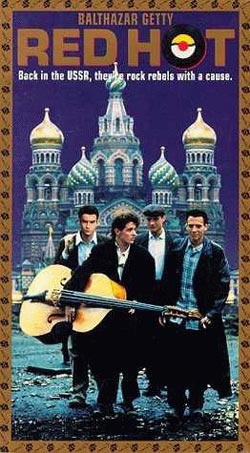
Red Hot

With Elvis Presley’s “All Shook Up” blaring, the camera swept across the surface of the Daugava River and, panning left, revealed the skyline of Rīga’s Old Town. Oh my, I said to myself, to actually see Rī;ga in a Hollywood movie! This was a treat. Too bad the rest of Red Hot wasn’t, well, so hot.

Red Hot was director Paul Haggis’ 1993 take on a fairly familiar story line: teenagers buck authority to do what teenagers want to do. In this case, the setting was Soviet Latvia in 1959. A group of music students discover the forbidden fruit of American rock ‘n’ roll. But the film, as the videotape sleeve suggests, could just as well have been Footloose or The Commitments. In other words, if you’ve seen one, you’ve seen them all.

Red Hot begins when a few 45 rpm records are smuggled into the country by Uncle Dmitri (Armin Mueller-Stahl), a seaman. He gives the records to his nephew, Alexi Fradis (Balthazar Getty). The records are ingeniously copied and the music spreads. Before long a quartet of students decides to turn a deserted industrial building into a rehearsal studio. Complicating the story are Alexi’s humble roots and his evolving love affair with Valentina Kirov (Carla Gugino), the privileged daughter of a highly placed but jaded KGB colonel (Donald Sutherland). It’s all just kid stuff until an overambitious KGB underling decides cracking a case of musical anti-Soviet propaganda might lead to his rise in power.

Admittedly, it is interesting to see acted out what scholars of culture in the Soviet era have noted: Western rock music seeped into the U.S.S.R. and was copied onto various media, including X-ray negatives. But beyond that the story is predicatable, the characters are wanting and the historical realism is skin deep.

Although the movie was filmed in Rīga (a number of scenes, such as one apparently filmed inside the National Library of Latvia or of the Dome Church, will bring nods of recognition), there is little that is Latvian about Red Hot. The characters are almost all Russians, although it appears the cast and crew counted few ethnic Russians among them. And about the only Latvians you’ll see are the back-bench actors who portray some of the students, jail guards and so forth. In one brief moment, the camera pans past a group of young musicians practicing the tune to “Tūdaliņ, tagadiņ.”

Careful viewers may catch an anachronistic glimpse of the radio and television tower on Zaķusala, visible as Alexi bicycles across the Daugava. Construction on the tower didn’t begin until 1979, two decades after the Red Hot story supposedly took place.

Still, the film no doubt provided a needed infusion of money and inspiration for local talent when Hollywood came to Rīga. For example, readers of the credits will notice that former émigré and now successful Rīga restaurateur Mārtiņš Ritiņš did the catering. Too bad the story is formulaic.

One odd thing about Red Hot has been its almost Soviet-style way of disappearing from filmographies and video stores. A search of the Web found only cursory information about the movie (one incorrectly categorizing this as a comedy), while few online stores seem to carry the film (one claimed the price was USD 93.65). This might suggest Red Hot is a “sleeper.” It’s not.

Details

Red Hot

Paul Haggis

Columbia Tristar,  1993

Notes: In English. Drama, color, 95 minutes. Principal cast: Balthazar Getty, Carla Gugino, Armin Mueller-Stahl, Jan Niklas, Hugh O’Conor and Donald Sutherland; music: Peter Breiner; costumes: Judith England; editor: Nick Rotundo; director of photography: Vernon Layton; screenplay: Paul Haggis and Michael Maurer.

Andris Straumanis is a special correspondent for and a co-founder of Latvians Online. From 2000–2012 he was editor of the website.