Australia: Where ‘Midsummer’ is cold and dark

It gets dark at 5 p.m. these days in Melbourne. Every morning the chill in the air is more and more noticeable. You can see your breath billow out in front of you when you go outside before the sun has started to warm the land. Even though most of the European trees have now shed all their leaves the Australian natives are still green as always.

Although it feels cold (no, never as cold as in Latvia or North America; the temperature rarely drops below -5C), by looking at the countryside you wouldn’t know that it is midwinter because the bush as well as the towns and cities are still primarily green. That’s except for the Australian Alps where the gum-trees will soon have a white cover (yes, it does actually snow in Australia).

To Latvians living in Melbourne this only means winter is well and truly here and that it’s time to start getting ready for the annual Jāņi celebrations as they have for the past 50-odd years.

It’s not that easy to go out in the meadow to pick fresh summer wildflowers to make your vainags (flower garland), like you would in Latvia. Some of the native bottle-brushes, grevilleas and gum trees are still in flower, though, but most Latvians still prefer to make their vainagi from more traditional European flowers. That’s why most of us would head to the nearest florist’s for our vainagi ingredients.

The men, if they’re lucky, can have their traditional oak leaf vainagi, as some of the oak trees, surprisingly enough, still have their leaves.

Some adventurous Latvians have been known to make their vainagi from eucalyptus leaves. The traditional decorating of the premises for Jāņi has often been done with branches from the gum tree branches instead of the birch, the customary Latvian pušķošanas plant.

This brings us to the celebrations themselves. If they’re happening out in the bush (as they do annually at the Latvian scout and guide camp premises “Tērvete” near Kilmore, an hour’s drive north of Melbourne) then Jāņu svinēšana is usually begun at about lunchtime, so that the bulk of the celebrating can be done during daylight hours. As it gets dark at 5 p.m. the remainder of this fun night has to be continued in darkness. The bonfire takes on a whole new meaning. It is a source of light as well as warmth for the revellers or Jāņu bērni. Everyone rugs up in a couple of layers of clothing for this celebration that takes place on the longest night of the year.

I’m sure the format of the celebrations is similar to those in other countries where Latvians have resided for 50 years and have formulated their own recipe for this annual festival. Usually song sheets are printed where the format of the celebrations is spelt out: first the coming together of the Jāņu bērni (Jāņu guests) and the mājinieki (the locals), then the apdziedāšanās (sex-segregated singing of līgo songs where the men make fun of the women and vice-versa) and then the rejoining of the groups where everyone promises to live together happily for the rest of the year. This, of course, is very simplistic, as other traditions such as the blessing of the house and farm could be part of this format, as could songs about the taste of the cheese and pīrāgi made by the hostess or the quality of the beer brewed by the host. And then we mustn’t forget the search for the mythical papardes zieds (fern blossom). We’ve never really found out if it blooms in the middle of winter.

One great thing about celebrating Jāņi during midwinter is that wearing your national costume may be the best decision you’ve made that year. All those woollen clothes and shawls will certainly keep you warm! Of course, there’s the other extreme in December when we celebrate Christmas in midsummer: 40C+ and flies everywhere! But that’s another story…
Daina Gross is editor of Latvians Online. An Australian-Latvian she is also a migration researcher at the University of Latvia, PhD from the University of Sussex, formerly a member of the board of the World Federation of Free Latvians, author and translator/ editor/ proofreader from Latvian into English of an eclectic mix of publications of different genres.

Forward into 1980s with latest Piecīši re-release

Last year saw the release of the latest compact disc of Čikāgas Piecīši re-releases, which takes us into the 1980s. The album Par mani, draudziņ, nebēdā was originally issued in 1982, while Made in Latvia was released in 1988. Both are collected now on CD.

Already in the 1980s the Piecīši were in their third decade of performing and recording, and as they are getting older, their songs have begun to develop a more sentimental (not to mention patriotic) bent to them. The distinctive tounge-in-cheek humor is still there, but it is enhanced with songs that show a group that has become older and wiser through the years.

It is not clear from the liner notes what the lineup is on the Par mani record, though I can be fairly certain that at least Alberts Legzdiņš, Armands Birkens and Janīna Ankipāne are there. “Made in Latvia” lists Legzdiņš, Birkens, Uldis Streips and Lorija Vuda as singers; musicians are Birkens on guitar and R. Daughtry on guitar and bass guitar.

Patriotism is a strong theme in these two recordings. One of the highlights is the song “Par mani, draudziņ, nebēdā,” the Piecīši tribute to the Freedom Monument in Rīga. The song is sung from the monument’s perspective, telling everyone “not to worry about me”—a song of optimism where no matter how bad things go, they will turn out fine in the end. And they did, so it was a prophetic song in a way.

Also in patriotic style is the song “Made in Latvia.” It is about how, even though everything in his house is imported in some way (Japanese shaver, South Korean alarm clock, Danish table), at the very least, his beloved is 100 percent Latvian. She is so Latvian that even when the neighbors ask her to play bridge, she can’t, as she is making pīrāgi.

Though the leader of the Piecīši will always be Legzdiņš, who provides almost all of the words and music, the real star of this release is the achingly sincere tenor voice of Armands Birkens. Just hearing his voice will make the listener weepy. Even if he sang the phone book, most listeners would break into tears! This is best displayed on the song “Lai visa pasaule to redz” (a duet with Lorija Vuda), a song about two lovers, one in Rīga, one in Chicago, who want the whole world to see how great their love is, regardless of the distance between them. This song is one of my favorites on this release.

Sentiment is also heavy on the song “Mūsu mīlestība,” a song about someday meeting again, because their love will never end. This song again features the voice of Birkens.

Now that the Piecīši have grown older, and have had had children, it was inevitable that there would be songs about the trials and tribulations of getting these children to Latvian school on Saturday mornings. The similarly titled “Piektdienas vakars, sestdienas rīts” and “Sestdienas rītā” are about the occasional panic attacks on Friday nights, and the massive process of getting everyone ready Saturday morning. Reminds me of the many occasions in my family when on Friday evening I realized that I had a domraksts to get done by the next morning!

On certain songs, the Piecīši display their growing country music influence, complete with twangy guitars, baying vocals and songs where a pickup truck is a major plot device—see “Šoferdziesma”. This song is actually a bit too country for me, featuring Birkens howling in the background. I usually skip over it.

Though heavy on sentiment, the distinctive Piecīši humor is still present. The opening track is “Kurpniekzeļļi,” a song about shoemaker apprentices who spend more time staring at women’s legs than doing their job. This song’s “sequel” is “Skroderzeļļi,” this time about the great life a tailor’s apprentice enjoys, which is apparently much better than a shoemaker’s apprentice’s life.

Also in the humorous vein is “Trīs vecenītes,” which is about three old ladies sitting around and bragging about what they have managed to keep “real,” even in their old age. Legzdiņš encourages the audience to spit along with the chorus.

My main complaint about this release is the same complaint I have had about the other Piecīši re-releases: the packaging. I think I have already whined about this enough in my previous reviews, so go read those, because I don’t think I have anything different or more insightful to say this time.

Though they may have gotten older, and their songs have gotten (perhaps a bit too) heavy on the sentiment and patriotism, these Piecīši re-releases still occupy a very important space in the Latvian music world. They give voice to the many Latvians in the United States (and elsewhere outside of Latvia) who were also growing older, and at the same time facing similar problems such as raising Latvian kids and trying to keep their Latvian identity. Though they have gotten advanced in age, these records still sound fresh and relevant today. They reinforce once again the importance of the songs of the Čikāgas Piecīši, both in the 1980s as well as today.

Details

Par mani, draudziņ, nebēdā & Made in Latvia

Čikāgas Piecīši

Balss,  2001

Egils Kaljo is an American-born Latvian from the New York area . Kaljo began listening to Latvian music as soon as he was able to put a record on a record player, and still has old Bellacord 78 rpm records lying around somewhere.

Song festival tribute mixes the old with novelties

Latvians are more likely to ask each other “Did you go to the last Song Festival?” rather than “Have you ever been to one?” Almost every year for decades, a song festival has been held somewhere in the world, and Latvians have flocked in droves to this most ubiquitous celebration of their culture and heritage. Non-Latvians may have difficulty understanding the excitement and emotion surrounding these events. Lasting several days to a week or more, the larger festivals feature numerous concerts, dance presentations, crafts exhibitions, nightly balls, and mass demonstrations of Latvian patriotism and nationalism—in short, total immersion in the Latvian ethos.

During the period of Soviet occupation of Latvia, festivals were held periodically in Latvia, but the repertoire and events were carefully manipulated. While the trappings of Latvian culture were present (at least those reasonably acceptable to Soviet authorities), many foreign influences were also felt and much was strictly proscribed. During those years, festivals in Latvian communities abroad helped keep the spirit alive, and when Latvians were finally allowed to hold a truly national festival in their own country in 1990, for the first time in 50 years, the excitement, pageantry, emotion, and sense of occasion were overwhelming.

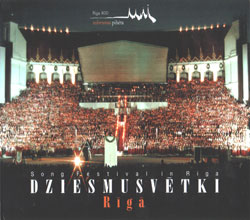
The album Dziesmusvētki Rīgā features some highlights from that milestone event, as well as more recent selections. Issued as part of the national commemoration of the 800th anniversary of the founding of Latvia’s capital, Rīga, this compact disc mixes old favorites with some novelties.

The disc opens with choral arrangements, by Jānis Cimze, Emīlis Melngailis and Pāvuls Jurjāns, of beloved Latvian folksongs. Original compositions by Jāzeps Vītols (“Gaismas pils”) and Raimonds Pauls (“Manai dzimtenei”) follow, works that have come to be as well known to most Latvians as their national anthem.

The Festival Choir has numbered up to 24,000 singers in Rīga, and the ability to cohesively and musically conduct such a huge mass of singers with subtlety and nuance is clearly an art form. Effectively recording such a widely dispersed field of humanity, where balance problems are already inevitable when one end of the choir is hundreds of feet away from the other, is also a highly specialized skill, with happier results in some selections than others.

All the conductors represented here are experienced in directing such large forces, though some are more satisfying than others. Haralds Mednis’ performance of “Gaismas pils” is a model of clarity, unity, and musicality. On the other hand, Jānis Zirnis succumbs to the temptation to stretch phrases to their limits and overemphasize dramatic effects in Melngailis’ “Jāņu vakars.” Subtlety is not really the point of these events, though: for the singer, it’s the joy of lending one’s voice under such momentous circumstances; for the listener, it’s the thrill of hearing a huge, stirring sound.

Two purely instrumental works follow: an old waltz tune, “Brūklenājs,” zips along merrily but the ensemble often verges on chaos. A potpourri of popular Latvian beer-drinking songs, arranged for brass band as “Alutiņš,” chugs along in marching-band style of a century ago. A 1998 choral composition by Juris Vaivods titled “Rīgas dziesmas” concludes the more traditional fare on this disc, and features a number of familiar tunes with connections to Rīga’s past. Effectively done, and enthusiastically sung.

Finally, something completely different—excerpts from Zigmārs Liepiņš’ rock musical “Teika,” presented at a Latvian youth song festival held in 2000. Despite generally not being fond of rock music, I found parts of the work very enjoyable and arresting. This is not a work with a strong, personal profile, though—much of the material is firmly rooted in the sound of groups and composers popular in the 1970s in the West, such as Supertramp and Electric Light Orchestra, and Imants Kalniņš’ influence is also felt. I suspect this work would have been much more interesting on video—the excitement of the audience and photos in the booklet suggest a strong visual element.

The album has attractive packaging, with thorough annotations in Latvian and English. Proofreading by a native English speaker would have been useful, though. In short, if you’d like a souvenir of “Rīga 800” and a melange of different musical genres doesn’t discourage you, then by all means try this unique, generally enjoyable compilation.

Details

Dziesmusvētki Rīgā

Various artists

MICREC and Latvijas Radio,  2001

MRCD 158