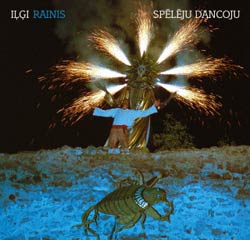
New disc brings alive Rainis’ phantasmagoria

Mythological songs, atmospheric arrangements for traditional instruments and postfolkloric freedom of interpretation are qualities usually associated with Iļģi, the best-known Latvian folk music group. Therefore it was a surprise last year to see the group in the capacity of theatre music authors—and for nothing less than “Spēlēju, dancoju” (I Play and Dance), the classic Latvian phantasmagoria by Jānis Rainis.

The play was a part of the programme of the International Festival of Contemporary Theatre Homo Novus 2001 during September 2001 in Rīga. The soundtrack has now been released on compact disc by UPE Recording Co.

“Spēlēju, dancoju” was staged by the Lithuanian puppet theatre Miraklis, well-known for its phantastic stagings of mysteries. The Rainis version of the orphic myth suited it well. Iļģi were chosen to create the music, and the result is more than an hour of a fresh, vivid and inspiring material that could be labelled as an ethno-rock musical. (Imants Kalniņš in 1977 composed the play as an opera.) It is amazing that even without seeing the play, the music can reveal all the phantastic and intricate visuality of the play.

The melodies are composed basically by Ilga Reizniece and Gatis Gaujenieks. Some motifs are traditional, such as the wedding dance “Tūdaliņ, tagadiņ,” “Apaļdancis,” the funeral tune and, partly, “Spēlēju, dancoju.”

The arrangements and instrumentation not only take on the character of the episode, but add some unexpected, almost mythical, dimensions. For example, on “Ko tu ‚rdies? Vai tev pr‚ts?,” a slow and deep-pitched reggae takes us to the strange abode of the Mole-cricket, its character skillfully transmitted by the unbelievable vocalisation of the “r” sound. The heavily distorted sounds of kokles and guitar evoke the depressing feeling of the realm of Kungs, the lord of the Netherworld (“Ha, ha! Kungs, vesels dzēris!”). The appearance of the dead Lelde to the satanic society is hardly possible without unusual powers, and the electrifying sound of tanpura, providing allusion to Oriental mysticism, does the job (“Vedat Leldi! Taisat kāzas!”). Similarly, on “Acis veras—aizveras,” the tabla-like sounds accompany Lelde’s fight for life.

Both the public and professionals have given high praise to the music and to the performances. Particularly lauded have been the leading roles of Tots (played by Gatis Gaujenieks), and Lelde and the Mole-cricket (both played by Rūta Muktupāvela). Also, Kaspars Putniņš’ vocal group is excellent. My youngest daughter listened to this recording five times a day for three months, and not just because her mother (Rūta Muktupāvela) and uncle (Māris Muktupāvels) sing on it. Can you make a 9-year-old listen to any music they dislike?

All the recording, mixing and mastering was done in the GEM studio by Iļģi member Gatis Gaujenieks, who also made most of instrumentations and programming. The CD has the high-standard cover design characteristic of other UPE albums, especially those in the Latvian Folk Music Collection. Ieviņa Liepiņa wrote the liner notes about the music while Janīna Kursīte wrote about the contents and symbolism of Rainis play. Full text of the Iļģi version of “Spēlēju, dancoju” is included, thus permitting the listener to follow the play in detail and to catch all the nuances otherwise lost because of the old-fashioned language style.

(Editor’s note: In the interest of full disclosure, it should be noted that Spēlēju, dancoju performer Rūta Muktupāvela is the author’s wife and that his brother, Māris, is a principal performer in Iļģi.)

Details

Spēlēju, dancoju

Iļģi

UPE Recording Co.,  2002

UPE CD 038
Foreign policy expert set for JBANC Webcast

A foreign policy expert is scheduled to discuss the status of NATO enlargement in the next Webcast sponsored by the Joint Baltic American National Committee.

Stephen Flanagan, director of the Institute for National Strategic Studies at the National Defense University, is scheduled to appear in the Webcast from Washington at noon (EST) Aug. 8. E-mail questions to Flanagan can be sent to jbanc@jbanc.org.

The Webcast is one in a series of such programs hosted by JBANC. Previous guests have included NATO experts Bruce Jackson and Ron Asmus, the three Baltic ambassadors to the United States and Ojārs Kalniņš, director of the Latvian Institute and the former Latvian ambassador to the United States.

Further information about the Webcast is available from JBANC’s Web site.

Andris Straumanis is a special correspondent for and a co-founder of Latvians Online. From 2000–2012 he was editor of the website.

Reunion visitors remember Auseklis high school

“Viņš ir Filadelfijā.” He’s in Philadelphia. “Viņa mira.” She died. Snippets of conversation revealed some of what has happened in the half century since a Latvian high school in Augsburg, Germany, closed its doors as Displaced Persons began to move to new homes overseas.

Former students of the Auseklis high school, which from 1946-1950 served students from two Displaced Persons camps, met July 21 during the 11th Latvian Song Festival in Chicago. The gathering was organized by Biruta Abula of Michigan, herself a 1949 graduate of the school. She’s been collecting information about her former classmates for a number of years.

The reunion was one of several gatherings of former DPs held during the song festival. Other groups that met included those from Esslingen and Wuerzburg.

The Latvian students came from the Hochfeld and Haunstetten camps, according to Abula. The high school, or ģimnāzija, came about at the urging of American military officials who were in control of that part of Germany after World War II. About 250 students attended the school, Abula recalled. The high school represented part of a refugee educational system that included elementary schools and institutions such as the Baltic University (Baltijas universitāte).

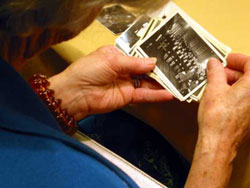
Abula said she thought only about five people would show up. Instead, more than 25 came to peruse lists of students Abula has tracked down, reminisce over old black-and-white photographs and share stories about their classmates and teachers.

It was clear that for these former students, their high school years are remembered fondly. In one photo album, images showed smiling students posing together for class pictures. A few portrayed athletic and cultural activities, such as dancing. Reunion participants pointed out each other, telling tales as they went. Some reassembled to have new class pictures taken.

If time allowed and the participants were willing, the reunion would have been a wonderful opportunity for Abula to record what these former high school students remembered about their time in Augsburg. Abula admitted it’s hard to convince people to make the effort.

But the effort has to be made. Too much of Latvian history, both in Latvia and abroad, has been lost. In the case of the Displaced Persons camps, some work has been done to retrieve that history, but much remains. Rediscovering stories such as those of the Auseklis high school would serve not just to rekindle the memories of former students, but would help all of us understand the formative years of a generation that for many years led exile cultural, social and political life in the United States, Canada and elsewhere.

And with hundreds of thousands of displaced persons still wandering the globe, thanks to any number of conflicts that have upset many homelands, improved knowledge about the Latvian DP experience might help others to deal with their particular need for ethnic survival.

Looking at old photo

A reunion visitor looks through a handful of old photographs of the Auseklis camp high school. (Photo by Andris Straumanis)

Andris Straumanis is a special correspondent for and a co-founder of Latvians Online. From 2000–2012 he was editor of the website.