Voting in Latvia can be confusing

It’s an election year in Latvia. Some of us who have grown up in western democracies and are now citizens of Latvia again will need to cast a vote, which is an often confusing experience. Others will simply be observers, wanting to know Latvia better, but finding its politics hard to follow.

If you feel confused, you are not alone: Latvia does have a radically different electoral system to that of most countries, not to mention a highly confusing party system!

The Latvian electoral system

In Latvia the parliament is unicameral. In other words, there is only one legislative house (the Saeima) and there is no upper house.

As in most countries, an election in Lativa is fought out between political parties, but on the basis of proportional representation. Voters do not cast ballots for a a member of parliament who represents a local area, but parties get candidates into the Saeima on the basis of the proportion of votes that the party as a whole obtains. Latvia is divided into five electoral regions—Kurzeme, Latgale, Rīga, Vidzeme and Zemgale—and in each region parties will get representation proportional to the vote received. Voters living outside Latvia are counted as part of the Rīga region.

This system of proportional representation was adopted for important historical reasons. After World War I, the powers at the Versailles peace talks (and later in the League of Nations) were very concerned about issues of minority rights. Minority issues particularly in the Balkans had directly led to World War I. It was considered that the new states in Eastern Europe that emerged after World War I should provide specific guarantees of minority rights in their constitutions. An electoral system allowing the broadest possible representation was favoured. Any significant minority should be able to get its candidates into the parliament, and proportional representation provided a way of doing this.

Proportional representation of some kind is still widely practiced in Europe. Of course, one down side of this system is that often there is no one clear majority party. After each election many parties are represented, and forming an effective government is difficult. Up to 30 parties were represented in the four pre-war parliaments in Latvia, and this was the ostensible reason for the ending of party democracy and the usurping of power by President Kārlis Ulmanis in 1934. This was more or less what happened in almost all Eastern (and many Western) European countries in the inter-war period; Latvia was not exceptional.

To save a repeat of the situation where many parties had just one or two members in the Saeima—leading to endless political instability and horse-trading—Latvia has introduced a 5 percent hurdle. Any party must get 5 percent of the vote to get any candidates in the Saeima. This has led to a drastic reduction in the number of parties represented in the Saeima, but has not resulted in any party having a majority after any Saeima election. The tradition of coalition government continues.

How to cast your vote

To vote in the proportional representation system, an elector receives a thick bundle of voting lists, one for each party standing, and from these they select and deposit in the ballot envelope just one such list. Choose your party, and vote for it.

So far, so simple. However, there is one further important feature: on the list of candidates of their chosen party, electors may place a “+” next to candidates, or they may cross out any number of names on the list, to indicate their attitude to individual candidates. A “+” next to a candidate’s name gives that candidate an “extra vote” relative to all the other candidates on that party list. Correspondingly, the crossing out of a candidate’s name loses that candidate a vote relative to all other candidates on that list. Thus, even when choosing a party, you can indicate a positive or negative attitude towards individual candidates of that party. This is to overcome a situation where you are forced to vote for a list even though some individuals on that list do not appeal to you.

Wherever you live or vote, I am sure that many of you would sometimes welcome the opportunity to cross out someone’s name on your ballot!

Which candidates on the party list are elected? The order of candidates on the list is determined by the party when handing in a list of candidates to the Central Elections Commission. Candidates are listed in order as the party prefers them. Whatever percentage of the ballots a party gets, that percentage of the party’s candidates are declared elected, in the order they appear on the ballot (give or take any changes made by the “+” marks or negations of individual candidates).

And just one final nuance. It is possible for candidates to stand in as many regions as they wish. Popular candidates will do this to attract more votes to their party.

You bet it’s confusing!

The system is even confusing to the people in Latvia. The Soviet system did have elections of a kind, but they were based not on proportional representation (after all, there was only one party!) but on local candidates in a specific electoral area. Interestingly, the last Latvian Supreme Soviet, elected in 1990 when the Soviet Union was rapidly changing, consisted of locally elected deputies. Through all the struggles of the following years, local electors often put considerable pressure on their deputies, and the deputies often felt accountable to their electorate.

This points to the second significant drawback of proportional representation, apart from always leading to coalition governments. That is, that voters do not feel like they have someone who is clearly identified as “their” local representative in the Saeima. Voters can never identify a local politician, and politicians can often have the feeling that they are not really directly responsible to electors. This is just one of the factors leading to considerable political disillusionment among voters.

Those who are used to voting in systems where we elect local members of a parliament or a congress (as for example in the United States, the United Kingdom, Canada or Australia) will always find this Latvian system strange. But it is important to remember that, not unlike other systems, you are in the end voting for one party.
For immigrants’ child, memories of a land never seen

“Is there electricity in Latvia?” asked one of the first Latvians born in Australia.

Vanda Willis’ voice sounded over the telephone receiver: “Memme (Mother) never learned English. She sang songs about Latvia: ‘Kur tu teci gailīt,’ ‘Dažu skaistu ziedu, Gaujā kaisīju.’ Yes, I know Gauja is a big river over there.”

As she spoke, Vanda sometimes used interesting but archaic phrases, such as “Priekš kara āboli bija smeķīgāki” (Before the war apples were tastier). Sometimes she switched to English, thought about it and searched for words, though most of the conversation was in Latvian.

“Memme talked about Latvia but she said she’d never go back,” Vanda said. “Dad didn’t say anything and I really wasn’t that interested in Latvia.”

Someone listening in on the conversation would not be able to tell that 90-year-old Vanda, who lives by herself in her Sydney home, has not spoken in her native language for many years. The life story of Vanda’s family is a good example of the fate of many Latvians who emigrated to Australia as a result of the unrest in Europe in 1905.

The only people who she would be able to speak to in her language are her sister Austra, who is a year and a half younger, or her other sister Frances, 14 years her junior. Austra lives nearby in a retirement village, but Frances is in Adelaide. If Vanda speaks to them on the phone—once a week with Frances, every day with Austra—their conversations are in English, Vanda says. They don’t have any Latvian friends. Vanda’s daughter, Nora, who died this year, never learned Latvian. Vanda’s grandson Michael, who works as a nurse and also looks after his blind grandmother, has never been spoken to in his grandmother’s mother tongue, let alone been to Latvian school.

Vanda was born on Dec. 31, 1911, in Grafton, New South Wales. She may well be one of the first full-blooded Latvians born in Australia. She is the first Australian of Latvian emigrant parents to be awarded an academic degree, from Sydney University in 1932, according to her nephew, Earl Ewers of Canberra.

Her father, Jānis Zariņš-Andersons (John Sarin-Anderson) arrived in Australia in 1906. He was 26 at the time. Following the 1905 Revolution in Latvia, he had been on the run from a Cossack forced labor expedition. Jānis fled from Bēne in the Kurzeme region of Latvia, traveled to Moscow and then to Vladivostok in eastern Russia, and from there by ship to Japan. Jānis had in fact planned to flee to America but had changed his mind when he heard about the earthquake in San Francisco. Television and radio didn’t exist in those days and according to the stories people told, America had exploded into little pieces and sunk, Vanda recalled with a laugh.

Jānis had been working in the Bēne railway station shop at the turn of the century and had been the first person to own a bicycle in his village. He never told his children what crimes he had committed so that he had to flee from the Tsarist government. Somewhere along the way his surname Zariņš had acquired an alias, Andersons. “Father had always liked Andersens’ fairy tales,” Valda said.

Vanda’s mother, Luīze Grīslis, who spent her childhood in Mezmuiža near the Lithuanian border, joined Jānis after five years. They got married the same day the young woman disembarked on Jan. 19, 1911. The last day of that same year Luiza and Jānis had a baby girl, Vanda. The midwife who helped with Vanda’s birth was an aborigine. “Memme said when she woke up there was a dark-skinned woman with a pipe sitting next to her,” Vanda remembered.

Jānis’ mother, Līze, joined the family in 1912. Jānis liked his new life in Australia so much that he had convinced his sister Marija and brothers Kārlis and Alfreds to emigrate as well. Marija ended up marrying a Latvian, Mārtiņš Pļaviņš, but both brothers took Australian brides.

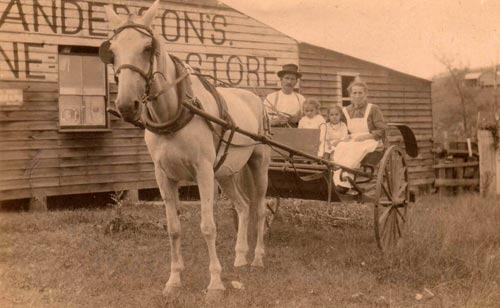
Jānis was secretary of the first Sydney Latvian Society from 1928-1939. The family’s livelihood was provided for by their shop in Grafton, or bode, as Vanda called it. A business run by Latvian emigrants had seemed suspicious to the locals and it wasn’t too successful. Their next project met with more success: a bus line from Port Campbell to Wollongong.

Vanda’s mother stayed home and tended to the housework as was the custom for women in the pre-war years. She spoke to her children and husband only in Latvian (Vanda had two other brothers and two sisters besides her sisters, Austra and Frances), so till the age of seven Vanda knew no English. When Vanda started school she began to wonder why she was so different to the other kids. Because she was so intent on fitting in with the other Australian girls she spoke to her sisters in English and started to call herself Susan.

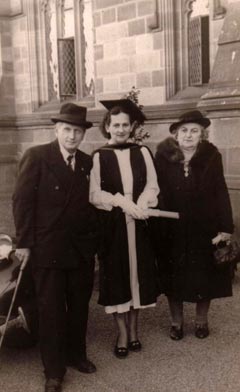
Vanda always knew she wanted to go to university. She even completed two university degrees, in 1952 earning an economics degree. Her husband, an Australian psychologist born in England, fully supported her studies. She had met him while working as a teacher in Newcastle. In the 1930s teaching was not considered a woman’s profession, however, the World War II changed all that, Vanda remembered. The war also changed the notion that a married woman’s place is in the home with kids, scrubbing pots and pans.

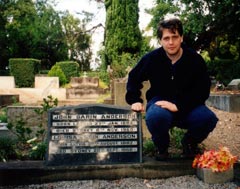
Vanda has been a widow for 36 years. And since her parents’ death (her father lived to the age of 80, her mother to 86, and both were buried in the Latvian section of the Rookwood cemetery in Sydney) she has had virtually no contact with Latvians apart from her own family. Vanda’s correspondence with relatives in Jelgava ceased after the war.

“Under Russian rule it was more difficult to make contact,” Vanda said. “Jelgava was destroyed and bombed, it was hard to locate them. They must have all been killed.”

At home Vanda still has a small Bible that had been among the possessions brought along from Latvia. The book had been a source of comfort to Luīze Grīslis, who had gone on a journey to an unknown destination nearly 100 years ago. But to Vanda, her mother’s homeland, located on the shores of the Baltic Sea, is a strange and distant planet. She remembered what her parents had told her about Latvia: “The rivers, forests, flowers were good.” She mentioned amber, rye bread, her mother’s sauerkraut, even sour porridge (skābputra)—a meal that non-Latvian guests had found inedible.

Then she surprised a visitor with a question: “Is there electricity in Latvia?”

(Editor’s note: This article was translated from the Latvian by Daina Gross.)

In wagon

In 1916, Jānis Zariņš-Andersons poses for a photograph with his wife, Luīze Grīslis, and two of their children, Austra and Vanda. In the background is their store at Grafton, New South Wales. (Photo from the Willis family archive)

Graduation

Vanda Willis poses with her parents upon her graduation from university in 1932. (Photo from the Willis family archive)

Michael Willis

Michael Willis, Vanda’s grandson, poses at his great-grandfather’s grave. (Photo by Ieva Puķe)

Latvia still viewed as most corrupt in Baltics

Despite improving, Latvia still is seen as the most corrupt of the Baltic countries, according to the latest Corruption Perception Index published by the Berlin-based watchdog group Transparency International.

Latvia placed 52nd in the latest survey, tied with the Czech Republic, Morocco, the Slovak Republic and Sri Lanka. Last year, the index ranked Latvia 59th.

The index, based on polls of business people, academics and country analysts, measured how experts view the level of corruption in 102 nations.

Estonia tied with Taiwan at 29th, down one notch from last year’s survey. Lithuania increased by two to 36th, tied with Belarus, South Africa and Tunisia.

In reporting the results, Transparency International expressed dismay that more than half the countries earned less than 5 on its 10-point scale of corruption. Estonia’s score was 5.6, but Lithuania’s was 4.8 and Latvia’s 3.7. According to the survey, Finland is perceived as the least corrupt nation in the world, while Bangladesh is the most corrupt.

Andris Straumanis is a special correspondent for and a co-founder of Latvians Online. From 2000–2012 he was editor of the website.