From horse race to horse-trading

The Saeima (parliament) elections are over. Now a new government is formed. Right? In Latvia it is never quite that easy.

According to the Latvian constitution, after an election the president can invite anyone he or she feels is capable of forming a government to do so. By convention the president would look first to the largest parties represented in the Saeima or to any major coalitions that are being formed, but there are no prescriptions for who should be asked.

And in any case the final decision is not up to the president. Ultimately, a government can only be formed if that particular coalition and its candidates for prime minister and the cabinet have the support of the Saeima.

So, horse-trading is the order of the day, not unusual in European coalition-building politics, but in Latvia still with its own unusual features. In the 8th Saeima elections Einars Repše and his New Era Party (Jaunais laiks) won the largest number of seats. He is expected to head a coalition government as prime minister. This outcome appeared relatively predictable in the beginning, but has increasingly become bogged down in battles over appointments of ministers from among the potential coalition members. Repše, once hoping for an clear majority for his party to avoid coalition weakness, is now ironically embroiled in it.

The likely coalition parties are the First Party of Latvia (Latvijas Pirmā partija), For Fatherland and Freedom /Latvian National Independence Movement (TB/LNNK) and the Greens and Farmers Union (Zaļo un zemnieku savienība). All these parties have broadly similar views on a range of economic, foreign and domestic issues, but that does not make the dealing easier. In fact, each party has to work hard to maintain its own distinct identity and appeal to its current and potential electors. And in the face of this ideals of good government and orderly coalition building recede into the background. At the time of writing, the Greens and Farmers Union seemed to be presenting the most difficult demands: promised the agriculture and environment ministries, it is holding out for at least one more high-ranking ministry, but that’s opposed by other coalition members.

It is comical, or perhaps tragic, that all the smaller coalition members have been trying to avoid several ministries, including social welfare, local government, social integration and regional development—all potentially difficult appointments for any incumbent.

The other curious aspect of this process is that Repše pointedly has not been talking with the other large centre-right party in the Saeima, Andris Šķēle’s People’s Party (Tautas partija). Repše has been critical of the People’s Party’s performance in the past, and of Šķēle in particular once his own administrations ran into the familiar problems of corruption and poor management.

Moreover, there is some wariness of creating a “grand coalition” government where too many of the largest parties are in power. Such arrangements seem to guarantee peace for a time but ultimately lead to great voter frustration as policy directions are always compromises.

But above all, the People’s Party in its stated policies is also very close to New Era, and the issue of maintaining a distinction between it and any other party is very much in New Era’s mind. So it’s “no” to the People’s Party.

Perhaps the most striking aspect of all this to an outside observer is not the horse-dealing but the rather leisurely way in which it all takes place. No outcome should be expected until the Saeima meets in early November, and even then it is not certain there will be a decisive outcome. Talks behind the scenes go on all the time but publicly there are only occasional meetings and announcements, and very often news of government formation is relegated to the back pages. No one is in a hurry, and to have a country drift without a clear government (the outgoing government of Prime Minister Andris Bērziņš is in caretaker mode) does not seem to faze anyone.

While the makeup of the new government is difficult to predict, it is useful to remember that a New Era-led coalition could still fail to materialise. In that case New Era and probably the First Party of Latvia would go into opposition, while a government could be formed by a coaltion of the People’s Party, the Greens and Farmers Union, and For Human Rights in a United Latvia (Par cilvēka tiesībām vienotā Latvijā, or PCTVL). PCTVL is the other big winner in the 8th Saeima and has declared its willingness to work with any party except the nationalist TB/LNNK. PCTVL has been in coalition government in the Rīga City Council and in several other local governments, thus patiently building its local reputation, and has had the advantage of always being the most vocal opposition voice to national centre-right governments.

A “grand coalition,” where Repše has to join with Šķēle, also cannot be entirely discounted.

Of course, there’s always the potential for a surprise.

Although perhaps unlikely to apply in this case, the Latvian parliamentary system is one where you do not have to be a member of the Saeima in order to be a minister—even a prime minister. This provision was used when the Latvia’s Way coalition after the 6th Saeima election could not agree on a candidate for prime minister from among its ranks. Instead, it picked well-known businessman Šķēle, who at the time was not a member of the Saeima and who had no political party base. Šķēle made the most of his opportunity and eventually formed the People’s Party, which is still well represented in the new Saeima.

This time around, could a potential stand-off be avoided by designating an outside candidate for prime minister? While it would be hard for Repše to stand aside, stranger outcomes have been known.
An election postmortem

The 8th Saeima elections of Oct. 5 produced a largely predictable result, justifying the claims of political pollsters in Latvia. Despite the predictability, the new Saeima lineup now portends significant changes to the balance of power in Latvia and the nature of future governments.

The highlights:

  • New Era (Jaunais laiks) – the newly formed party of the former Bank of Latvia governor, Einars Repše,  will be the largest party with 26 seats in the 100-seat Saeima.
  • As in previous elections, several sitting parties were not able to get past the threshold of 5 percent of the vote and so will not be represented in the new parliament, most significantly Latvia’s Way and the Social Democrats.
  • For Human Rights in a United Latvia (Par cilvēka tiesībām vienotā Latvijā, or PCTVL) increased its representation strongly and now holds 24 seats.
  • The other largest party in the previous Saeima, the People’s Party (Tautas partija) was returned with only a slight drop in numbers.
  • Meanwhile, the nationalist For Fatherland and Freedom /Latvian National Independence Movement (TB/LNNK) suffered a loss in support, dropping to seven from 17 seats.
  • One of Latvia’s oldest political parties, the Farmers’ Union, has returned, this time in coalition with the Greens.

The biggest winner of the election was Repše’s New Era party with 26 seats, well short of a majority but an outstanding result for a newly formed party. Campaigning on the basis of honest government, combating corruption, entering European institutions and ensuring the integrity of Latvian independence, this party will now have to govern in a coalition to realise its aims.

Almost equally impressive were the gains made by the PCTVL coalition, ensuring a Moscow-oriented opposition remains strong in the Saeima. The gains of PCTVL came in part from the demise of the Social Democrats.

Another big winner that must be noted is the People’s Party, which largely held its own in these elections, losing only three seats from its 1999 result, and avoiding the fate of other previously governing parties of declining dramatically at subsequent elections.

The coalition of the Greens and Farmers Union—a highly unusual and perhaps unique coalition 00 performed strongly to win 12 seats. The Farmers Union is one of Latvian’s oldest traditional parties, now recovered from its years in the wilderness, but how it performs in tandem with the Greens remains to be seen.

Finally, one other new party gained representation, the First Party of Latvia (Latvijas Pirmā partija). Latvian elections always throw up at least one curiosity and this is it. Dubbed the “religious party” and having on its list some prominent clergy, it also has a number of other decidedly less spiritual politicians, including some familiar managerial and bureaucratic faces from previous parties no longer represented in the Saeima. They may be hardest to predict of all.

The story of the big losers is equally interesting. Latvia’s Way, the party that has formed part of every government in post-independence Latvia, and which has provided most of the prime ministers and ministers, fell agonisingly short of the benchmark with just 4.88 percent of the vote. Long criticised for the bureaucratic, apparatchik and professional politician manner in which it performed, it nevertheless also had some of Latvia’s best-known and respected politicians. Its failure also means the absence of one of the strongest voices for integration with European institutions such as the European Union and NATO. It remains to be seen if New Era and the People’s Party can push these policies, to which they say they committed to as well.

Other big losers were the Social Democrats. Not for the first time in their colourful history they split before the elections, this time into three separate lists, splintering the vote so that the largest—the traditional Latvian Social Democratic Labour Party (LSDSP)—gained just over 4 percent. Splits in the Social Democrats centred on ideological issues and on what relationship should hold with the Moscow-oriented PCTVL. On the Rīga City Council, the LSDSP and PCTVL are in a controversial coalition, but those not trusting this coalition of convenience split from the party.

Also among the significant losers must be counted TB/LNNK, which lost 10 seats and now precariously holds only seven. TB/LNNK was overtaken by the success of New Era, which is less overtly nationalistic in its program but which clearly attracted a large number of former TB/LNNK voters. For example, while a majority of voters outside Latvia previously strongly supported TB/LNNK, this time a majority of them voted for New Era. TB/LNNK had also had its own internal problems, not least being unable to prevail with its harder line nationalist policy on issues such as language policy and citizenship rights. Some if its coalitions in local governments also have not performed well.

By contrast, both PCTVL and the People’s Party had concentrated a great deal on performing at the local government level. This is now a significant feature in Latvian politics, and will reward careful monitoring. The PCTVL, while widely regarded as a former communist and Moscow-leaning party, has often performed credibly at the local government level and knows the value of competent politicians being visible locally. Equally, the People’s Party contested and won a number of local councils, with an emphasis on developing local economic enterprises.

Finally, one of the significant losers was the small but widely publicised Freedom Party (Brīvības partija), modelling itself on Joerg Haiders’s rightwing party in Austria with an overtly racist campaign, including claiming that entry to Europe will mean flooding the country with black immigrants. They gained only 0.2 percent of the vote.

So, what do we have?

  • A highly popular but relatively politically inexperienced new party, New Era, most likely forming the basis for a centre-right coalition government.
  • A very experienced and confident opposition in PCTVL, therefore maintaining a nationality-based politics as the continuing mode of Latvian politics, rather than a more standard left-right political spectrum.
  • Another more experienced centre party—the People’s Party—capable of being effective critics if New Era should stumble.
  • The disappearance of the highly experienced Latvia’s Way, and another split in the Social Democrats.
  • And the Farmers Union is back, this time with the Greens.

And last, for those of you who have followed the labyrinth of the Latvian election system and the election results, there is still one even more complex aspect of Latvian politics: how governments are formed. But more about that later.

Jaunais laiks wins; voter turnout shrinks abroad

Latvia’s next government will be a coalition. That much is clear from provisional results from the Oct. 5 nationwide voting for a new parliament. But just which of the six parties that earned spots in the 100-seat Saeima will form the new government remains open to speculation.

Einars Repše’s reform-minded Jaunais laiks (New Era), which at one point expressed confidence that it could win a clear majority and thus avoid a coalition, won the most seats (26) in the 8th Saeima, earning 23.93 percent of the estimated 990,000 ballots cast in Latvia and abroad.

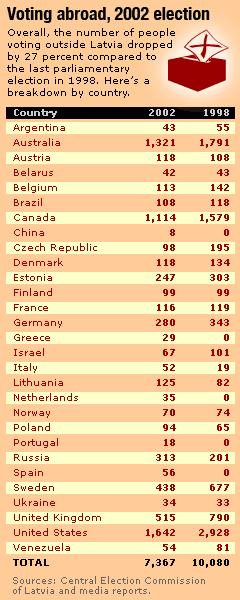
But 27 percent fewer voters cast ballots abroad this year than in the last parliamentary election in 1998. According to reports from 34 of the 35 voting sites abroad, 7,367 votes were cast in person or by mail. In 1998, a total of 10,080 voters abroad participated.

Results are still awaited from Venezuela.

According to the provisional results tabulated by Latvia’s Central Elections Commission, the heavily ethnic Russian party, Par cilvēka tiesībām vienotā Latvijā (For Human Rights in United Latvia, or PCTVL), drew 18.94 percent of all ballots, earning 24 seats in the parliament. Andris Šķēle’s Tautas partija (People’s Party) took third with 16.7 percent of ballots, earning 21 seats. At the time, results from 978 of Latvia’s 979 voting districts—including those abroad—had been tabulated.

A total of 20 parties fielded candidates in the election, but only those earning more than 5 percent of the national vote get a slice of the parliamentary pie. The other parties to clear the barrier were Latvijas Pirmā partija (The First Party of Latvia), 9.58 percent, earning 10 seats; Zaļo un zemnieku savienība (Green and Farmers’ Union), 9.47 percent, earning 12 seats; and Tēvzemei un brīvībai/LNNK (For Fatherland and Freedom), 5.39 percent, earning 7 seats. The Green and Farmers’ Union gets two seats more than the First Party because of how Saeima seats are apportioned according to voting region.

Although its popularity had been waning in recent years, it was still a surprise to some observers to see Latvijas ceļš (Latvia’s Way) drop below the 5 percent line. The party earned 4.88 percent of the national vote.

Latvia’s social democrats, who split into two parties earlier this year as a result of infighting, also won’t be warming any seats in the 8th Saeima. The Latvian Social Democratic Labour Party earned 4.02 percent of the vote, while the splinter Social Democratic Union received 1.53 percent. That suggests that if the social democrats had stayed together, they might have earned enough votes to stay above the 5 percent threshhold.

Voting results from Latvians abroad, particularly from the Americas, came in later as polls closed at 8 p.m. local time.

Voting abroad

Voting got off on a sweet note at the Latvian Ev.-Lutheran Church in Rockville, Md. It was the Three Tenors—Miervaldis Jenčs, Nauris Puntulis and Guntars Runģis—who cast the first ballots in the Washington, D.C., suburb, said Uvis Blūms, chairperson of the local election commission. The singers had performed in concert the previous evening in Washington.

Voting there and in New York progressed smoothly, but election judges may have had less work in this election compared to four years ago. Just 1,642 Latvian citizens voted in the United States, 44 percent less than four years ago, when 2,928 cast ballots in person or by mail.

In all, Blūms said, 263 voters cast ballots in person in the Rockville church. Although a final count of mail ballots was not yet known, Blūms said a total of 1,155 had been sent by the Latvian Embassy to potential voters who requested them. Meanwhile, in New York at the Permanent Mission of Latvia to the United Nations, a spokeswoman reported 281 ballots cast.

In Canada, 465 fewer voters cast ballots this year compared to 1998, a decrease of 29 percent. A total of 930 votes were cast at the Latvian Canadian Cultural Centre in Toronto, making it the busiest in-person polling place abroad. Another 184 ballots were cast at the Latvian Embassy in Ottawa, including just 79 by mail.

Four years ago, a total of 1,579 ballots were cast in Canada.

An hour before closing, Irēne Sadde, Latvia’s honorary consul in Caracas, Venezuela, told Latvians Online that voting was progressing without problems. A total of 54 people cast ballots in person, but nobody voted by mail.

“The mail doesn’t work,” Sadde said of Venezuela’s postal service.

Four years earlier, 81 ballots were cast in Venezuela.

In the Argentinian city of San Miguel, 35 kilometers from Buenos Aires, a total of 43 people voted, 41 of them at the home of Honorary Consul Mirdza Restbergs de Zalts. “We had no problems,” she told Latvians Online.

Four years ago, 55 people cast ballots in Argentina, according to Central Elections Commission data.

This time, according to draft results, the largest bloc of Argentina’s votes—15 in all—went to Jaunais laiks.

Voting in Latvia

Balloting in Latvia apparently went according to ethnic lines. Jaunais laiks and Tautas partija—perceived as more “Latvian” parties—drew strong support in the Kurzeme, Vidzeme and Zemgale regions. Meanwhile, PCTVL ran away with the election in heavily Russian Latgale and received the most votes in Rīga and its environs, where ethnic Russians also outnumber ethnic Latvians. Ten of PCTVL’s seats in the 8th Saeima will be filled by candidates from Rīga, while nine will come from Latgale.

In all, 72.49 percent of an estimated 1.36 million voters cast ballots.

In Kurzeme, Jaunais laiks earned 26.66 percent of the votes, while Tautas partija got 25.32 percent. In Zemgale, Jaunais laiks received 25.57 percent to Tautas partija’s 20.18 percent. And in Vidzeme, Jaunais laiks received 27.85 percent of ballots, compared to 21.61 percent for Tautas partija.

But in Latgale, PCTVL earned 36.8 percent of votes. In a distant second was Zaļo un zemnieku savienība with 9.62 percent. Jaunais laiks, according to provisional results, remained breathing down the Greens’ and farmers’ necks, just five ballots shy of matching them for second place.

In the Rīga region, PCTVL—which had already shown its power in the Rīga City Council election last year—also came out on top, taking 30.11 percent of the votes. Jaunais laiks was in second with 25.94 percent.

Votes from abroad are counted in the Rīga region. Overwhelmingly, most Latvians abroad gave the lion’s share of their ballots, 51.83 percent, to Jaunais laiks. However, in Belarus, Israel, Russia and Ukraine, most voted for PCTVL.

Election results abroad

Andris Straumanis is a special correspondent for and a co-founder of Latvians Online. From 2000–2012 he was editor of the website.