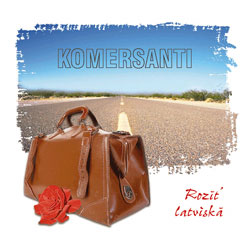
Komersanti play professional country music

Komersanti

Komersanti (The Merchants) play music in a folksy, country style. I wouldn’t necessarily call it schlager, though I think this album would appeal to schlager fans. Actually, they remind me a bit more of Bet Bet than anyone else. In any case, their 2002 album, Rozīt’ latviskā, is a collection of 12 songs in a number of different kind of folk styles.

The group is made up of Juris Pavītols on vocals and guitar (he’s also the main songwriter), Norlands Millers on guitar and vocals, Aldis Žīmants on bass guitar and vocals, and Edijs Cionelis on drums.

Komersanti prove themselves excellent musicians. However, the songs do not stay in memory very long, and I probably will not listen to this album much in the future.

One of my criticisms of this album is technical: the production makes some of the songs sound like they were recorded in an echo chamber. This is particularly evident on the lead track, “Roze,” which is a nice little song about a Latvian rose that is blooming somewhere very far away. Though this was probably my favorite song on the album, the echo effect on this song is a bit annoying.

Komersanti also must have listened to a few American country records, because there is a country feel to many of the songs. A good example is “Oda lidojums” (The Mosquito’s Flight), where the guitar work gives this song a particularly country feel. To further illustrate the country influence, they even have a song with a horse motif, “Zirga smaids” (The Horse’s Smile). No songs about pickup trucks, though!

Another song I like is “Aizlūgums.” Although once again in a country style, it is a very catchy, inoffensive song. “Velna dziesma” (The Devil’s Song), performed in more of a “boogie” style, is another a song I like. “Tu tik man netraucē” (Don’t You Disturb Me) is also a catchy song. I’m not sure who sings on the track, though it sounds strangely like Ainars Virga from the guitar rock group Līvi, as the vocal is rather deep and gruff. Like Līvi, Komersanti are from Liepāja, while Pavītols (who is a bit of rock legend in Latvia) has ties to Līvi.

Liner notes are very sparse, with no lyrics and just a few pictures of the band. Not knowing much about this group, it would have been nice to have a bit more information about the group in the notes.

Overall, Rozīt’ latviskā is not a bad album, but there are no songs that leap out and demand you listen to them over and over again. It is clear that these guys got together to play music, mainly because they enjoy it—and that is a good thing. They aren’t trying to change the world with their songs, and it is nice to listen to some music that isn’t overly earnest or overly serious.This is much better than much of the schlager in Latvia, as it isn’t bogged down by cheesy synthesizer tracks and drum machines. And because the members of the group are capable musicians, the album itself is very professionally done.

If you have an aversion to schlager or country music, best to avoid this release. This album is for those who prefer their music very mellow and with few surprises.

Details

Rozīt’ latviskā

Komersanti

Baltic Records Group,  2002

BRG CD 120

Egils Kaljo is an American-born Latvian from the New York area . Kaljo began listening to Latvian music as soon as he was able to put a record on a record player, and still has old Bellacord 78 rpm records lying around somewhere.

Latvia names new ambassador to France

Rolands Lappuķe has been named Latvia’s new ambassador to France. He replaces Sandra Kalniete, who earlier this month was appointed Latvia’s new foreign minister in the government led by Prime Minister Einars Repše.

Lappuķe has been serving as the ambassador to Portugal.

Lappuķe intends to foster direct relationships between French and Latvian regional and municipal governments, as well as between citizens of both nations, according to an announcement from the office of President Vaira Vīķe-Freiberga.

The president presented Lappuķe with a letter of accreditation during a meeting in Rīga.

Andris Straumanis is a special correspondent for and a co-founder of Latvians Online. From 2000–2012 he was editor of the website.

On Nov. 18, optimism and realism in Canada

When I was little, 18. novembris consisted of two parts: a solemn church service with lots of room for tears, and a formal ceremony that left oodles of time to doodle on the program. Both usually occurred on the weekend closest to the real date—and the formal ceremony was usually dominated by solemn speeches and official presentations.

“The ceremonials had become mere rituals devoid of any real meaning, substance or emotion,” explains Valdis Liepiņš, chairman of the organizing committee and first president of the Latvian Canadian Cultural Centre (LCCC) in Toronto. “They were over in about three to four hours, and everyone could go home satisfied in the knowledge of having done the right thing.”

But growing numbers of people, especially the younger generation, thought otherwise, and attendance at these formal ceremonials dwindled from one year to the next.

When the LCCC became a part of the Toronto landscape in 1979, it also brought a new angle to Independence Day celebrations.

“Something more memorable, more authentic, more substantial was required,” recalls Liepiņš. “Something that addressed the reality of Latvia, and gave each of us the opportunity to be connected, at least spiritually, with Latvia and Latvians under Russian occupation.”

Nov. 18 became “Diena Latvijai” (A Day for Latvia), a celebration, not a commemoration. That celebration would take place on the real date, regardless of whether it fell on a weekday or a weekend, and would start with a flag raising ceremony at 7:30 a.m. (early enough so those who chose could make it to work). It would be followed by not just three or four hours of passive sitting, but a whole day of active participation. Over the past 23 years, “Diena Latvijai” has become a integral part of the Latvian Centre’s program, and like everything else, has gone through various phases and demographic shifts.

For the first few years I accompanied my family to the early morning ceremony, but after a while I found little in the full-day program that appealed to me, not to mention few kids my age I could hang out with. Fortunately the evening programs, at least initially, were interesting combinations of song, poetry and images that inspired, for example, the way the Latvian school Valodiņa celebrated Nov. 18. In later years there have even been performances by the Latvian post folkloric group Iļģi.

I dropped out of the “Diena Latvijai” scene for about 15 years, but returned two years ago, when the celebrations fell on a Saturday, to organize a half-day children’s festival complete with clowns, face painting and a range of activities coordinated by 10 Latvian children’s organizations in Toronto. I wanted to give my children a “Diena Latvijai” they could enjoy.

Diena Latvijai 2002

This year “Diena Latvijai” falls on a Monday—which makes things not just difficult, as they always are, but even more difficult. “Every year there are less people,” says Auseklis Zaķis, current president of the LCCC. Today people over 65 account for about 80 percent of “Diena Latvijai” participants.

“The older generation is dying off, and the younger generation isn’t as committed, and isn’t willing to take a day off from work,”  Zaķis says.

This leaves organizers in a conundrum. If the bulk of participants are seniors, should the program be created mainly for them? If there is a program for those under 65, will they take the day off and attend? Moreover, where do you find volunteers to organize a full day of activities for three different demographics—and is it worth it?

This year, kids’ activities are limited to the preschool set. The Latvian Centre Playgroup, which has 20 members under the age of four, is inviting children one to four years old (and their parents) to celebrate Latvia’s birthday with singing, flag crafts and cake.

The official program, entitled “Our Limitless Possibilities,” kicks off with a keynote speech by city planner and architect Andris Roze, who will talk on a city vision for Rīga in 2020. That’s followed by “There and Back Again,” a panel discussion exploring what happens to Latvians from Canada who live in Latvia for a few years, and then return “home.” What’s their post-Latvia experience? Participants include Vizma Maksiņa, Ingrīda Mazutis, Andris Roze and Dagnija Staško.

As is customary, there will be a 1 p.m. live broadcast of the president of Latvia’s Independence Day speech in Rīga. This is followed by an opportunity to view all the “Sveiks” television programs broadcast to date, while those interested can watch the film Latvian Legionnaires and participate in discussions led by Austris Siliņš, president of the Latvian National Youth Association of Canada. Toronto Sun reporter Bob MacDonald will follow with a talk on his personal experiences during the Cold War.

The official ceremony, which used to occur outside the Latvian Centre’s program, has now become part of the Toronto Latvian community’s daylong celebration. It will feature a speech by Imants Purvs, president of the Latvian National Association in Canada, and a concert by Toronto Latvian High School students and various musicians.

The day ends with an evening celebration featuring the international (that’s Canada and the United States) men’s choir Straume, as well as performances by the folk dance groups Daugaviņa, Diždancis, Dižais Dancis and Mēnestiņš. Ēriks Taube, organizer of this year’s “Diena Latvijai,” says he’ll consider the event a success if people say they had a good time, and if they look forward to next year.

“If, at the end of the day, it feels like we’ve celebrated the new Latvian independence, then we’ve finally moved past regretting the lost old independence,” he says.

That said, there are still many issues to resolve when it comes to Nov. 18 celebrations. What does the community need? What does the community want? What will “Diena Latvijai” celebrations look like in 2020?

“That’s a good question, and would make for a good 18. novembris topic of discussion,” says Zaķis of the LCCC. “That is, if we could do it optimistically and realistically.”

Optimism and realism—apparently that’s what keeps us ticking.

Mara Gulens is an editor and writer based in Toronto.