A kiss on the hand or daggers behind the scenes?

Last week’s decision by NATO to invite Latvia and six other former Soviet bloc countries to join the organisation is certainly a momentous occasion. The striking photograph of red-clad President Vaira Vīķe-Freiberga having her hand ceremoniously kissed by Jacques Chirac as she stood amid the other dark-suited leaders of the western world provides an unforgettable memento of the Prague summit.

But behind the euphoria, questions remain about the meaning of joining NATO, the guarantees and obligations that will come with this, and the hard road that Latvia still has to travel to realise its membership. The Prague summit formally issued an invitation, but membership would com after fulfilling a number of conditions ranging from the amount of military spending to administrative reform to social policy issues. Anachronistically, even the U.S. Senate has to give ultimate approval as well. The final act of joining should come in 2004 for the candidates, which besides Latvia are Estonia, Bulgaria, Lithuania, Romania, Slovakia and Slovenia. An earlier post-Cold War expansion of NATO in 1999 brought the Czech Republic, Hungary and Poland into the pact.

Latvia’s desire to join NATO, like that of the other candidates, stems from a fundamental concern: to gain protection from western countries against any potential threat. The most likely threat is rarely mentioned by name but is overwhelmingly understood as Russia. This is a particular concern for the Baltic states that were formerly incorporated in the U.S.S.R. and for which memories of the Soviet years are still particularly sharp.

But curiously, this seemingly straightforward desire is now riddled with paradox. Is the NATO of today still the same creature as the Cold War warrior explicitly formed to counterbalance the Soviet Union? In the early 1990s when Latvia’s desire to “return to Europe” was first expressed and membership of NATO mooted, there was an overwhelmingly hostile reception from Russia. It would be unacceptable for especially the Baltic States to join NATO, Russia warned, and such membership would bring about an irreconcilable breach between Moscow and NATO. Now, hardly a murmur has been heard from Russia, whose foreign minister also attended the Prague summit as an interested but not antagonistic party.

What has changed?

The Washington Post in a perceptive editorial argued that NATO has long since lost its chief role as a military warrior and is now more a club of like-minded governments. Moreover, the expansion of NATO membership is coming at the same time as NATO included Russia itself more centrally into the functioning of the alliance (through the “Partnership for Peace” arrangement where consultation with Russia takes place on important issues). Rather than NATO now confronting Russia, NATO provides a window to the West for Russia.

Other actions have also been important, for example NATO’s complete agreement that the Chechen conflict is an internal matter for Russia alone and Russia’s own subsequent jumping onto the anti-terrorist bandwagon. In sum, the objections to the Baltic states joining NATO have withered away largely because Russia itself is very comfortable with NATO as it presently functions.

Despite this, the importance for the Baltics of being able to join NATO should not be underestimated. This is the first time in history that the Baltics in particular have had anything like a security guarantee from powerful western forces. America’s relentless push to expand NATO (the Europeans were always less unanimous on this) has yielded results.

Yet this in turn only leads to a deeper paradox.

It would be foolish to believe there were no longer threats to Latvia’s security as result of NATO membership. However, a crucial point is that of all the kinds of threats that might be envisaged from Russia, that of direct old-fashioned military invasion (against which ostensibly NATO would react to defend Latvia) is also by far the least likely. Threats to security can come in much less military ways: by diplomatic pressure, economic blackmail, using international organisations to push agendas on matters such as human rights, or manufacturing incidents and creating political instability. Watch this space.

Finally, there is the other question of just how well prepared Latvia is to fully contribute to NATO. NATO makes heavy demands, including having its members committed to spending 2 percent of their gross domestic product on defence (Latvia spends a little more than 1 percent at the moment but plans to rapidly raise this). Upgrading of defence capability, committing troops to NATO missions and re-equipping are also a must.

Beyond this, however, there are perhaps more difficult concerns over the ability of the candidate countries to avoid corruption, protect against espionage and accomplishing bureaucratic reforms. For the Baltic states there were even more demands: the position of the Russian minority and even Baltic participation in the Holocaust were all points of discussion with NATO.

A telling point here was that in the week before the NATO summit in Prague, the press reported (from undisclosed or shadowy sources) that the U.S. defence establishment was not happy with the security risks that countries such as Latvia presented for secret NATO information. In their view, corruption, the lack of checking of officials’ past credentials and generally lax security meant these countries could not be trusted with NATO information. Despite already several years of discussion and painstakingly detailed visits and inspections, this deliberate leak seems to have been timed precisely to keep candidate countries such as Latvia off-balance in the lead-up to the summit.

Latvia’s outgoing Foreign Minister Indulis Bērziņš fumed that these accusations were malicious and had never been raised formally with the Latvian government. This is an almost predictable sequence of events now in Eastern European politics: whenever progress seems to be made towards a particular outcome, last-minute doubts are raised (often from oblique sources) that particularly point to possible corruption or weakness to undermine the efforts. As it turned out, this behind the scenes criticism of certain countries was finally put to rest by U.S. Defense Secretary Donald Rumsfeld, who urged all candidate countries to institute the necessary reforms in their infrastructure that would enable them to be trusted with all NATO secrets.

Joining NATO is certainly one step forward for Latvia, but the road to security is still full of traps and dangers.
NATO invites Latvia to join defense alliance

As the festive mood fades following last week’s historic NATO summit meeting in Prague, politicians and military leaders in Latvia are getting to work preparing the country for eventual admission to the defense alliance.

NATO (the North Atlantic Treaty Organization) last week extended invitations to seven nations to begin accession talks with the defense alliance. Invited were Latvia as well as Bulgaria, Estonia, Lithuania, Romanis, Slovakia and Slovenia.

While the event was laden with symbolism—as if seven more nails were driven into the coffin of communism—NATO Secretary General Lord George Robertson on Nov. 21 underlined the “heavy responsibilities” the candidate nations are taking on. Meanwhile, U.S. President George Bush traveled Nov. 22 from Prague to St. Petersburg to reassure President Vladimir Putin that the West is not out to bury Russia. And then Bush jetted to Vilnius, where on Nov. 23 he was greeted by an enthusiastic Lithuanian crowd chanting, “Ačiu! Ačiu!” (Thank you! Thank you!), according to news reports.

The candidates now have to pass NATO muster for military readiness. In addition, they will have to navigate diplomatic dances to get NATO member states’ legislatures to approve of the expansion—including convincing the U.S. Senate, a job that Baltic lobbyists in America are not considering a fait accompli.

The Prague summit also saw President Bush push NATO members for assurances about their willingness to participate in a possible attack on Iraq should United Nations-sponsored weapons inspections fail to disarm the country of its weapons of mass destruction. NATO members also debated a greater role for the defense alliance that goes beyond merely stepping in should one of its members be attacked. Instead, NATO may see itself involved in the wider “war on terrorism” in areas beyond Europe.

Baltic leaders, lobbyists react

Political leaders in the Baltic countries and lobbyists in the United States reacted favorably to the invitation.

Although the invitation was expected, it nonetheless marked a culmination of several years’ effort. At one point, it appeared only Lithuania might get invited in a first wave of NATO expansion. And looming over all three Baltic countries, but especially over Latvia, has been continued Russian antipathy to enlarging the defense alliance into territory that once was claimed by the Soviet Union.

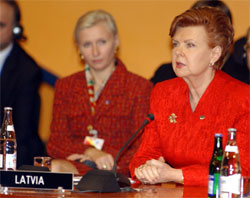
Latvian President Vaira Vīķe-Freiberga, in a statement released by her press office, said the invitation is an historic and joyful event for the nation. “Nothing will ever be the same for Latvia,” she said. NATO membership will offer Latvia security, Vīķe-Freiberga said, but it will also require the nation to work hard to meet NATO standards.

Valdis Pavlovskis, president of the California-based Baltic-American Freedom League, noted in a widely circulated e-mail that “our work is not yet done.” He called on Baltic Americans to thank those politicans who helped push for the NATO invitation.

Implicit in his note is the message that U.S. senators will have to be convinced to vote in favor of NATO expansion. Although Congress has expressed its support for NATO enlargement, actions such as the Oct. 7 adoption of two pro-expansion resolutions have been seen as mostly symbolic.

Latvia’s role in NATO

If accession negotiations are successful, Latvia could become a member of NATO in 2004.

But with a total of only 5,400 personnel on active duty (plus about 14,000 part-time members of the National Guard), according to the Ministry of Defense statistics, what can a small military like Latvia’s offer to NATO?

The answer, in one word, may be specialization. Writing in Time magazine’s Europe edition, James Geary noted that the Baltics’ strategic importance to NATO is BaltNet, a USD 100 million radar system financed by Norway and the United States that is able to peak into Russia’s Kaliningrad enclave.

Latvia’s specific contribution may be in the art of defusing or detonating bombs, according to Roger Boyes, a reporter for The Times of London. In a visit to the Ādaži training ground, Boyes learned that more than 50,000 shells have been exploded there since 1993. Latvian troops are expected to travel to the former Yugoslavia on a bomb-clearing mission.

NATO meeting in Prague

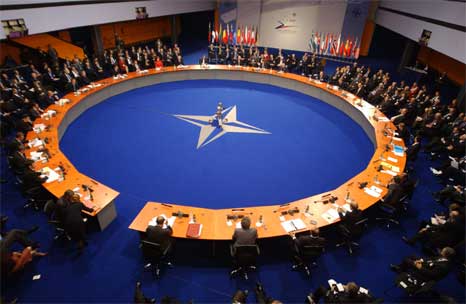
NATO leaders and the heads of state of seven candidate countries meet Nov. 21 in Prague. (NATO photo)

Vaira Vīķe-Freiberga

Latvian President Vaira Vīķe-Freiberga speaks during the Nov. 21 NATO summit meeting in Prague. (NATO photo)

Andris Straumanis is a special correspondent for and a co-founder of Latvians Online. From 2000–2012 he was editor of the website.

Let those in Latvia decide Nov. 18 meaning

To me, the meaning of Latvia’s Independence Day today is very different to what is was when I was growing up.

As a child of post-war Latvian refugees I too attended “Saturday School” where we learnt about Latvian language, culture and our heritage. It was our duty to attend—we were the future.  We had to keep alive the idea that Latvia could again regain its independence and be a free, independent nation.

Year after year, our elders would at the time of Nov. 18 retell the stories of how Latvia regained its independence in the post-World War I period and how, in the following years, people would celebrate the day. We would each go and place flowers and candles at the feet of a large photo of “Milda” (Latvia’s Freedom Monument). We would listen to recordings of the ringing bells of Rīga’s cathedrals and churches.

As a child I would look forward to the celebrations as we would each get a tub of ice cream to mark the event. But I could not help but feel that for the adults and our elders the day was always tainted with sadness.

In those days, the marking of Independence Day had some sort of personal meaning. Even though I was born and raised in Australia, had never been to Latvia and only knew of the place through what I had learnt at language school and through the stories of my grandparents, I felt personally touched, personally responsible, for making sure that in spite of it all the day would be marked and not forgotten. In my late teens (before Latvia regained its independence) I would attend the events, filled with a sort of nationalistic pride, thinking that we must never forget the dream and that we must ensure that Latvia does regain what it once had.

Today, now that Latvia has regained its independence, the meaning of Independence Day as it used to be seems somewhat redundant. The flame has been handed back to those living in Latvia. The job of the diaspora is done.

No longer do I have a personal sense of duty that the day must be marked and remembered. It has been a number of years since I attended one of the official ceremonies held every year at the Latvian House. It’s not that I have forgotten Latvia or that I am Latvian. I have travelled to Latvia five times and keep in contact with relatives there. I still consider myself part of the Latvian community as many of my closest friends are Latvian and I am married to a person of Latvian heritage. It’s just that since Latvia regained its independence, the celebrations of Nov. 18 hold little or no meaning to me.

In some ways I have fallen to the fate of my fellow Latvian emigres and their descendants. Ever since Latvia regained its independence we are forced to re-invent ourselves—our reason for collective existence—as well as the meaning of Nov. 18. It could be said that Nov. 18 can finally become a true celebration as Latvia is now generally regarded as a free and thriving democracy.

And if we have handed back the flame, is it not up to now up to the people of Latvia to define the true meaning of Nov. 18?  Who is to say that Latvia’s independence needs to be celebrated on Nov. 18? Maybe the date should be changed to some time in August when Latvia regained its independence and the world community recognised that it had done so. Either way, it is not up to those outside of Latvia to decide.