Bands in U.S., Canada grow Latvian fan base

For Adam Zahl, the past half year has been busy. Warming up the crowd one humid July night, the mostly Chicago-based band took the stage in the Metro club to open for Latvia’s Prāta Vētra. Next, the band released two albums. And, just last month, it zipped to Latvia for a quick tour with The Hobos. Not bad for a group of guys with day jobs in different cities. But that’s what life can be like for a Latvian band in North America—and Adam Zahl is just one of several with a small but ethnically loyal fan base.

During the half century that Latvian exile culture has flourished in North America, performers of popular music have been a small but strong part of a musical world dominated by folk ensembles and church choirs.

Earlier generations listened to Čikāgas Piecīši, Trīs no Pārdaugavas and other artists, and the latest crop of performers—like Adam Zahl—continue a pattern of adapting contemporary popular music genres to the Latvian language. Folk rock, punk and other styles can be heard in the live performances and recordings of today’s artists.

Here’s a look at several of the bands active in the United States and Canada.

Adam Zahl

Formed last year, Adam Zahl is five guys who share an interest in music and a connection to the Gaŗezers center in south central Michigan. In fact, the name of the group is a play on words, taken from the Latvian ēdamzāle, specifically the food hall at Gaŗezers.

Band members include Kārlis Briedis (guitar), Ēriks Kīns (guitar), Rūdis Pavlovičs (drums), Mārtiņš Šimanis (bass) and Ēriks Kore (saxophone and flute). They had known each other for years, but had played in different groups, such as Yes-I (a reggae band in Latvia), Skandāls, Morālais bankrots, The Minnow Buckets and Bob & The Latvians. Why form a new band? “We’ve known each other for a long time, the time was right, blame it on cosmic convergence,” said Kīns.

“Fundamentally,” he added, “our sound is rock-based with country, reggae, punk, polka and folk influences drawn from the diverse backgrounds of each member.”

Among the band’s recent accomplishments was spending two weekends recording two albums, Lone Tree Road and Pirmā plate. (The former takes its name from the road that runs past Gaŗezers.) As the album titles suggests, Adam Zahl performs in both Latvian and English.

Lusts

Unlike Adam Zahl, the Toronto-area “folk rock” band Lusts performs mostly in English, said Viktors Kūlnieks, one of four members of the group.

The band traces its beginnings back to 1995, when several Latvians in the Toronto area got together to play music. Until 2000, they called themselves Neil on Yonge Street. Today band members include Andrejs Kūlnieks (bass and vocals), Viktors Kūlnieks (guitar and vocals), Mike Rundāns (keyboards) and Aldis Sukse (drums, bass and guitar).

Lusts’ musical influences are broad and include artists such as Neil Young, Black Sabbath, the Grateful Dead, Jauns mēness and others, according to Kūlnieks.

The band has performed about 40 concerts and has released two albums. The more recent one, Vista, was released in December and Kūlnieks described it as “not polished at all.”

“We’re often living on different continents, or at least in different cities,” Kūlnieks told Latvians Online, “so we figured if we didn’t put out the stuff in whatever state we could get it to with us in the same place, we’d never get anything out.”

Although Lusts has not appeared together in Latvia, some band members have performed there, Kūlnieks added.

Mācītājs on Acid

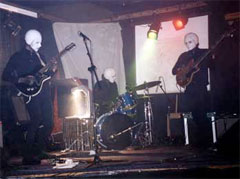
Mācītājs on Acid is known as much for its music as for its outrageous stage presence and offbeat name (which, translated, means Priest on Acid).

Formed in 1992, the “Latvian love punk” band began as a duo: brothers Kristaps (guitar and vocals) and Laris (drums and vocals) Krēsliņš. A bass player by the name of Treiops Treyfid occasionally joined the brothers.

But three years ago, with the addition of cousin Gustavs Mergins (bass), MOA became a trio.

Based in Washington, D.C. (where Kristaps Krēsliņš owns the Pharmacy Bar), MOA kept busy through the 1990s touring Latvia three times and completing three recordings, including Rock Bridge, the band’s first compact disc released as a joint effort with the Ukrainian-American band Kavune.

The group remains active, focusing on live performances rather than recordings.

“MOA’s music is hard to explain,” said Mergins. “It must be experienced. That also explains the paucity of MOA recordings. Every concert is an event and every concert is different.”

The band also is intent on performing in Latvian, although in concerts it projects translated lyrics onto a screen so non-Latvians can understand.

“MOA sings in Latvian because rock songs in German sound completely stupid,” Mergins said, “and none of us knows Spanish.” Latvian, he said, is a natural language for rock music. “Besides, there are enough groups that sing in English.”

The band returned to Latvia in 2001 and, Kristaps Krēsliņš said, plans to “conquer” it again this summer “with our weapons of love.” By that time, a new album could be ready as well.

Agrais Pīrāgs

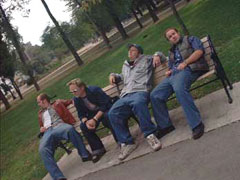
Hailing from Chicago and Ontario, Agrais Pīrāgs is among the younger of the current Latvian bands. The group includes Jānis Kļaviņš (guitar and vocals), Rob Ozoliņš (drums), Yuri Eliashevsky (bass), Kārlis Kanderovskis (guitar and vocals) and Austris Siliņš (guitar and voice).

The band describes its music as Latvian punk. “We took the traditional latvian songs that everyone knows, made them faster, louder, added a ‘punk’ flavor, more vocal harmonies, and just a ‘wall of sound’ feel,” said Kļaviņš. “It adds a lot more energy, and it gets the crowd really excited and wanting to sing along.”

Kļaviņš said Agrais Pīrāgs has drawn its influences from American punk music as well as from Latvian-American bands like Akacis and Skandāls.

Like other bands, Agrais Pīrāgs has been making the round of youth events, such as November’s congress of the American Latvian Youth Association in Chicago and the young artists’ exhibition, Šī māksla ir jauna, in Toronto last month.

The band began forming in the summer of 2000 while a number of the original members were working at the Gaŗezers center or attending the summer high school there. In November of last year, Agrais Pīrāgs (a Latvian expression meaning “jumping the gun”) released its first album, Tic vai ne Tic. A second album is expected this year.

While the band hasn’t played in Latvia yet, it is planning to tour there this summer, Kļaviņš said.

Skandāls

In another year, Skandāls will be able to celebrate its 20th anniversary. The Toronto-based band was founded in 1984 before that year’s song festival in Canada because, explains band member Alberts Vītols, no other band wanted to be the first to perform during the festival’s “rock night.”

During those two decades, the band has had a number of members, but its current lineup includes Vītols (guitar and vocals), Maria Thorburn (vocals), Mike Morrow (drums), Andris Daugavietis (bass) and Andris Krūmiņš (guitar).

Highlights of the band’s career have included performing before an estimated 50,000 people during the Rīga 800 celebrations two years ago. Calls to perform have taken the band across North America and Europe, Vītols said.

But, so far, the band has put out only one album. Vajag’ smērēt was released on cassette in 1986 and re-released on CD three years ago. Skandāls in 2001 also recorded four songs in the UPE Recording Co.‘s studio in Sigulda, Latvia.

“There are a few songs that we have performed that might be considered ‘hits’ in one way or another,” Vītols said. “Some of these songs are ‘Tevi vien,’ ‘Domas par mājām,’ ‘Jā gan!,’ ‘Paga, paga’ and ‘Vajag’ smērēt.’”

Other artists

Adam Zahl, Lusts, Mācītājs on Acid, Agrais Pīrāgs and Skandāls are not the only rock music artists who have become known to at least some segments of the Latvian community in North America.

For example, Linda Maruta in 2000 released her first recording, the straightforward rock album Buttercup, and has garnered some success in Toronto and in Rīga. She’s now looking at releasing a second album this year, according to her Web site.

These and other Latvian artists have at least one thing in common with earlier generations that have had to pursue their musical careers outside the homeland. They have managed, despite the demands on their lives and the distances that often separate them, to create music and a develop a base of fans. At least these days it’s a bit easier to make the leap back to Latvia.

(Editor’s note: An earlier version of this article appeared in the Latvian music magazine, Mūzikas Saule.)
Mācītājs on Acid

Stage performances by Mācītājs on Acid feature unusual costumes. (Photo courtesy of Mācītājs on Acid)
Agrais Pīrāgs

Four of the five members of Agrais Pīrāgs relax in a park. (Photo courtesy of Agrais Pīrāgs)
Andris Straumanis is a special correspondent for and a co-founder of Latvians Online. From 2000–2012 he was editor of the website.

Actually, we’re all Roberts Larionovs

ZZZ

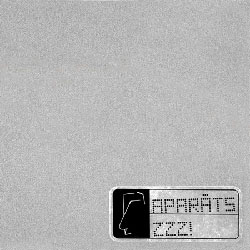
If you take away nothing else from ZZZ, the debut album by the Rīga-based group Aparāts, it’s this simple message: We’re all Roberts Larionovs.

What does it mean? Beats me. Maybe “Roberts Larionovs,” the final track on the album, is a song about a real person. In fact, after hearing the song for the first time I saw an interview on Latvian state television’s Panorāma with someone named Larionovs, but she wasn’t Roberts. Or maybe she was. Maybe Roberts Larionovs is really a sort of twisted Latvian Everyman.

No matter who Roberts Larionovs is, the song is just fun to listen to, as is most everything else on the album.

Describing the musical style of Aparāts isn’t easy. “Eclectic rock” comes to mind, which could fit well considering the group’s participants. The sextet includes a Latvian-singing and guitar-playing Dane named Peter Helms; guitarist Pēteris Sadovskis; bass player Mareks Auziņš; drummer Rihards Fedotovs, and backup singers Santa Pētersone and Ilga Grinpauka. Album credits also list guest singers (such as Alvils Cedriņš, who provides the operatic lead on “Milestības doktors”), as well as several musicians who lend their talents on instruments such as clarinet, flute, saxophone and tuba. The band must be a riot to see live on stage.

Aparāts was formed in 2000 and, by the time ZZZ was released late last year, had become well known in Latvian clubs.

Listen to the music and you’ll hear lots of rock flavored with funk, rap, jazz, the operatic voice or two, and what almost sounds like bits of klezmer thrown in.

ZZZ features 13 tracks, all but two penned by Helms alone. While several had been heard on Latvian airwaves before the album’s release, the song “Galdnieks” made it onto the 2002 Priekšnams compilation featuring music by little-known Latvian groups.

While some of the songs could no doubt be interpreted as having deeper meaning, on their face they are just plain fun. Helms must have enjoyed coming up with some of the rhymes, such as in the chorus for “Miers”: “Es esmu mierīgs, Tik ļoti ļoti miermīlīgs, Es mīlu dzīvniekus, ēdu tikai rīsiņus, Tādus mazus īsinus, Jebkura būtne ir mans draugs” (I am calm, So very very peaceful, I love the animals, Eat only rice, So small and short, Any being is my friend).

“Benedikte,” the loudest song on the album, is an example of why it’s important for some artists to provide the words to songs in album liner notes. Fortunately, Aparāts does, for otherwise “Benedikte” with its screamed lyrics would be unintelligble. Only after reading the lyrics did the song’s anguish and outrage—about a girl named Benedikte who doesn’t love the song’s protagonist—begin to make sense.

ZZZ also is among the newest releases from Baltic Records Group, which has added several new artists to its catalog in the past year in what seems to be an attempt to become a major contender in the Latvian market. The label’s biggest claim to fame is Marija Naumova, winner of last year’s Eurovision Song Contest.

In Aparāts the label appears to have found another success story.

Details

ZZZ

Aparāts

Baltic Records Group,  2002

BRG CD 130

Andris Straumanis is a special correspondent for and a co-founder of Latvians Online. From 2000–2012 he was editor of the website.

Teach your children well

In recent months, Viesturs Zariņš and Juris Mazutis have offered their thoughts on the Latvian community in North America. I wanted to put in my 5 cents’ worth, although none of my statements will be as intellectual or highly developed as theirs.

When one uses the phrase “Latvian community in North America,” it immediately conjures up dozens, if not hundreds, of different issues. However, I would like to address only one: parents teaching or not teaching their children Latvian.

While reading The Washington Post one recent morning, I came across an article about immersion programs that was rather relevant to the topic of Latvian language acquisition in Latvian families outside of Latvia. (To clarify, I’m referring to “total immersion programs,” in regular Monday-Friday, September-June schools, which, according to the Center for Applied Linguistics, teach all or part of their curriculum through a second language.) Virginia Collier, a George Mason University professor who has done research on second language acquistion, was quoted in the article: “There is oodles of research showing the tremendous advantage with acquiring a second language. The stimulus of acquiring a second language raises the intellectual academic achievement of all students.”

Thus, my initial question: If you have the opportunity of giving your children this great gift at home—without sending them to a special school—why not do so?

The swimming pool analogy

In his commentary, Mazutis wrote: “For parents who had counted on two weeks of ‘immersion’ as remedial magic that would correct years of linguistic neglect at home, non-acceptance of their children was a tragic surprise. Which part of ‘unqualified’ ( resulting in ‘excluded’ ) did they not understand? They have no one to blame for disappointment and anger but themselves. The standards a family ‘lives to’ (which later on open opportunities, or set roadblocks for offspring) are not trivial investments.”

As a friend of mine commented, Mazutis’ observation might not be a politically correct thing to express. But it is most certainly true. As someone who spends the vast majority of her life in the Latvian community, I see this situation too frequently. Whatever a Latvian summer camp does in two weeks will not replace what is done in the home the other 50 weeks of the year, just as whatever a Latvian Saturday or Sunday school can accomplish in four hours a week will not undo what takes place in the child’s home the other 164 hours of the week.

Think of it this way: if I push a fully clothed person into a swimming pool on Saturday, and she climbs out, her clothes will be dry by the following Saturday. However, if keep pushing this person back into the pool every single day of the week, her clothes will never fully dry.

Just do it

How many of us know families in which the parents are of different religious faiths, but go through the trouble of introducing their children to both faiths so that, when the children are old enough, they themselves can chose which faith, if any, they would like to pursue further?

I would suggest something similar with the Latvian language. We all know that different languages and ethnicities are an essential part of humanity. If you have the chance of giving your child the gift of a second (or, third, as the case may be) language, do so! I have met far too many adults of Latvian heritage whose parents did not make the effort to teach them Latvian, resulting in their children later having to ask, “Why?”

The year is 2003, and North American families that speak a language other than English at home presumably do not face the same problems and prejudices as such families faced in the 1950s.  I believe that society has progressed in the past 50 years, and most intelligent people see the benefits of bi- or multilingualism.

‘Sorry’ does not cut it

My interest in immersion programs reaches beyond its relevance to being Latvian in America. Back in 1981, when I was five and my sister was four years old, we began attending a German immersion school, one of the very first of its kind. This was after we had learned Latvian (at home) and English (through playing with neighbors, attending a preschool and watching Sesame Street).

When most Americans find out that I was learning three languages by the age of five, they are amazed. Having been brought up in another language and culture (Latvian) is already astounding enough, but being sent to an immersion program on top of that?!

Certainly, teaching one’s children Latvian is not easy. But what in life is easy? Give your children the opportunity and option to learn another language, to be a part of another culture, so that they can make the choice as to whether pursue it or not.

A young Latvian-American woman I know recently asked her father why he and her mother (both of whom are Latvian) had not spoken Latvian at home, resulting in her and her brother not knowing the language. He had no answer. All he could say was, “Sorry.”  Unfortunately, “sorry” does not cut it in this situation.

Similarly, just last month I met a young man of Latvian descent (his father is Latvian, his mother is not), who is struggling to learn Latvian, which certainly is not an easy language for an adult to learn. Most parents know that young children are like sponges. They soak up everything you teach them. The same is not true of a 25-year-old.

My opinions and advice are based only on my own life experiences. However, I can without hesitation say that every single day of my life I am grateful for having been taught Latvian, in addition to being thankful for the various experiences knowing Latvian and being involved in the Latvian community have afforded me.