


A family of wild turkeys, two adults and eight little ones, scurried across Galkin Road as I neared the Martin Luther Cemetery. I pulled my car through the partly open gate and gave the dust from the dirt road a moment to settle. Once again, I had come to northern Wisconsin’s Lincoln County to take stock of the old Latvian immigrant colony.
Outside in the dry heat, I was greeted by flies of the pesky horse and beautiful dragon varieties. Looking up the slight hill, I saw that things had not changed much from the last time I was here. The reddish-brown monument to the Latvian pioneers, who dedicated the cemetery in 1903, still stands. A number of graves are decorated with flowers, some perhaps left over from Memorial Day. A few gravestones are still hidden in clumps of overgrown greenery, forgotten by relatives.
Down to the right of the entrance, close to the dirt road and out of sight of the folks on the hill, the pagānu kapi looked pretty much the same, too. It’s here that people who were not members of the Martin Luther congregation were buried.
The few Latvian ancestors who still live near the unincorporated village of Gleason, as well as members of the Latvian Ev.-Lutheran Church of Milwaukee, had made plans to mark the 100th anniversary of the cemetery’s dedication on July 27. The Rev. Lauma Zušēvica would lead the kapu svētki service.
At the home of George Mondeik, conversation was interrupted by questions from extended family members about what food to bring, where to be when, and whether the grass in the cemetery should be trimmed one more time.
Mondeik, born in 1928, is one of only about four local Latvians who still recall the old days of the colony. His father, Jānis Mandeiķis, emigrated about 1895 from Žagari, near the modern-day Latvian-Lithuanian border. Like other Latvians, he was eventually drawn to Lincoln County by the promise of good land and the potential of creating a new Kurzeme in America. The Lincoln County colony was marketed by the Wisconsin Valley Land Company and promoted by Jēkabs Zībergs, editor and publisher of the Boston-based newspaper, Amerikas Vēstnesis.
Latvian settlers founded the Martin Luther congregation in 1900, the same year they got hold of land for a church and cemetery. The first Latvians were buried there in 1902, according to church records, but the cemetery was not dedicated until 1903. In 1906, the first church ever built by Latvians in the United States was erected in the cemetery.
Historians such as Osvalds Akmentiņš, who documented the colony in the Minneapolis-based magazine Tilts and in his 1958 book Amerikas latvieši, claim that upwards of 2,000 Latvians once lived in Lincoln County. Mondeik said he’s doubtful about that number, but allowed that maybe 750-1,000 may have once been in the area.
The Martin Luther cemetery certainly is no guide. Only about 125 people are buried there. Quite a few, according to cemetery records, are in unmarked graves.
In part because of religious and political conflicts within the community, Latvians also chose to bury their family and friends in other area cemeteries. Many are interred in the Gleason town cemetery. Others are in a cemetery in Merrill, the largest nearby city.
But the Martin Luther cemetery also reveals some of the hardships faced by the veclatvieši. For example, one family lost three children in three years. Minna Eglit, born May 22, 1903, lived only three days. The year before, Adam Eglit, survived three weeks after his birth on July 19, 1902. And Emilie Eglit, born Sept. 22, 1904, lived until January 1905.
By the 1940s, Mondeik said, regular church services “petered out.” In 1956, the church board adopted a resolution dissolving the congregation. The church itself was demolished in 1961.
A few years ago, the responsibility for the cemetery was passed on to Mondeik. Cemetery plots, bargain priced at USD 100, may still be purchased, he said.
Thankfully, the history of the Lincoln County settlers has not been forgotten. Mondeik has done his part, rescuing photographs and tape recording his memories. In recent years, the Milwaukee Latvian church has reached out to Lincoln County. Church member Artūrs Mundeciems of Waukesha, Wis., has done much to gather the history of the Martin Luther congregation.
Yet the story of Lincoln County goes beyond the old church and the cemetery. In fact, Lincoln County was a microcosm of the Latvian immigrant experience, with people of differing religious and political leanings trying—but failing—to coexist.
For the moment, it’s good just to be able to walk among the gravestones of the Martin Luther cemetery and to imagine what might have been.
(Editor’s note: Some research for this article was supported by a grant from the Latvian Foundation, with research assistance provided by Amanda Jātniece.)
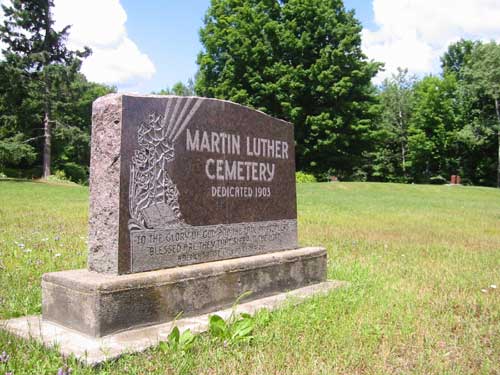
A stone monument, which sits on the site of the old Latvian church, notes the date of dedication for the Martin Luther Cemetery in Lincoln County, Wis. (Photo by Andris Straumanis)
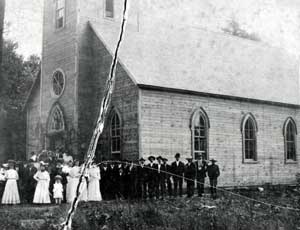
Latvian immigrants gather sometime in the early 1900s outside the Martin Luther church in Lincoln County, Wis. (Photo from George Mondeik’s personal archive)
