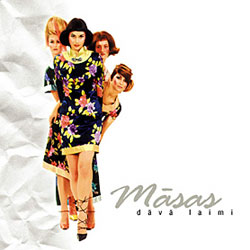
The all-female rock band is a scarce species, but in the past few years one has emerged in Latvia. They are the quaintly named Māsas and their debut album, Dāvā laimi, was released by MICREC in 2001.
The name Māsas is appropriate because the four-member band contains two sets of sisters. Līga Celma is on vocals and guitar, and her sister Daina Celma is on vocals and keyboards. Kristīne Dortāne sings and plays bass, while her sister Ingūna Dortāne sings and plays the drums.
I had heard the song “Dāvā laimi” on the compilation SuperIzlase 2, released in 2001 by MICREC. It is a very catchy, poppy song, and I really liked the lyrics by Līga Celma: “Dāvā laimi, nelaime nāks pati” (“Give the gift of luck, bad luck will come on its own”).
Having only heard that song prior to purchasing this compact disc, I was expecting a recording of mainly pop songs. I was pleasantly surprised to find that this was not the case. The music performed by Māsas is hard to classify. The album contains many different styles, giving it an eclectic feel. This range of styles, as well as strengths in songwriting and performing, makes this CD enjoyable and also stand up after repeated listenings.
Some of the songs even have a jazzy flavor. I especially like “Stacija,” a very pretty song about waiting with a loved one for a train. Another song I liked is “Laidīsimies prom,” a more up-tempo tune.
Another enjoyable aspect of Māsas is their sense of humor. This is evident not only in the photos in the CD booklet (showing the members of the band dressed up in some rather absurd fashions, not to mention a bit too much makeup) but in the songs as well. To close out the album, there’s “Intervija ar skumjo govi,” a song about a sad cow. The song even starts out with band members mooing.
The packaging contains the lyrics to all the songs, which was very nice to have.
Make no mistake about it—this is a band here, not just a collection of four female singers. Songwriting and musicianship are top-notch, leading to an enjoyable CD in Dāvā laimi. Adeptly switching between many different styles over the course of the album, Māsas have created a great collection of songs. For those who still might hold the outdated notion that “girls can’t play,” look no further than this album. Māsas can play with the best of them!
Details
Dāvā laimi
Māsas
MICREC, 2001
MRCD 160
Egils Kaljo is an American-born Latvian from the New York area . Kaljo began listening to Latvian music as soon as he was able to put a record on a record player, and still has old Bellacord 78 rpm records lying around somewhere.