Latvian doctor among hockey hall honorees

Dr. V. George Nagobads, who served as the team physician, is among those honored Oct. 18 when the 1980 U.S. Olympic hockey team was inducted into the U.S. Hockey Hall of Fame in Eveleth, Minn.

The “Miracle on Ice” team, which won the gold medal in a final game against the Soviet Union during Winter Olympics in Lake Placid, N.Y., is only the second team so honored, according to a press release from the Hall of Fame.

Born in 1921 in Rīga, Latvia, Nagobads has served as a team physician for a number of American teams, including the former Minnesota North Stars of the National Hockey League. He also served from 1958 to 1992 as the team physician for the University of Minnesota’s hockey team.

Last year he was honored with the Paul Loicq Award for lifetime service to hockey worldwide. The award was presented by the International Ice Hockey Federation.

Andris Straumanis is a special correspondent for and a co-founder of Latvians Online. From 2000–2012 he was editor of the website.

Old Piecīši humor still works sometimes

As part of their live performances, not only do the Čikāgas Piecīši perform satirical songs, but they also do satirical comedy sketches. The sketches poke fun at a wide variety of topics, but the most common motif is the experience of being Latvian while living in the United States.

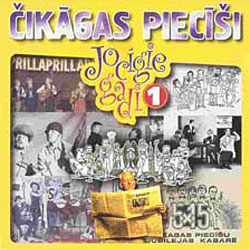
The latest compact disc from the Piecīši, Jocīgie gadi 1, collects a number of these sketches. Many of these sketches were already released on the vinyl recording Vēl jau viss nav pagalam, but this collection also contains other sketches recorded throughout the group’s career. And because this is a comedy album, there are very few actual songs here.

So do jokes from as long ago as the 1960s hold up? Not surprisingly, some of the material doesn’t age well, but some of it can still provoke laughs even today.

The theme of being Latvian in the United States is a rather timeless one, so there the humor is still relevant. One of the funnier sketches on the album is “Jauktā laulība,” which is about the marriage of a Latvian man to an American woman. The woman finds out more than she wants to know about certain Latvian foods, like asins desa (described to her as pig’s intestine filled with fresh blood) and galerts (compared to frozen vomit).

The sketch “Pēc pilsoņu papīriem” details the travails of a Latvian getting his American citizenship, coached by another “helpful” Latvian about how to best answer the questions. “Kokteiļpartija” also has a conversation between a Latvian and American, with the American being bewildered by some of the Latvian customs that are described.

Generational differences are always good for comedy, as shown by “Draudzīgais aicinājums,” which has an older Latvian going on an extended rant about the way the young Latvians dress, with the obligatory comment about “back when I was young…”

But the political humor doesn’t hold up too well. The occasional reference to President Lyndon Johnson dates the humor.

A few “songs” are found on the album, including “Sunītis,” which is a comical attempt at performing “How Much is That Doggie in the Window?” in Latvian.

Most of the texts were written by Piecīši leader Alberts Legzdiņš as well as Uldis Ievāns.

Perhaps some of the recorded humor not working as well as it could is due to sketches having a certain visual aspect. The few photographs that are in the CD booklet show the members of the band dressed up in costumes, which often add to the humor in live performances.

As with most all comedy albums, this CD does not invite repeat listenings. There are more laughs here than I expected, but it is still not a CD I listen to with any kind of regularity. It best serves as an archive of the last 40 years and as a reminder that some humor can be timeless.

Details

Jocīgie gadi 1

Čikāgas Piecīši

Balss,  2002

BACD 067

Egils Kaljo is an American-born Latvian from the New York area . Kaljo began listening to Latvian music as soon as he was able to put a record on a record player, and still has old Bellacord 78 rpm records lying around somewhere.

Lyrics aside, R.A.P. turns out good alt-rock

When first looking through the liner of R.A.P.‘s new compact disc, 2, I felt like someone was trying to play with my mind. R.A.P. isn’t a rap group, as its name might suggest, but an alternative rock band. And instead of looking like a stereotypical rock band, the picture in the disc jacket portrays a group I would expect to be singing a song by the Doobie Brothers. Thankfully, first impressions aren’t always everything.

R.A.P. (originally called Rāpuļi ar putniem) is a four-member band that has been playing together since the mid-1990s. Members include singer A.D. (Artis Varionas), bassist Masters (Artis Rozītis), guitarist Štro (Aleksandrs Štro) and drummer Gatis L. (Gatis Lagzdenieks). 2, the group’s third album, was preceded by the 2001 album Feel? and the 1999 album Vanilla.

In Latvia, the group’s song “Nekas vairs nav tā” not only held a spot in Radio SWH’s Top 40 for 22 consecutive weeks, but was also ranked as the most-played song across the nation’s radio stations. Only to confirm R.A.P.‘s growing popularity, in 2002 “Nekas vairs nav tā” received the award for Latvia’s best modern rock song.

The album includes 13 tracks in English and three “bonus” tracks in Latvian.

The beginning of the first track, “Looking Stone,” holds promise. The elements of rock are present: a riff from a bass guitar starts out, the lead guitar enters and takes over, soon followed by drums. It’s good, really good. The singing adds on, and everything seems to fall into place.

But when I listened to the lyrics, which, while serious and belted out in an alternative rock manner, made no sense: “…Walk on by, shove and flee, Happen still to call your name, Looking small, all night long, Laughing tall, she saw what?…”

Don’t we all experience this scenario at some point? I was left thinking, “They said what?” Minus the lyrics, the song is acceptable.

The rest of the album wavers between alternative rock and what I would label as “light metal.” The music stays consistently excellent, reminding me of a mixture of American groups such as Linkin Park and Incubus. My favorite tracks—for purely instrumental reasons—from the main part of the album are 7 and 12. Track 7, “Touch in the Night,” starts out with a kind of tribal-sounding instrument. Its riff is then transferred to bass guitar and is heard throughout the entire song. My only regret is that the original instrument is not used again.

Track 12, “Scabs of the World,” is instrumentally fulfilling. The song is anything but boring, as the center of interest of the track switches from bass to vocal to lead guitar to all instrumental and vocal. The vocals, however, don’t stand out. Nothing’s wrong with the voice—the talent and angst are clear. Unfortunately, in this and other songs, the vocals don’t seem to be the focus of the songs. They’re hard to hear and don’t jump out enough to be appreciated. It seems like they’ve been added only to provide a bit of icing to the cake that is the instrumentals.

However, after listening to the three bonus tracks, I was left with the impression that vocalist A.D. is more comfortable singing in Latvian. And—big surprise—the lyrics made sense. Another thing that finally made sense is why R.A.P. was ranked so high in Latvia with “Nekas vairs nav tā.” It’s a perfectly developed rock song. The music is not too fast, nor too slow. The consistent tempo is easy to get into and makes your head bob. The vocals aren’t off the wall and insane. They’re calm and soulful, and when put together with the somewhat “screamed” vocals of the chorus, they left a happy humming in my brain—an alt-rock warm fuzzy. If R.A.P. keeps putting out songs of this caliber, then for them viss vienmer būs tā.

Details

2

R.A.P.

Platforma Records,  2003

PRCD 106

On the Web

R.A.P.

R.A.P. (originally called Rāpuļi ar putniem) is a four-member band that has been playing together since the mid-1990s.This the group’s official Web site. EN LV