Auction of hockey pucks to help Latvian kids

An online auction of hockey pucks and other sports memorabilia, the proceeds of which will benefit Latvian children, is scheduled from Nov. 20-30 on the eBay service, the Milwaukee, Wisc.-based Kids First Fund has announced.

The “All-Stars Hockey Puck Auction for Kids” will feature hockey pucks signed by more than 115 National Hockey League players and celebrities.

Among them are Mario Lemieux, Jaromir Jagr, Pavel Bure, Mike Modano, Bill Guerin, Marty Turco, Ed Belfour, JS Giguere, Brian Leetch, Marian Gaborik, Nikolai Khabibulin, Jeremy Roenick, Jason Arnott, Teemu Selanne, “Mr. Hockey” Gordie Howe, Kids First Fund board member Arturs Irbe and honorary director Sergei Zholtok. Irbe and Zholtok are from Latvia.

The auction will be available at members.ebay.com/aboutme/kidsfirstfund/.

“Sergei Zholtok of the Minnesota Wild and Arturs Irbe have been tremendous assets in organizing our auction,” Jay Sorensen, Kids First Fund board president, said in a press release. “During 2003, Arturs and Sergei personally asked fellow NHL players to donate autographed hockey pucks and other items. Their efforts along with the generosity of players and team staff will raise thousands of dollars for our projects in Latvia.”

The Kids First Fund supports programs in Latvia to educate child welfare professionals such as police officers, judges, social workers and prosecutors on child abuse issues. Direct assistance is also given to centers providing care for abused children. The fund also anticipates it will develop Latvia’s first family shelter for abused children and their mothers during 2004.

Further information about the Kids First Fund is available from the charity’s Web site.

Andris Straumanis is a special correspondent for and a co-founder of Latvians Online. From 2000–2012 he was editor of the website.

Documentary captures youth in Soviet Latvia

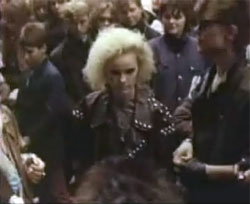
A group of Latvian punks is among people studied in Juris Podnieks’ 1986 documentary.

The body of work by Juris Podnieks lends itself to superlatives that often sound too good to be true. His accidental death in 1990 at the age of 42 deprived Latvian film of an incredible talent who would have been entering the prime of his career. Podnieks’ skill and talent combined to make a filmmaker who would be considered great not only in the context of Latvian film, but by any global cinematic standard. This is made even more extraordinary given where and when he made his films. Working under Soviet rule as a documentarian, a genre that demands clarity and truth under a government that provided neither, he managed to make singular films that withstand the test of time.

Perhaps no other film exemplifies this better than Vai viegli būt jaunam? (Is it Easy to be Young?). Released in 1986, the film played to packed houses across the Soviet Union and to critical accolades in the West.

The film opens with rock concert footage spliced with coverage of the trial of several youths who were charged with the vandalism of a train at the conclusion of that concert. Podnieks contrasted the exuberance and implied rebel spirit of the concert with shots of the accused standing uncomfortably before those who would judge them. There is no question how this trial will turn out. It’s a forgone conclusion. They don’t stand a chance before these authoritarian figures who deliver the “facts” without passion or emotion and with an unwavering conviction of their “right” and “righteousness.” The accused don’t even attempt to defend themselves, not as an admission of guilt, but with a hopeless resignation to their fate. The only one of them to even attempt to raise a defense is eventually sentenced to several years of hard labor.

And so starts the exploration of whether it is easy to be young. Podnieks presented a variety of subjects in various settings providing us with a wide cross-section of youths from various walks of life and divergent destinations. He created a snapshot of time which not only captured the difficulties of growing up, but also of the Soviet Union as it was beginning to unravel under its own banality, hypocrisy and utter disregard for humanity.

We meet an eager Krishna who seems to be rebelling against what he perceives as a corrupt society, but who does so by replacing one form of blind allegiance with another. Down with Lenin! Up with Hari!

We meet a young punk who is exceptionally articulate, intelligent and informed, but for all of that can’t see beyond his own fatalistic nihilism. There’s a young girl who failed in her suicide attempt being browbeaten by those who are supposed to cure her and a first-time filmmaker who isn’t sure of what he wants to say but knows that he needs to say something. All of them will seem familiar to those of us who can remember entering adulthood regardless of where and when we did so.

But perhaps the most poignant moment in the film is the before-and-after interviews with young conscripts who were sent to Afghanistan. The contrasts are as shocking as those of the most cynical and broken combat veterans as seen in any documentary about war and its consequences. Watching a young veteran walking through a city filled with people on whose behalf he had believed to be fighting and in defense of a system and ideals that he no longer can share is as powerful of an image as I’ve seen on film.

Podnieks’ greatest strength was in getting these individuals to reveal so much. We get the feeling as if we are sitting in on a late night conversation between friends where they let down their guard and reveal their true selves and feelings. Even more extraordinary is that Podnieks got them to do so in a time and a place where public introspection of this kind often had severe consequences.

The film’s greatest strength is in showing what it means to “grow up,” and answering the title question with: It never is, nor should it ever be.

Details

Vai viegli būt jaunam?

Juris Podnieks, director

Rīgas kinostudija,  1986

Notes: In Latvian. Documentary, color, 80 minutes. Screenplay: Ābrams Kleckins; director of photography: Kalvis Zalcmanis; music: Mārtiņš Brauns.

Tumsa leaves rock roots, chooses pop sound

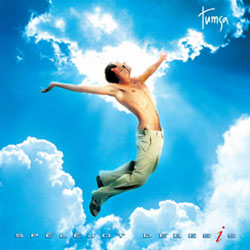
Spēlējot debesis

Mārtiņš Freimanis, lead singer of the band Tumsa, seems dead set on becoming a pop star. Not content with leading his band in a more poppy direction, he is also part of the pop group F.L.Y. (along with Lauris Reiniks and Yana Kay), and F.L.Y. competed earlier this year in the holiest of Europop events, Eurovision 2003.

Perhaps because of his pop inclinations, Tumsa has come a long way since its debut, Putni. Putting that first album side by side with the latest compact disc, Spēlējot debesis, the average listener might be hard to convince that they are by the same band. Becoming slicker with each passing album, Tumsa has left behind its hard rock roots and is courting mass appeal.

Now, this does not mean that Spēlējot debesis is a bad album. On the contrary, I think it is quite good, and perhaps the band’s most consistent album to date. Having had this album for a while now, it still finds its way into my CD player quite often. It may be poppy and it may be slick, but it is still an excellent album.

The lineup remains as before: Freimanis on vocals and acoustic guitar (he’s also the principal songwriter), Jānis Daugalis on bass guitar, Aigars Šmits on keyboards, Haralds Drekslers on guitars and Kaspars Boroduško on drums.

Much like other Latvian bands, Tumsa is at its best when offering up more melancholy songs. Not coincidentally, my favorite songs on the album are the first track “Pēc mums (vēl ilgi zeme skums)” and “Es esmu mazliet don Kihots,” both of which show the band at the peak of its ability.

It’s not all melancholy, though. “Pēc mums” is followed by the far more cheery “Spēlējot debesis,” providing a nice balance to the more heartrending songs on the album.

The song “Logi mākoņos” (a rather sincere anti-drug song) features the Latvian rap group Device often repeating the main theme of the song, “Lūdzu nepadodies” (Don’t give in).

“This is not paradise” is the only song in English and features a saxophone solo by Alex Balinsky, not to mention an appearance by well-known Latvian violinist (and Bet Bet lead singer) Zigfrīds Muktupāvels. This is one of the more poppy songs on the album, practically a dance track.

Tumsa seems to be going for an Elton John feel on the song “Balāde par sirdīm salauztām,” what with piano and a soaring string section, added presumably for dramatic effect.

One of my favorites on the album is “Tu esi tāda viena,” a more up tempo number and probably the catchiest song on the album.

I may have misgivings about Tumsa’s transition to a more pop-oriented sound, but Spēlējot debesis is still a very well-crafted album, full of even more classic Tumsa songs. Also nice is that all the lyrics are included in the CD booklet. Perhaps now that Freimanis has become a bona fide pop star as a member of F.L.Y., he will be able to take out his pop agression there and return revitalized to Tumsa. There is no denying the songwriting talent of Freimanis (his name appears in the songwriting credits for many other artists) and that is why you can always count on Tumsa to put out excellent records, Spēlējot debesis included.

Details

Spēlējot debesis

Tumsa

MICREC,  2002

MRCD 187

On the Web

Tumsa

The group’s official Web site includes background on the band and samples of its music. EN LV

Egils Kaljo is an American-born Latvian from the New York area . Kaljo began listening to Latvian music as soon as he was able to put a record on a record player, and still has old Bellacord 78 rpm records lying around somewhere.