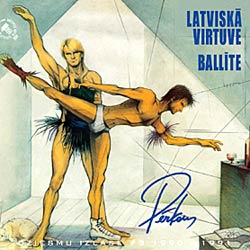
After what seemed to be an interminable length of time, the MICREC recording house in August released Dziesmu izlase #3, the third and final compact disc compilation of Latvian rock group Pērkons’ early albums. The previous compilation came out in 1996.
Once again, the release features two albums on one CD, this time 1990’s Ballīte and 1991’s Latviskā virtuvē. Both original releases were long out of print (Ballīte was supposedly released on vinyl but I never saw it on any of my trips to Latvia, and Latviskā virtuve didn’t even have an official release, per se). MICREC has done a phenomenal job of releasing the pearls of Latvian music on CD and this is yet another treasure that I am very thankful has once again seen the light of day.
As with many Latvian groups, it is sometimes very difficult to know what to expect with Pērkons. The first compilation, Dziesmu izlase #1, collected songs from 1981 and 1982 featured some rather raw tracks, with the focus being on the guitar. However, it did have some more sublime moments, including the hit “Pie baltās lapas.” It is a beautiful song that has the distinction of being the very first to break Raimonds Pauls’ stranglehold on the Mikrofons song competition (achieving first place at the Mikrofons 83 competition).
The second compilation, Dziesmu izlase #2, reissued albums from 1985 and 1987. It was a far more mature effort and featured hit after hit (such as “Zaļā dziesma,” “Gandrīz tautas dziesma” and “Cik pulkstens”).
What to expect from the third compilation? Surprises abound, and there are enough great songs to make the lengthy wait for this release worthwhile.
I previously had heard only two songs on Dziesmu izlase #3. The first was megahit “Mēs pārtiekam viens no otra” (lyrics by Viks, who is composer Imants Kalniņš’ brother, Viktors Kalniņš), a song that once again got Pērkons to first place in the Mikrofons song competition, this time 1989. It is easy to understand why, as it is one of Pērkons’ most moving songs. The oft repeated lyric, “Mēs pārtiekam viens no otra, un neviss no pārtikas precēm,” also likely struck a chord in many listeners in those final days of Soviet occupation. The music and the lyrics combined perfectly.
The second song I had heard—on the 1990 Vecais ratiņš aptauja record—was “Ballīte” (lyrics provided by famous Latvian author Anšlāvs Eglītis), which is just about my favorite Pērkons song of all time. The title is appropriate for the song, as it actually makes me want to dance. It is such a rousing number. Just having this song finally on CD makes the entire collection worthwhile.
The major fault of this CD release is that lyrics are not included. I always have had trouble figuring out the words to “Ballīte.”
All of the music on this CD, as well as all on the other CDs, was composed by the group’s keyboardist, Juris Kulakovs. In recent times, he has made a name for himself by composing a number of “long form” pieces, as well as performing with the Latvian Three Tenors.
The rest of Pērkons includes Nauris Puntulis on vocals, Juris Sējāns on bass guitar and vocals, Leons Sējāns on guitars and vocals, Ikars Ruņģis on drums and Raimonds Bartaševics on vocals, as well as the famed singer Ieva Akurātere.
Though very able to craft hit singles, the band also had a number of songs that are at once unusual and creative, and often times the lyrics are either humorous or just plain strange. For example, the song “Lūgums,” with lyrics by Andris Žebers, is basically a request to not stand on the toilet with your feet, because that will leave black footprints (other people have to sit there, you know). Another example is one of my favorites, “Kamēr es tevi mīleju” (lyrics by Juris Kronbergs), which, for the most part, is a straight ahead rock song, with a guy detailing all the things a girl did while he loved her (she became a vegetarian, she fought for women’s rights, she went to the dentist, etc.). This song also features a vocal appearance by Kulakovs, who details how penicillin makes you weak and want to sleep all the time.
As with the second compilation, the capacity of the format limits the number of songs that could be put on the CD. The songs “Saule purā” and “Viss rudens,” as well as the instrumental finale to the play “Spēlēju, dancoju,” can only be found on the cassette version.
The packaging is skimpy: No lyrics, just pictures of the band members. It would have been nice to read some of the likely very interesting history of this band.
This third compilation illustrates again why Pērkons is one of the most beloved bands in Latvia. Even though these were the band’s last albums (released more than a decade ago now), the group is still popular and attracts concertgoers.
The future might even bring a new album, which I think will be eagerly anticipated by many. Hopefully that album will include the also-not-available-on-CD song “Kāzas,” which can only be found on the Mikrofons 93 cassette. Also worth releasing on CD are the “alternate” versions of “Gandrīz tautas dziesma” from the Mikrofons 87 record and “Mana dienišķā dziesma” from the Mikrofons 88 Stafete record. In any case, this CD has enough gems to tide me over for at least the foreseeable future.
Details
Dziesmu izlase #3, 1990-1991
Pērkons
MICREC, 2003
Egils Kaljo is an American-born Latvian from the New York area . Kaljo began listening to Latvian music as soon as he was able to put a record on a record player, and still has old Bellacord 78 rpm records lying around somewhere.