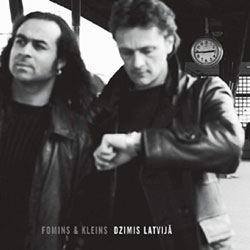
Here’s to good, old Latvian rock and roll

Dzimis Latvijā

With but a single album, the Liepāja duo Fomins & Kleins established themselves as one of the premiere rock groups in Latvia. Their debut album Muzikants, released in 2003, contained hit single after hit single and brought them prominence and popularity.

Could they keep up this momentum on their successive albums? On their second album, Dzimis Latvijā (Born in Latvia), they continue right where they left off, with their lyrical rock and roll, not skipping a beat.

The lineup of the group remains almost the same from their first album. Ivo Fomins (lead vocals) and Tomass Kleins (guitars, keyboards, vocals) are joined by Egils Mežs on bass, Valērijs Iņutins on drums, and new keyboardist Jānis Lūsēns Jr. Once again, Kleins wrote all the music, and lyrics were written by omnipresent Latvian wordsmith Guntars Rāčs. Since the ingredients in the formula did not change much, the resulting concoction has a welcome familiarity, like a dependable friend.

Fomins & Kleins also are notable as they are the Latvian entries in the Eurovision Song Contest this year. Nearly winning the Latvian national competition in 2003 with the song “Muzikants,” they re-entered this year with the song “Dziesma par laimi” (Song of Happiness), and won convincingly. As in 2003, this was the only entry in the Latvian competition that was performed in Latvian. The songs are somewhat similar—they are both in the same key and use the same chords. But I don’t mind really and do like both songs. Though conventional wisdom would say that a song sung in Latvian has little chance of winning Eurovision, it will be nice to have a break from the overly slick pop that seems to dominate the competition every year. All of Europe will have the chance to hear what the Latvian language sounds like. Besides, I think there are worse things that could happen to the band than not winning Eurovision, though it would be nice to have a pair of rockers in their mid-thirties triumph over the usual mundane stuff the contest offers! The song itself, as its title indicates, is a song of happiness and hope, that even when all is lost, this song will still remain.

I think the key to their success is the simplicity. “Professional” musicians might scoff at Fomins & Kleins’ simplistic songs, but great songs are rarely made great simply due to the number of chord changes and modulations. Do remember that many Latvian folk songs get by with three or four chords, and they have remained popular for hundreds of years. For example, the duo’s song “Nekas” (Nothing) is a song about a lonely girl whose only greetings come from the morning sun. The chorus, as with many of their songs, stays with you, since it is easy to remember.

Another favorite is “Aizejošas dienas” (Departing Days), a song about time flying and time lost, once again with an anthemic chorus. Also in this vein is the opening song “Otrās dienas rīts,” which starts with the line “Tici vai nē, bet šī diena ir skaista bez tevis” (Believe it or not, this day is beautiful without you).

Since the release of their first album, the Latvian rock music world was hit by the tragedy of the death of Dainis Virga (drummer for the group Līvi) in an automobile accident. There is a tribute to him on this album called “Ar Dievu bral’” (Go with God, Brother), a touching ballad with the words “Ir tikai beigas vēl vienai dziesmai, bet piedziedājums pārāk īss” (It is just the end to another song, but the chorus was too short.)

Without missing a beat, Fomins & Kleins’ second album picks up where their debut left off. As the old saying goes, if it ain’t broke, don’t fix it, and certainly the songs of Fomins & Kleins ain’t broke! I think their songs can be appreciated by just about any listener. Even though they are simple, the songs can speak to many different kinds of listeners. Here’s to good old fashioned Latvian rock and roll triumphing over manufactured pop at Eurovision!

Details

Dzimis Latvijā

Fomins & Kleins

MICREC,  2004

MRCD 237

Egils Kaljo is an American-born Latvian from the New York area . Kaljo began listening to Latvian music as soon as he was able to put a record on a record player, and still has old Bellacord 78 rpm records lying around somewhere.

Song fest visitors to see normal border delays

As Latvians prepare to visit this summer’s biggest Latvian ethnic event in North America—the song festival in Toronto—they should also ready themselves for delays at the border as they enter Canada. But, says a border service spokesman, those delays should not be any greater than expected during a busy holiday season.

The 12th Latvian Song Festival in Canada is scheduled July 1-4 in downtown Toronto and occurs over two major holidays, Canada Day on July 1 and the Fourth of July in the United States.

“That weekend will be a busy, busy time,” Canada Border Services Agency spokesman Danny Yen told Latvians Online. Visitors arriving by automobile should expect on average a 20-minute delay as they enter Canada, he said.

“We do staff up for the busy times,” Yen added. However, he said the border services agency can’t predict if additional security measures might be in place because of unexpected events. Border security has become tighter since the Sept. 11, 2001, terrorist attacks in the United States.

Latvians traveling by automobile most likely will use one of seven main border crossings into southern Ontario, including the bridge crossing from Detroit, Mich., into Windsor, Ont., the busiest on the Canada-U.S. border, Yen said.

Other points include a tunnel from Detroit into Windsor; a crossing from Point Huron, Mich., to Point Edward, Ont.; a crossing from Buffalo, N.Y., to Fort Erie, Ont., and three bridges at Niagara Falls.

Literature about traveling to Canada includes suggestions such as carrying appropriate documentation, including U.S. passports or green cards that show a person’s citizenship status. Latvians without U.S. documentation, such as those holding Latvian passports, might check with a Canadian consulate for travel information. Further information about traveling to Canada is available from the Canada Border Services Agency’s Web site, which includes a page with hourly updates on Canada-bound and U.S.-bound border wait times.

Andris Straumanis is a special correspondent for and a co-founder of Latvians Online. From 2000–2012 he was editor of the website.

Arson investigated as cause of Kuldīga fires

Local officials are not ruling out arson as the cause of a series of Easter holiday fires that damaged nine buildings in the historic heart of the western Latvian city of Kuldīga, media reports say.

The fires, which are estimated to have caused about LVL 100,000 in losses, began about 5 p.m. April 12, according to the local newspaper, Kurzemnieks. The fires burned several structures considered to be of historical value.

Kuldīga has only two fire trucks, but assistance came from several neighboring towns and as far away as Jūrmala, the newspaper reported. In all, about 25 fire trucks were called to fight the blaze.

Local firefighters were called out at 5:07 p.m. to a report of a fire in a shack on Smilšu Street, Kurzemnieks reported. Soon after, reports came in that a shack between Putnu and Liepāja streets was on fire, as well the roof of the old hospital on O. Kalpaka Street. Other buildings on Putnu Street also began burning.

“It’s obvious that the fire was set intentionally,” reporter Edgars Liepiņš wrote in a story posted on the paper’s Web site. State fire officials and police are investigating, according to the national daily newspaper Diena. The cause of the fire may also have been accidental.

The fire spread because of high winds, some media reports suggest.

Although no one was hurt in the fire, two families were left homeless.

The Kuldīga City Council is expected to ask the state government for at least LVL 80,000 in assistance to repair or rebuild the structures.

Andris Straumanis is a special correspondent for and a co-founder of Latvians Online. From 2000–2012 he was editor of the website.