President visits United Kingdom

A visit to Oxford University, discussions with government officials and a brief meeting with Latvian community leaders are on President Vaira Vīķe-Freiberga’s schedule as she visits the United Kingdom May 11-13, according to her press office.

Among her plans are May 11 visits to Oxford’s Wolfson and St. Anthony’s colleges, where she is expected to meet with faculty and students to discuss Latvia’s role in the European Union.

On May 12, Vīķe-Freiberga is to meet with the London’s Lord Mayor Robert Finch and various London business representatives. In a brief meeting with Latvian-British community leaders, the president is expected to thank them for their role in seeing Latvia become a member of the EU and the NATO defense alliance, two foreign policy goals that have been achieved in the past two months.

Also planned May 12 is a meeting with British Prime Minister Tony Blair.

The president also is expected to host a reception in the British Parliament in honor of her book, In the Name of Freedom, published last year by the Jumava publishing house in Rīga. The book was originally published in Latvian as Brīvības vārdā.

A May 13 visit to Wales will include meetings with political leaders and signing of a memorandum of understanding between Wales and Latvia. Vīķe-Freiberga also is to be interviewed by BBC Wales television.

The president is scheduled to return to Latvia the evening of May 13.

Andris Straumanis is a special correspondent for and a co-founder of Latvians Online. From 2000–2012 he was editor of the website.

Eurovision gets bigger, goes ethnic

This year’s Eurovision Song Contest will be the largest, and perhaps most ethnic, ever. Thanks to fundamental changes in how the contest is run, a total of 36 nations will be in the competition to be presented in two stages May 12 and 15 in Istanbul, Turkey. Latvia’s duo of Fomins & Kleins has a shot to make it to the 24-nation final, but they won’t win.

Fourteen countries already are in the May 15 final, based on their population or their showing in the 2003 contest that was hosted by Latvia. Guaranteed a spot are Austria, Belgium, France, Germany, Iceland, Ireland, Norway, Poland, Romania, Russia, Spain, Sweden, Turkey and the United Kingdom. Turkey’s Sertab Erener won the contest last year, giving her home country the right to host this year’s Eurovision.

Latvia and 21 other countries will compete in the semi-final on May 12. The 10 nations getting the highest number of international television audience votes will join the other finalists. Up against Latvia in the semi-final will be Albania, Andorra, Belarus, Bosnia and Herzegovina, Croatia, Cyprus, Denmark, Estonia, Finland, Greece, Israel, Lithuania, Macedonia, Malta, Monaco, Netherlands, Portugal, Serbia and Montenegro, Slovenia, Switzerland and Ukraine.

Several entries this year will be sung in a language other than English, a shift from the past several years when any taste of the diversity of Europe seemed to disappear. Also, perhaps owing to Turkey’s victory last year and a second-place showing by a group from Belgium performing in a make-believe “ethnic” tongue, several songs have been entered that draw on traditional cultures.

My favorites to advance out of the semi-final include Albania, Belarus, Cyprus, Estonia, Latvia and Ukraine. I think Croatia, Finland, Lithuania, and Serbia and Montenegro might also make it to the final.

Albania’s Anjeza Shahini sings “The Image of You.” The tune has some nice lyrics (for example, “I’m queen of the world of make believe”), but it’s Shahini’s powerful voice that impressed me, especially at the close of her performance.

Among the more ethnic songs in this year’s lineup is “My Galileo,” a pseudo-Celtic and sort-of-Slavic song by Alexandra & Konstantin of Belarus. It is a strange piece. I’d vote for the song to pass on to the finals for no other reason than to give listeners time to figure out what it’s about. After playing it three times, I still wasn’t sure what language I had to use to decode the lyrics. I ruled out Belarussian because it just didn’t sound like it. Then I read the lyrics on the Web site of the National State Teleradiocompany of Belarus. Surprise, the song’s in English. (The remixed version, by the way, makes that clearer.) “My Galileo” is the first song Belarus has had in the Eurovision Song Contest.

“Stronger Every Minute,” a soulful tune performed by Lisa Andreas of Cyprus, resists the urge many Eurovision songs seems to have to radically change tempo.

Another ethnic entry is “Tii,” performed by Estonia’s five-woman Neiokõsõ. An attempt to use folk music motifs in a pop setting, it’s not a bad effort and may remind some of Finland’s successful Värttinä. Neiokõsõ (which means “the lasses”) sings the tune in the Võro dialect of southern Estonia.

Latvia’s entry, “Dziesma par laimi” by Fomins & Kleins, is a good, basic rock song carried by guitars. For those familiar with the long-lived Līvi, the performance should make it clear that the tune is inspired by the “Liepāja sound.” Ivo Fomins (brother of well-known singer Igo) and Tomass Kleins will have a hard time competing against some of the other entries in the final, but they should at least get to compete on May 15. Their song was the only one in Latvian performed during Eirodziesma, Latvia’s runup to Eurovision.

The most exciting entry among the semi-finalists is “Wild Dances,” sung by Ukraine’s Ruslana Lyzhicko. Beginning with the blaring of shepherds’ horns, the song includes a primal percussion grounding a mix of wild Slavicism and European dance music. The ethnic inspiration for the music and lyrics is the culture of the Gutsul people of Ukraine. Ruslana, as she is known in Ukraine, boasts two graduate degrees in music, according to her Web site. Her album Dyki tantsi (Wild Dances, released in June 2003) in 100 days achieved platinum status, which in Ukraine’s market means sale of 100,000 units.

Of the songs already in the final, I only found two real contenders, with three more that are promising.

The lyrics of “1 Life,” performed by Xandee of Belgium, are nothing special. However, the song’s energy carries the listener along, combining what seem to be Latin and Middle Eastern elements with a touch of techno. It might be enough to carry her to the finals.

I’ve enjoyed France’s entries over the past several years. “A chaque pas,” sung by Jonatan Cerrada, is no exception. Although musically not as interesting as previous French entries, Cerrada’s young and clear voice adds a quality that lifts this tune.

“Can’t Wait Until Tonight” by Germany’s Max, “Love Song” by Poland’s Blue Cafe and “For Real” by Turkey’s Athena also might be worth voting for.

But how the Eurovision Song Contest handles 36 total entries will be the real test of this competition.
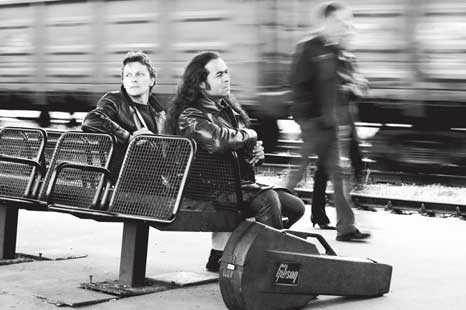
Fomins & Kleins

Ivo Fomins and Tomass Kleins, performing as Fomins & Kleins, will try to make it from the semi-final to the final of the Eurovision Song Contest with their song, “Dziesma par laimi.” (Photo courtesy of Eurovision Song Contest)

Andris Straumanis is a special correspondent for and a co-founder of Latvians Online. From 2000–2012 he was editor of the website.

A primer on Ūsiņi, the start of summer

Although not as well known as other traditional Latvian holidays, Ūsiņi has a charm of its own, not the least of which is its cute name. The name makes one think of ūsas (whiskers), but is actually the name of the old Latvian patron of horses: Ūsiņš. Ūsiņš also symbolizes the dawn and light, and he is said to bring leaves to the trees and greenness to the grass in the spring. In other words, he is the bringer of the goodness of spring.

Ūsiņi marks the halfway point (May 10) between the spring equinox and the summer solstice, and as such it heralds the beginning of summer. In some places of Latvia Ūsiņi is instead celebrated on April 23, which is actually the day for the Jurģi celebration. Jurģis is another Latvian patron or deity, who in some places has melded together with Ūsiņš. Some researchers consider Ūsiņš and Jurģis to be two different names for the same deity, Ūsiņš most likely being the older of the two. Their respective celebrations are quite similar and thus are fairly interchangeable.

One tradition, though, belongs exclusively to the Jurģi celebration: moving day. April 23 used to be the day when the contracts of the farm help ended and they were then free to arrange work elsewhere and therefore to move away. Many beliefs are associated with moving; for example, if it rains on Jurģi, then the movers will be doomed to cry the whole next year at their new home. Another belief states that one is not supposed to say goodbye to anyone while moving to a new home at Jurģi, otherwise things will not go well at the new place.

The livestock were traditionally put out to pasture at Ūsiņi for the first time after the long winter. This occurred not only in Latvia, but also in many other agrarian cultures of Europe. Likewise, at this same time horses were put out to night pasture for the first time (they worked the fields during the daytime). Children typically worked as daytime shepherds (gani), while older boys and young men stayed with the horses, taking turns staying awake through the night to guard them from wolves. This mostly enjoyable nighttime activity was called pieguļa, and it was believed that Ūsiņš also took part with his own horses. Many songs associated with the Ūsiņi celebration revolve around horses, pieguļa, livestock, and wishes for Ūsiņš to help people during the coming summer, especially concerning their horses. An interesting note: the best horse of a herd was often named in honor of Ūsiņš.

After the usual feast, the Ūsiņi celebration continued later into the evening, when it was time to take the horses out to pasture. Many people joined the boys and men on this first night of pieguļa. They gathered around the campfire, sang, danced, ate and drank—activities that would keep the boys and men awake during subsequent nights at pasture. The best known Ūsiņi food is pentags, scrambled eggs with sausage. Of course, this one-dish meal happened to be very easy to prepare over a campfire in the pastures!

Just as at the spring equinox, Lieldienas, eggs play an important role at Ūsiņi, presumably because they symbolize life and the return of the sun. In some areas of Latvia shepherds and pieguļnieki were given eggs to take along with them—as many eggs as there were horses’ legs, or as many eggs as there were cows to take out to pasture. Sometimes the eggs were colored, especially a black color. One of many recorded rituals involved a person lowering a boiled and colored egg from the reins of a horse’s bridle into the hole left by a post pulled out of the ground. This was believed to insure that the horses would stay calm while at pasture. In another ritual eggs were put in an oak tree hollow to make the horses as strong and hardy as oak trees. In general, most Ūsiņi rituals, not only the ones done with eggs, were done to insure that the livestock and horses stay healthy for the coming year. Some of the old rituals even involved sacrificing a rooster.

Although not necessarily associated with Ūsiņi, there is a specific type of singing, called rotāšana, that is sung only in the spring, and only by women and girls. The song refrains, appropriately, consist of the word rotā, and songs with this refrain are sung only until a couple of weeks before the summer solstice, Jāņi, when the līgo-refrained songs take their place (which in turn are sung only until and during the Jāņi celebration, and not a day afterwards). The rotā songs are to be sung out in the open, not indoors, and preferably atop a hill. The perfect time is a calm, warm spring evening, when the voice carries particularly well and the fingers and toes do not get cold too quickly. When singing in a group, as it is usually done, one singer assumes the role of “sayer” (teicēja). She sings the verse first, while the others listen and learn the text. Then the whole group repeats the verse, some singing variations of the melody, others singing a drone accompaniment. When the teicēja tires or has run out of texts, another takes her place. The texts vary a lot, and are often improvized on the spot. Rotā melodies tend to be slow, yet often quite ornamented.

Girls and women sing rotā songs out of joy for the spring and for once again being able to sing together out in the open. But it is said that young men used to pay close attention to the singing from neighboring farmsteads and sometimes chose the best singers for their brides. Unfortunately the traditional way of singing rotā songs has pretty much died out, although plenty of the melodies and texts have survived in folk song collections.