Czechs beat Latvia 2-1 in Euro 2004 game

Maybe Latvia should just avoid the Czech Republic in athletic contests. Two months ago, the Czechs beat Latvia in the world ice hockey championship. And now, in Latvia’s first-ever match in a European football (soccer) championship, the Czechs have done it again.

The Czech Republic beat Latvia 2-1 in a June 15 game played in Averio, Portugal, as part of the 16-team Euro 2004 football championship.

Latvia may have been a long shot going into the Euro 2004 football (soccer) championship, but by the start of the tournament plenty of observers were being careful to not ignore the first-time contenders. Call it the jinx factor.

Latvia surprised the Czechs just as the first half was coming to an end, when forward Māris Verkapovskis picked up a pass from Andrejs Prohorenkovs to score the country’s only goal, according to the official Euro 2004 Web site.

But the Czechs came back 28 minutes into the second half, when Milan Baroš got the ball past Latvian goalkeeper Aleksandrs Koliņko, and then again 12 minutes later on a kick from Marek Heinz.

The Czechs outshot Latvia 28-7, according to game statistics, while the Latvian committed 20 fouls to the Czechs’ 11. The Czechs controlled the ball for 64 percent of the game.

Latvia’s next game in Group D preliminary competition is June 19. Latvia plays Germany in a game beginning at 17:00 local time in Besso stadium in Porto. Latvia’s last preliminary match is June 23 against the Netherlands in a game starting at 19:45 local time in Braga Municipal stadium in Braga.

Andris Straumanis is a special correspondent for and a co-founder of Latvians Online. From 2000–2012 he was editor of the website.

U.S. says human trafficking still a problem

Latvia’s efforts to protect the victims of human trafficking have taken a slight step back during the past year, according to a U.S. State Department report issued June 14. However, prosecution of traffickers and prevention of trafficking appear to be on course.

Lack of funding is in part to blame for Latvia’s slide in protecting victims, the State Department said in its annual “Trafficking in Persons Report,” which examines how women and children worldwide are exploited for sex and forced labor. Two shelters run by the Latvian government in Rīga and Jelgava were closed in the past year.

“The government funds no rehabilitation facilities specifically for trafficking victims, nor does it provide direct funding to foreign or domestic NGOs (non-governmental organizations) for services to victims,” the report said. At the same time, NGOs are being asked to do more.

The report examines what 140 countries are doing to meet the standards outlined in the Trafficking Victims Protection Act, a law passed in 2000 by the U.S. Congress. Latvia for the past three years has been listed as a Tier 2 country, meaning that it among those nations that do not fully comply with the minimum standards “but are making significant efforts to bring themselves into compliance with those standards,” according to the report.

Women and children from Latvia are trafficked for sexual exploitation to Finland, Germany, Ireland, Italy, Israel, Poland, Spain and the United Kingdom, the report said. Israeli, Polish and Ukrainian organized crime groups control the main trafficking networks in concert with domestic Latvian crime groups. In addition, the report said, women and girls from rural Latvia are trafficked domestically for exploitation in the capital city of Rīga.

Although Latvia is criticized in the report, the State Department also notes the country is making an effort to improve. A national action plan to combat trafficking in persons was approved by the Cabinet of Ministers in March, while prosecution of traffickers has increased slightly. To raise awareness, more than 10,000 high school students across Latvia were shown the Swedish anti-trafficking film Lilya 4-Ever. The film tells the story of a young woman from Russia who travels to Sweden in the hope of a better future, but instead is forced into prostitution.

Estonia fared slightly worse in the report, landing on the Tier 2 Watch List because of slow efforts in protecting victims and preventing trafficking. Lithuania remained ahead of both its Baltic neighbors on the Tier 1 list, fully complying with the minimum standards of the U.S. law.

Andris Straumanis is a special correspondent for and a co-founder of Latvians Online. From 2000–2012 he was editor of the website.

The kid’s got talent, now give him a band

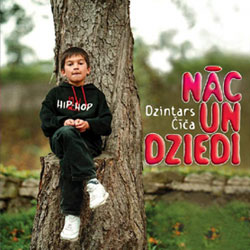
Dzintars Čīča

For those of you who can’t get enough of Eurovision, there is also the Junior Eurovision, where all the budding stars of tomorrow get a chance to display their talents for all of Europe to see. Snobby music fans (like me) turn their noses at such a spectacle, at times calling it, in the best case, “heavy on the cheese” and, in the worst case, exploitation.

Not to say there isn’t talent at these competitions. These are trained (if a wee bit young) musical artists, though the material that they are given is often of a lesser nature. Case in point: Dzintars Čīča, singing prodigy from Sabile, Latvia. Born in January 1993, this singing wunderkind has achieved much already, including participating in the 2003 Junior Eurovision contest, where he earned ninth place. With all his talent, you would figure that a better album could be put together to show off his talents.

The album Nāc un dziedi was released in November 2003 after his appearance in Children’s Eurovision. The album includes one of Čīča’s original compositions, “Tu esi vasara,” as well as his interpretations of a number of different songs.

Nobody is disputing his talent. This kid has an amazing voice. It is just too bad that he is saddled with material that in my opinion is not suited for him (or anybody, really).

“Tu esi vasara” is one of the best songs on the album, but it becomes immediately clear what is going to happen—all the music sounds heavily synthesized, and it seems that there aren’t even any “live” musicians besides Čīča (at least none are listed in the sparse liner notes). It makes it seem that Čīča is simply just singing karaoke, which is a shame. “Tu esi vasara” would be a much better song if there was an actual band, or even just a guitarist, not this unnatural synthetic stuff.

Most of the rest of the songs are taken from the Raimonds Pauls repertoire. You get versions of “Sikspārņa Fledermauša šūpuldziesma,” “Mežrozīte” and “Mēma dziesma,” among others. Nothing wrong with the songs at all, but the life and vitality in the music that was in the originals is replaced with mechanical backing tracks. In fact, the backing track for “Mežrozīte” sounds suspiciously like the group Bet bet’s version of this song from a few years back.

Also on the album is a version of “O sole mio,” once again demonstrating that Čīča has a phenomenal voice, but one would have wished for an actual orchestra or some kind of accompanist.

The entire album seems a bit rushed as well, as if the producers just pulled whatever Pauls standards they had available and let Čīča sing along. And I am not sure who the intended audience is for this compact disc. I wouldn’t call it inappropriate for children, but I can’t see young kids getting into this. Nary a folk song is to be heard here. Even the liner notes seem rushed, including only the lyrics for only two songs (“Tu esi vasara” and the Guntars Račs-penned tune “Nāc un dziedi”) and some pictures. Among those is the (presumably) unintentionally funny picture of Čīča and friends adopting the hats-on-backwards, baggy-clothing look.

Perhaps Čīča’s next album will be a bit more organic than this one. He’s got the voice, now put him together with some actual musicians and let’s see what happens.

Details

Nāc un dziedi

Dzintars Čīča

MICREC,  2003

MRCD 231

Egils Kaljo is an American-born Latvian from the New York area . Kaljo began listening to Latvian music as soon as he was able to put a record on a record player, and still has old Bellacord 78 rpm records lying around somewhere.