


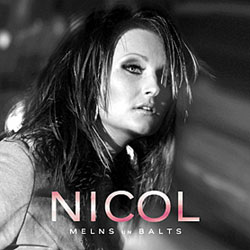
Once upon a time I was used to the idea that the Latvian music world would take a while to get the hang of more mainstream popular music genres. Then, while in Latvia in December, I heard Nicol’s “Melns un balts” play on the radio. The song immediately caught my attention, and I wondered: since when did Latvian R&B exist? How did it come off sounding so good? Who is this singer? I personally don’t listen to R&B artists that often, much less favor them. I was even a bit embarrassed to admit that I liked “Melns un balts.” Since then I’ve listened to her album countless times and have overcome my embarrassment to the point that, when I’m sure no one else is around, I sing along.
Nicol just recently made her debut as a professional singer. Before releasing her newest album Melns un balts in November 2003 (her first Latvian album, preceded in August by a three-song “single” and a full-length album, both mostly in Russian) she sang in clubs, won an award in a new artists’ competition in 2000 in Belarus, and was a finalist in Latvia’s 2002 Eirodziesma competition with her self-written “One More Dance,” according to MICREC’s Web site.
It turns out the album Melns un balts isn’t an R&B album, but rather a mixture of R&B, pop, dance and sometimes a hint of 1980s rock. For me, the first time listening to the compact disc was spent complaining. Eventually I did become used to the overall feel of the album—after the 30th or so time playing it, the music seemed totally normal. Why had I been complaining?
The beginning of the first track on the album, “Noktirne,” reminds me of any song from Vivo, a 2001 album of works composed by Uldis Marhilevičs (released by UPE Recording Co.): footsteps on a gravel path and distant-sounding, airy music. Definitely not R&B. But it’s not a bad sound, either, so I kept away from the “skip track” button and continued listening. The second track, “Ja būsim kopā,” isn’t too bad, either. The lyrics to this song are written by Nicol. Actually, out of the 26 songs on her three albums, Nicol has written the lyrics for 12. This, as far as I know, is also rather atypical of an R&B artist. It’s admirable.
Realization sets in quickly: Nicol, point blank, can sing. I can understand, for the first time, why she has been called “Latvia’s Christina Aguilera.” Nicol’s vocals soar (she took opera lessons in high school), no matter the style of music she’s singing. She easily adapts to the genre of the individual song: soothing ballad, upbeat pop, and offbeat or syncopated R&B. There are neither harsh breaks in her voice as she belts out lyrics in the more intense tracks, nor are there overly sugary stretches in the calmer melodies. It’s a balance that’s refreshing to hear.
The third track is the popular “Melns un balts.” R&B all the way, it’s a very catchy “in your face” song about a failed relationship and finding independence. This track and I had a bumpy beginning. At first I liked it. Then I was frustrated at how much more striking it would have been had there been a heavier bass beat and less synthesizer. The beginnings of a truly captivating R&B song were there, but I still felt empty after listening to it. Now we’re friends again, and the lyrics often stay in my mind: “…Un tad Tu man teici, ka viss būs savādāk / bez pārsteigumiem / bez baltiem ielūgumiem / bez kompromīziem un velns / nav nemaz tik ļauns un melns…”
Go ahead, hit the “back” button, listen to the song again. As lame as it may sound, it’s fun to hear Latvian lyrics set to R&B music.
Later on the album hits some tough spots. While listening to track six, “Pieskaries man,” all I could think of was Sweden’s disco-pop group Ace of Base.
The final track is “One More Dance.” The lyrics sound rushed, but the music and vocals somewhat make up for what ends up being a choppy, grammatically sinful song. The lyrics are choppy, the spelling in the insert appears to be incorrect, and if you pay attention too much, the song makes little sense: “…put your hands around me / ‘couse it feels so right / I wanna be surrounded / with your love tonight / if that’s for one night stand / you’re moving fast / don’t forse me make an and / and turn this dance into last…”
Word for word, from the insert. I see Nicol as another artist who should either stay away from singing in English, or have a text editor who knows what he or she is doing. The Latvian lyrics make sense, of course.
One of my favorite tracks other than “Melns un balts” is track four, “Aiziet vieglāk,” which is a beautiful and soulful song, but doesn’t hold back any of Nicol’s amazing vocals. She manages to work a few belt-outs in there. Another favorite is track 10, “Dzīvoš’ ilgi, ne tik ilgi.” It’s a Latvian folk song put to modern music. The overall effect is kind of eerie, quite unlike the folk song remakes of such artists as the girl group 4.elements and the long-gone techno-inspired Saule.
All in all, I’m surprised and pleased at what Nicol has to offer, and I look forward to her future projects.
Details
Melns un balts
Nicol
MICREC, 2003
MRCD 232
