


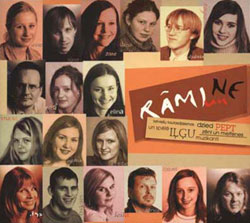
Every year children and teenagers gather at the “Pulkā eimu, pulkā teku” festival in Latvia to gain experience in presenting folk songs that they’ve learned. Last year the handful of singers chosen as “Great Singers” during the festival’s competition were awarded the opportunity to collaborate with the well-known world music group Iļģi. The compact disc Rāmi un ne is the result of that collaboration. Listen well, because here is the next generation of Latvian folk singers.
On the CD 13 teenagers sing 15 songs on 25 tracks. Some of the songs are fairly well known—“Aiz upītes es uzaugu,” “Ai zaļā līdaciņa, ” “Rozēm kaisu istabiņu”—but others are less common. But they will all appeal to almost any listener. They are easy to listen to and even easy to sing along with.
Which leads to an explanation of the additional 10 tracks on the CD. Karaoke anyone?
In the liner notes Māra Mellēna, an initiator of PEPT, writes, “If you have an apple and I have an apple, we can swap them, but in the end we each still have only one apple; we cannot gain more apples by swapping. If you have a song and I have a song, and if we swap them, then we each now have two songs.”
The aim of PEPT is to encourage youngsters to learn the songs of their regions. The way one does this is by first listening to others sing. In the same way, one aim of this CD is for the audience to listen again and again, and then to try singing for themselves. To that end, the CD provides the accompaniments to 10 of the songs, as well as the texts to all of them, so you can sing your heart out and learn a few new songs in the process.
Why Rāmi un ne? All I can come up with is that the CD title is purely descriptive. Rāmi means calm, quiet, thoughtful. Some of the rāmi songs on the CD are “Divi siermi kumeļeņi,” “Man pazuda kumeliņis” and “Man sajāja rāmas tautas.” Other songs are not rāmi, but rather more happy and bouncy, such as “Klipu klapu kaimiņ Janka,” “Ai kad es būtu zinājuse,” and “Aiz kalniem.”
“Purvu brydu na jobulu” is a well-done melding of traditional singing technique and text with a modern accompaniment, involving drums and electric guitar. All of the other accompaniments tend towards acoustic guitar, kokle and violin, with some quiet accordion. On the whole the young singers have surprisingly strong and sure voices.
Often it seems that Latvian folk songs are losing ground to rock, pop, hip-hop, television, computer games and car engines. Through events such as PEPT we see that folk songs, and along with them Latvian identity in general, are still alive somewhere under all of that modern noise. Even if you’re not into the karaoke-style singing part, the songs and accompaniments of Rāmi un ne are pleasant to listen to, and PEPT is definitely a cause worth supporting.
Details
Rāmi un ne
Iļģi un PEPT
Lauska, 2004
On the Web
Pulkā eimu, pulkā teku
Information about the “Pulkā eimu, pulkā teku” festival is available from the Ethnic Culture Center at the University of Latvia. LV
