


The dark-coloured beer known as a porter, although not a common drink among Latvians, nonetheless has a long history. The careful reader of Augusts Deglavs’ novel Rīga, which describes the social and cultural milieu of the first Latvian Awakening in the second part of the 19th century, will come across a passage where Pēteris Krauklītis is working the bar at his Germanicized uncle Georgs Rabemanis’ party. Krauklītis has to unload boxes of beer and properly sort the bottles: porters, Muncheners, Kulmbachers, bock beers and others.
Today, the Aldaris Brewery of Rīga makes a such a beer—Aldaris Porteris. Renowned British beer expert and author Michael Jackson describes Aldaris Porteris as a “liquorice-tinged interpretation” of a “strong Baltic Porter.” He rates it between two and three stars out of four, a rating surpassed only by a couple of beers from the Baltic States.
Cēsu Alus, Latvia’s oldest brewery, also has resumed brewing a porter, according to the company’s Web site.
Aldaris has been brewing its Porteris continually since pre-war independence days, said brewmaster Valdis Ilguns. Aldaris was established in 1937 when the former Waldschlosschen brewery founded in 1865 but dormant since the outbreak of World War I was revived. It too was brewing a porter at the turn of the 20th century.
Aldaris is Latvia’s biggest brewer and is owned by Baltic Beverages Holdings, which in turn is a joint venture of Scottish & Newcastle the United Kingdom and Carlsberg of Denmark.
Aldaris Porteris can trace its roots back to England. In the early 18th century at the start of the Industrial Revolution, porters were introduced and brewed in London, quickly becoming the most popular beer of the time. Porters were one of the first beers brewed by emerging mechanized breweries. According to legend, writes Jackson in The Beer Companion, “the new type of beer became popular with porters in nearby produce markets, and this is one theory as to how it acquired its… name.”
Porters were exported to Ireland. Locally brewed versions were dryer and darker and evolved into Irish stouts with today’s Guinness Stout popular around the world. From the 1780s porters were also exported to ports around the Baltic Sea, but they were brewed stronger to survive the longer sea voyage. One of the first shippers from London was founded by a Belgian named Le Coq.
Strong porter became popular in the court of Empress Catherine II, who ruled from 1762-1796, and it acquired the name Imperial Russian Stout. The Courage brewery in England, now part of the Scottish & Newcastle brewing group, has brewed an Imperial Russian Stout for more than 200 years and still does so periodically, albeit rarely, as a vintage dated brew. Imperial Russian Stouts are also popular with some of today’s microbrewers in North America and England (for example, Old Rasputin Russian Imperial Stout from California’s North Coast Brewery and Samuel Smith’s interpretation from England).
Local variations popped up around the Baltic with the style retaining the name porter. A Scottish settler Carnegie founded a brewery in Gothenburg, Sweden, in the early 19th century. Now under the name of Pripps, it still brews Carnegie Porter. Russian Nikolai Sinebrychoff founded a brewery in Finland in 1819. It too brews Koff Porter today. Denmark’s Carlsberg produces Carls Porter. The label also carries the designation Imperial Stout, cementing the connection.
Closer to home we have Utenas Porteris from Lithuania and Saku Porter from Estonia. Other Baltic porters can be found in Poland and St. Petersburg. But Aldaris and Cēsu Alus brew the only Latvian porters today.
In the early 20th century the British shipper Le Coq acquired the Tivoli brewery in Tartu, Estonia. It was adapted to brew porter in order to circumvent Czarist import duties and started shipping Imperial Extra Double Stout in 1912. The brewery survived the Soviet era, but had stopped brewing porter in 1969. Today it has reverted to the name A. Le Coq and the porter tradition has been revived. Coincidentally A. Le Coq owns Cēsu Alus, which traces its roots back to the estate brewery at Cēsis castle, first mentioned in 1590. A. Le Coq in turn is owned by the Finnish brewing group OLVI Oy. Today’s Harvey & Son brewery in Sussex, England, plays homage to the Estonian connection and brews a vintage dated Imperial Russian Stout embossed with a facsimile label of the original brew. “Brewed in Dorpat” (Dorpat is the German name for Tartu) is clearly visible on the label.
The dark colour of Aldaris Porteris is produced by 10-15 percent dark malt and 5 percent roasted malt, Ilguns explained. It weighs in at approximately 7 percent alcohol by volume, a bit lighter than Imperial Stouts which can hit 10 percent, and the sweetness is due to unfermented sugars. The recipe has changed little over time although hop pellets are now used rather than hop cones and the maturation process has been shortened. Like other Baltic porters, Aldaris Porteris is brewed with bottom-fermenting rather than the top-fermenting yeasts typically used in porters and stouts from the British Isles and elsewhere. With their high alcohol content, Imperial stouts can be laid down and some can be consumed even after 10 years. Similarly an Aldaris Porteris kept in a cool cellar can be poured a year or two later.
Aldaris Porteris is a big brew, a winter warmer that is somewhat out of place on a hot summer’s day. Drink it in a brandy snifter and let it warm up a touch so that its complex flavours open up to the palate.
You can find Aldaris Porteris in many markets in the United States. In Canada, it’s usually in stock at the Latvian Canadian Cultural Centre in Toronto. While it’s a niche product and represents only 2-3 percent of Aldaris production, Ilguns said Porteris is a unique style that has its fans.
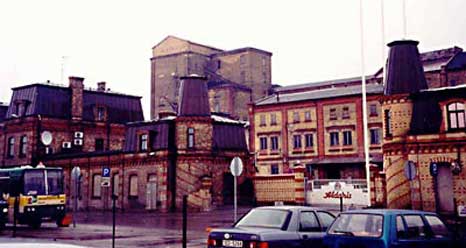
The Aldaris Brewery in Rīga sports a brewing tower of traditional design in the background. Raw materials aided by gravity work their way through various stages of brewing from the top ending up with the finished product at the bottom. (Photo by Viesturs Zariņš)
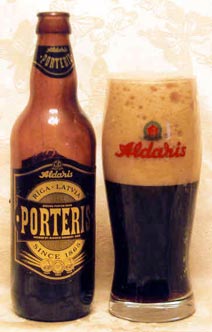
The porter made by the Aldaris brewery in Rīga is described by one expert as a “liquorice-tinged interpretation” of a strong Baltic porter. (Photo by Viesturs Zariņš)

