


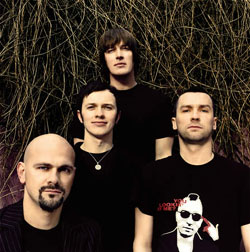
Prāta Vētra opened for R.E.M. when the American band played in Helsinki.
At precisely 8 p.m. on Jan. 29 in Helsinki’s Hartwall Areena, world-renowned rock group R.E.M. bassist Mike Mills introduced the Latvian popular music group Prāta Vētra (known in English as BrainStorm). This was the group’s last performance together with R.E.M., on a concert tour through several Eastern European cities, including Rīga.
I travelled to Helsinki to find out two things: How does BrainStorm sound without its original bass player Mūmiņš (Gundars Mauševics, who was killed in a May 2003 automobile accident) and how does the Latvian band stack up against a world famous rock group?
Unfortunately, at the start of the concert only a few hundred listeners had entered the hall. This was due to two circumstances. First, concertgoers were not permitted to take drinks into the hall, so many took advantage of drinking beer in the outer hallways of the arena. Second, the Finnish public was there to see R.E.M.
Our boys from Latvia seemed rather pale and tired as they started their set. (The preceding concert in Saint Petersburg was cancelled because transportation was delayed at the border between Estonia and Russia.) Only by the end of the set was BrainStorm warmed up.
I thought frontman Renārs Kaupers was just going through the usually ritual dance motions without any real emotion or feeling. The public wasn’t convinced about the performance, but did applaud politely after every song. The reaction of the public was probably a big surprise for BrainStorm, who were warmly received by the home crowd a few nights earlier in Rīga.
The group members seemed to be caught up in themselves and shared little if any contact with one another. Guest bassist Ingars Vilums didn’t even take a glimpse at the bored drummer Kaspars Roga. I wonder if Vilums has found his real place in the group yet. Māris Miķelsons was as usual on the ball and performed his keyboard and accordian parts with precision. Guitarist Jānis Jubalts played well for the most part, but started the song “Kitten Who Did Not Want to Give Up” at a dreadfully slow pace.
The sound as usual was less than perfect for an opening act and it seemed as if soundman Tālis Timrots was prevented from pressing certain sound and volume buttons. The fact that the songs were sung in English didn’t appease me. Even though Kaupers has improved his English immensely over the past 10 years, his English lyrics don’t stand up to his lyrics in Latvian. This was not the best BrainStorm show I have seen. I was disappointed, expecting more from Latvia’s top pop band.
After BrainStorm finished its 35-minute set, a 30-minute intermission followed. During that time 12,000 spectators filled the hall eagerly awaiting R.E.M. From the very first beat, singer Mike Stipe danced and pranced, singing with full force. Bassist Mike Mills played well and sang great harmonies. Even though Peter Buck played horribly and at times completely wrong notes, second guitarist Scott McCaughey covered up for his mistakes. Guest drummer Bill Riefen didn’t shine much, but then again R.E.M’s material wouldn’t let him. Guest keyboardist Ken Stringfellow was steady all night. Still the group performance relied mostly on Stipe. Throughout the entire concert, he controlled the group and the audience as a cult fugure. As Stipe conducted, audience members rhythmically waved their hands in unison, singing along to hits like “Losing my Religion” and “Man on the Moon.”
After the concert I asked R.E.M. guitarist McCaughey what he likes about BrainStorm.
”Renārs is a great frontman,” he answered. That is exactly how I feel. Without Kaupers, BrainStorm would not have enjoyed the success it has so far. Undoubtedly Brainstorm has been where no other Latvian group has been before, but borrowing a line from one of its songs, ”What’s next?”.
BrainStorm should get out on tour of the European and American club circuit. It just doesn’t cut it to release an album or a video and naively hope that somebody is going to notice. You have to tour and then tour some more. Bruce Springsteen played between 250 and 300 concerts a year before he became famous. This is really the only way for BrainStorm to ever hope of achieving the same. The band might just be content with being popular in Eastern Europe.
Then again, it could wait for Stipe and R.E.M. to call for help again…
Details
In concert in Hartwall Areena
Prāta Vētra
Helsinki, Finland: 2005
