Court gives go-ahead to gay and lesbian parade

A gay and lesbian “pride” parade planned July 23 in the Old City district of Rīga is on again after a court decision overturned the city manager’s decision to cancel a permit for the event.

The Rīga District Administrative Court ruled July 22 that the city must re-issue a permit for the parade, but a city attorney said that may not be possible because of time contraints, according to the LETA news agency. Instead, City Attorney Ivars Mauriņš said, based on the court’s decision the earlier permit will be valid.

The parade is planned as part of Rīga Pride 2005, the first-ever gay and lesbian event of its kind in Latvia.

“We salute the decision of the court and consider it a victory for democracy and reason over prejudice and hate,” the Gay and Lesbian Youth Support Group (Geju un lesbiešu jauniešu atbalsta grupa, or GLJAG), said in an announcement posted on its Web site.

But the conservative and religious Latvijas Pirmā partija (First Party of Latvia, or LPP) announced its disappointment over the court’s decision and called on the public to participate in an ecumenical service in the Dome Church on July 23. The service is to start at the same time as the parade, which itself concludes with a service at St. Saviour’s Anglican Church.

LPP issued a statement in which it apologized to the public, saying that even though the party is in the ruling coalition in the Rīga City Council it was unable to stop the parade.

Citing concerns about potential unrest involving extremist groups, Rīga City Manager Ēriks Škapars on July 20 cancelled the parade permit.

Ironically, one of the groups pointed to as a potential troublemaker, the nationalist youth organization Klubs 415, now finds itself without a permit for its planned counterdemonstration, an event titled “Mēs par ģimeni!” (We’re for Family!) in the Esplanāde park in downtown Rīga. While Klubs 415 on July 20 commended the “courageous decision” by the city to pull the permit for the gay and lesbian parade, on July 22 it slammed the city for refusing to issue a permit for the group’s own event.

Klubs 415, in a statement to the press, said its event will take place even without a permit.
Andris Straumanis is a special correspondent for and a co-founder of Latvians Online. From 2000–2012 he was editor of the website.

Sixth volume highlights Eglītis’ work since return

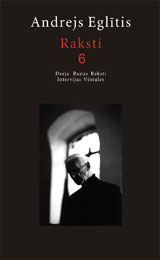
The sixth in a planned seven-volume collection of the work of poet Andrejs Eglītis, who spent more than 50 years in exile in Sweden before returning to Latvia in 1998, has been published by the Rīga-based Valters un Rapa.

The volume presents work created from 1998-2004, including his 2001 collection, Sila priede; interviews with the poet from newspapers and magazines, speeches and other writings. Also included are the poet’s correspondence with exile writers Anšlavs Eglītis (1906-1993) and Jānis Klīdzējs (1914-2000).

The 288-page hard-cover volume includes commentary from literary critic Dzidra Vārdaune, according to a July 21 press release from Valters un Rapa.

Valters un Rapa, which is both a well-known bookstore in downtown Rīga as well as a publishing house, released the first volume of Eglītis’ work in 2002. The fifth volume, covering the 1980s up to his return to Latvia, was released earlier this year.

Andrejs Eglītis book

The sixth volume of work by poet Andrejs Eglītis has been published by Valters un Rapa.

Andris Straumanis is a special correspondent for and a co-founder of Latvians Online. From 2000–2012 he was editor of the website.

U.S. sees increase in immigration from Latvia

After declining for two years in a row, the number of immigrants from Latvia admitted to the United States saw an increase of 23.2 percent last year compared to 2003, according to data compiled by the U.S. government.

A total of 598 persons born in Latvia were admitted into the United States in 2004, according to the latest Yearbook of Immigration Statistics released in June by the Office of Immigration Statistics. In 2003, a total of 459 immigrants from Latvia were admitted. Since 1991, immigration from Latvia has waxed and waned, last reaching a peak in 2001 when 712 persons were admitted.

The data don’t reveal the ethnicity of the immigrants from Latvia.

By comparison, the number of immigrants admitted from Lithuania last year, 2,462, represented a nearly 8 percent increase over 2003. A total of 312 immigrants from Estonia were admitted in 2004, a 24.3 percent jump over the previous year.

Of the immigrants from Latvia, a total of 378 (63 percent) were immediate relatives of U.S. citizens—and the majority of those were spouses.

Just 15 orphans born in Latvia—seven boys and eight girls—were admitted into the United States last year, according to the yearbook.

Last year, 335 persons born in Latvia became naturalized U.S. citizens, an increase of nearly 50 percent over 2003. Also, last year 82 refugees and asylum seekers born in Latvia were granted permanent resident status.

During 2004, a total of 10,140 nonimmigrant Latvian citizens were admitted into the United States for business, pleasure, study or other reasons. The largest share, 42 percent, were tourists. Of the total, 2,373 Latvian citizens entered the United States through New York, 1,680 came in through Chicago, and 1,082 entered through Newark, N.J.

Andris Straumanis is a special correspondent for and a co-founder of Latvians Online. From 2000–2012 he was editor of the website.