A U.S.-based charity that focuses on helping abused children in Latvia has fallen victim to an Internet scam that went as far as to clone much of the design and content of the charity’s Web site.
Jay Sorensen, president of the Kids First Fund in Milwaukee, Wis., said he first became aware of the scam on July 26, when someone in Great Britain forwarded an e-mail to him. Now he worries what damage the scam may have caused to his fundraising efforts and to the reputations of KFF’s board of directors, which includes such well-known individuals as hockey player Artūrs Irbe and Irma Kalniņa, director of the NGO Centre in Rīga.
The e-mail claimed to come from a woman in Latvia affiliated with an organization called the Hope Children’s Home. The writer, someone supposedly named Liza Nikauskas, gave a testimonial for a supposedly London-based group called the European Charity Union and listed the group’s Web site as www.europeancharity.net.
When Sorensen visited the group’s Web site, he said he was surprised to see that most of the content and design was the same as that of the Kids First Fund. Even a description of his family, part of Sorensen’s “message from the president,” was there, except that the president now was named Jason Soren.
“These culprits have associated the narrowly defined mission of KFF with their illicit activities,” Sorensen said in an e-mail to Latvians Online. “They have probably sent out millions of spam messages to potential donors throughout the world—to solicit funds and to seek representatives to conduct their fraudulent fundraising.”
Rather than seeking funds through online donations, as Kids First Fund does, the European Charity Union advertised for country coordinators to solicit donations, offering commissions of 5 percent to 7 percent of whatever they brought in.
The group registered at least three different Web addresses, europeancharity.biz, .com and .net. All three have been removed after Sorensen complained to the Internet service providers hosting the addresses.
Along the way, Sorensen got a lesson in how the Internet works and how easy it is to set up Web sites with false information.
As Sorensen began to track the owners of the European Charity Union sites, he found they provided false details about who they were and where they were located. The Web site europeancharity.biz, for example, supposedly belonged to a registered sex offender in Florida, whose name and address is publicly available information.
On its europeancharity.com Web site, the European Charity Union listed a contact address in London that is the same as that of a long-standing organization called the Family Welfare Association. But when contacted by Latvians Online, a spokesperson for the association was surprised to learn of the European Charity Union.
Helen Dent, the chief executive of the Family Welfare Association, said through the spokesperson that the FWA was founded in 1869 and has never been associated with the European Charity Union or any organization sounding like it.
The European Charity Union also is not registered with the Charity Commission for England and Wales.
“I intend to aggressively pursue any cloning and to shut down the offending sites,” Sorensen told Latvians Online. “I also hope news of this will cause those who regulate the domain registration process to tighten up the rules. It’s far too loose and that is the cause of most of the problems.”
He said he has contacted the FBI in Milwaukee about the scam. A spokesperson for the FBI was not available for comment before this article was published.
The Kids First Fund, found on the Web at www.kidsfirstfund.org, is a registered non-profit organization. It describes its mission as “supporting the needs of kids that are sexually and physically abused, abandoned or neglected.” Most of its efforts are focused on rural Latvia. Last year, according to its tax filing, the fund took in more than USD 60,000 in donations.
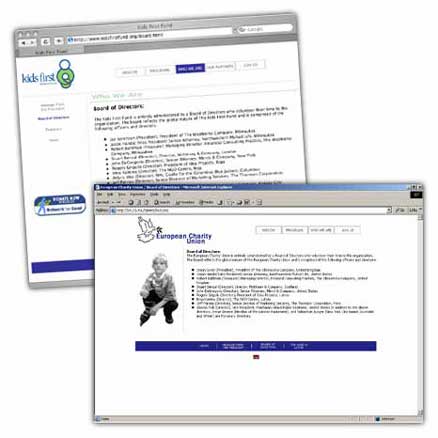
The now-defunct Web site for the European Charity Union (in foreground) offered a list of its supposed board of directors that was the same as that for the Wisconsin-based Kids First Fund. Even the look of the Web site was similar to that of the Kids First Fund.
Andris Straumanis is a special correspondent for and a co-founder of Latvians Online. From 2000–2012 he was editor of the website.


