Rīga offers its visitors no shortage of art galleries and museums, but most of them are filled with masterpieces from another century—impressionistic snow-covered landscapes or images of happy farmers working the land. While there are indeed a number of interesting galleries showing the work of contemporary artists, the most exciting developments in the visual arts are in the realm of art history, where for the first time a discourse about Latvian art is being created.
During the Soviet period, the tedious and stagnant style of Socialist Realism remained the only one tolerated by the government on an official level. By working unofficially, however, artists were able to progress in a manner similar to their Western colleagues, experimenting with such “subversive” genres as conceptual, installation and performance art.
But art history did not evolve as a discipline, because Socialist Realist art was supposed to present a lucid and unequivocal message, which precluded any form of criticism. Unofficial art was not to be commented on at all. Consequently, after 1991 the Latvian National Museum of Art (Latvijas Nacionālais mākslas muzejs), along with the newly founded Soros Center for Contemporary Art (since 2000 the Latvian Centre for Contemporary Art, or Latvijas Laikmetīgās mākslas centrs) began the immense task of documenting and creating a history of Latvian art where one never had existed. One way of doing this has been through the organization of exhibitions.
This past spring, the Latvian Centre for Contemporary Art curated “Robežpārkāpēji” (Trespassers), a retrospective of the art of the 1980s. This was the first comprehensive look at the decade that could be described as the coming of age of Latvian artists. In the West, artists had been experimenting with performance art and installation since the 1950s, and with video art since the 1960s. It wasn’t until the ‘70s and ‘80s that artists in Latvia were able to try out these art forms for themselves—not only because of government restrictions over art production, but also because of the lack of materials, as well as lack of contact with the West. By the 1980s, with the social changes that resulted from perestroika and glasnost, artists felt more free to experiment, with less risk of consequences for doing so.
In conjunction with its 100th anniversary in 2005, the Latvian National Museum of Art put together an exhibition of art from the second half of the 20th century (“Latvijas Māksla 20. gadsimta otrajā pusē”), on view at the Arsenāls Exhibition Hall until June 2006. This is the very first assessment of the art that developed in Latvia from after the Second World War until the present day, showcasing works of Socialist Realism side by side with avant garde experiments. Exhibitions such as these are crucial, because there are no textbooks on Latvian art history, no resources that tell us who influenced whom, and how this or that style developed. The history of Latvian art is still very much an oral tradition, and the exhibition is currently the only site where visitors can bear witness to a history that runs the risk of soon being forgotten, unless it is recorded for posterity.
When that exhibit closes next summer, Rīga will once again be without a permanent display of contemporary art. There are plans to build a contemporary art museum but, like many projects in the works in Latvia, it is dependent on the availability and readiness of funds.
As a result, alternative spaces—including virtual exhibitions—are being created where those interested may view works and read about the artists, art movements and significant events in the history of Latvian art.
CAMP (Contemporary Art Museum Project) is an online art database being developed by the Latvian Centre for Contemporary Art. The project’s Web site is in Latvian and English, and contains a catalogue of contemporary Latvian artists and art works, as well as useful bibliographies of art publications since the 1980s. A section entitled “Games” is intended as an educational tool to help children understand and interpret works by contemporary Latvian artists, but it can also be entertaining for adults. The site’s creators also aim to provide a forum for discussion about the conception of a contemporary art museum in Latvia. It is an excellent resource both for art historians and those with a general interest in what has been happening in Latvia art during the last 25 years.
The Latvian Artists’ Union Museum (Latvijas Mākslinieku savienības muzejs) maintains a collection of more than 15,000 works, but the museum’s approximately 60 square meters of exhibition space is not sufficient to display even a fraction of that. The curators have managed to circumvent these limitations by putting together an online exhibition entitled “Art. Myth and Document. 1940-1941. 1944-1991.” The virtual exhibition seeks to document Latvian art from the Soviet period by focusing on three aspects: the continuation of Latvian traditions in art that developed during the period of the First Republic, innovations in Latvian art during the second half of the 20th century, and commissions from the regime that aimed to keep art in line with party ideology. Unlike CAMP, this site is literally an online museum, and the focus is more on presenting works of art in an exhibition format than creating a research tool.
There are also places in Rīga where one can view contemporary art in real time and space. While most of the galleries are commercial, offering very traditional canvases for purchase, there are a select few that feature contemporary artists and promote experimental work that is happening in Latvia today.
NOASS is not only a gallery located on a narrow strip of land across from the Radisson SAS hotel in Rīga (the physical address is AB dambis), but also a culture and arts project that aims to promote contemporary art, experimentation, and the use of new technologies in art works. NOASS supports a variety of projects taking place in Latvia, and the gallery hosts not only exhibitions, but also performances and film festivals.
Galerija Māksla XO, located in a great cellar space in Konventa sēta (Skārņu iela 8), Rīgas Galerija (Aspazijas bulvāris 20), and Galerija Bastejs (Basteja bulvāris 12) often feature exhibits by leading contemporary Latvian artists as well as up-and-coming ones.
Finally, one can also see a variety of interesting shows by local as well as international artists at the Artists’ Union of Latvia Art Gallery (11. Novembra krastmala 35). After visiting the gallery on the first floor, one can head up to the third floor to view the works on view at the aforementioned Artists Union of Latvia Art Museum.
If you don’t have the opportunity to come to Rīga and visit the galleries yourself, online resources provide a convenient alternative. Hopefully, as those continue to develop, publishing will also increase and Rīga will soon see the opening of a contemporary art museum to complement the virtual experience of the visual arts. Until then, the advantage is to the armchair traveler sitting at home in front of their computer.
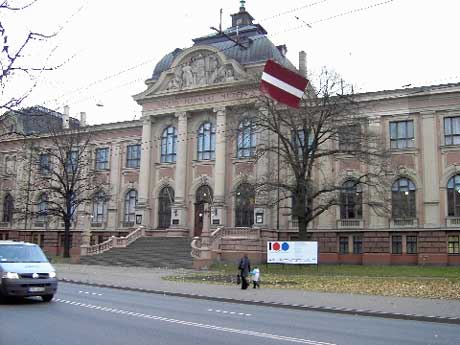
The Latvian National Museum of Art in Rīga marked its 100th anniversary in 2005. (Photo by Amy Bryzgel)
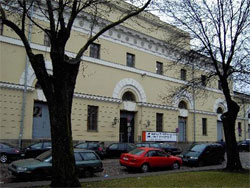
The Arsenāls Exhibition Hall, situated in an old customs warehouse at Torņa iela 1 in Rīga, is used by the Latvian National Museum of Art for some exhibitions. (Photo by Amy Bryzgel)