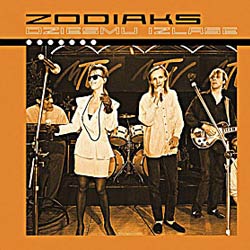
Zodiaks collection recalls period of reawakening

One of the most amazing statistics in the Latvian music world is the Soviet-era success of composer Jānis Lūsēns. The instrumental ensemble Zodiaks, which he formed in the 1970s, sold a staggering 20 million copies of the 1980 album Disco Alliance in the Soviet Union—an unbelievable amount for that time. To put in perspective, this was a hit on the level of Michael Jackson’s Thriller.

However, this review has nothing to do with the Zodiaks of that period, but with a reimagined Zodiaks—this time with vocalists—and its album Mirušais gadsimts, first released in 1995. The purpose of the statistic was to give an idea of how popular Lūsēns was in those times and how, when he turned to vocal music, his magic touch remained. The new Zodiaks, formed in 1987, had its heyday in the time of Latvian reawakening at the end of the 1980s and beginning of the 1990s—the perfect time for the group and its often patriotic lyrics, which were often taken from classic Latvian poets. Lūsens, besides composing all the music for the group, also played the keyboards.

This is a compact disc I have been waiting for a very, very long time. Many of the bright spots of the Mikrofons records of the late 1980s were Zodiaks songs. For example, Mikrofons 88 had the melancholy ballad “Tautas laiks” (lyrics by Imants Ziedonis), featuring perhaps the most impressive vocal performance of singer (and violinist) Zigfrīds Muktupāvels’ career. There was also “Taisnība” (lyrics by Edvarts Treimanis–Zvārgulis) from Mikrofons 89, with the line “Nāc ārā no metāla zārka” (Come out from the metal coffin)—words that rang true then, at the eve of Latvian independence. Years later, I managed to get hold of the long out-of-print 1990 album Mākoņi, which had a number of other great songs on it.

Thankfully, as part of its extensive republishing of classic Latvian albums and songs, MICREC earlier this year released Mirušais gadsmits, a collection of 17 of the best songs from the vocal era of Zodiaks.

Besides Lūsēns and Muktupāvels, the group included Aivars Gudrais and Dzintars Sāgens on guitar, as well as Maija Lūsēna on vocals. As Lūsens was the composer and keyboardist, many of the songs have a strong keyboard and synthesizer base, but not always. Since Muktupāvels was also a violinist, some of the songs featured his violin work. Perhaps the best example—and one of the stranger songs the group performed—was “Mirušais gadsimts” (lyrics by Klāvs Elsbergs), which features Muktupāvels on violin in the introduction.

As mentioned, many of the songs featured lyrics by classic Latvian poets. These included Vilis Plūdonis (“Manas mīļākās puķes” and a personal favorite, “Bohemiešu dziesma”), Kārlis Skalbe (“Staburags un saulesmeitiņa”), and, of course, Rainis, whose poetry was used for the song “Daugava,” yet another one of my favorites on this album.

Sadly, the group as a vocal and instrumental entity was short lived. After a tour of the United States in 1990, the group broke up. Muktupāvels went on to found the group Bet Bet, which Gudrais also joined for a period of time. Lūsēna still sang some of the songs of Zodiaks with Dāmu pops. Lūsēns himself remains busy with composing. Perhaps his best known work is the rock opera “Kaupēns, mans mīļais,” which remains one of the most popular examples of that genre in Latvia. However, the instrumental version of the group still does periodically perform together.

Packaging, as with many of these releases, is minimal. No lyrics, but there is a short biography of the group, as well as some pictures that I’m sure would look much better if they didn’t have a dreadful orange tint to them.

To say that I am overjoyed at having all these songs finally on CD would be an understatement. There are many classics here, many of which still are popular today. As an example, the a cappella group Cosmos covered “Tautas laiks” on its first CD. Mirušais gadsmits is an essential recording, with many timeless songs, and is highly recommended.

Details

Mirušais gadsimts

Zodiaks

MICREC,  2006

MRCD 305

Egils Kaljo is an American-born Latvian from the New York area . Kaljo began listening to Latvian music as soon as he was able to put a record on a record player, and still has old Bellacord 78 rpm records lying around somewhere.

Saeima approves new coalition government

In a quick turnaround, Latvian lawmakers met in the morning of Nov. 7, organized the new Saeima and, gathering again in the early evening, voiced their approval for a continuation of a government coalition led by Prime Minister Aigars Kalvītis.

The four-party conservative coalition received 58 votes in favor and 41 against, according to the parliament’s official Web site.

Of the four parties in the coalition, Tautas partija (People’s Party) got seven portfolios, including the job of prime minister. Zaļo un zemnieku savienība (Unions of Greens and Farmers) got five portfolios. Four went to Latvijas Pirmā Parija (First Party of Latvia) and Latvijas Ceļš (Latvia’s Way), which joined forces for the Oct. 7 parliamentary election. The newest coalition member, Tēvzemei un Brīvibai/LNNK (For Fatherland and Freedeom/LNNK) got three porfolios.

Tēvzemei un Brīvibai/LNNK joined the coalition in just the past few days, disappointing Jaunais laiks (New Era), which had been trying to mend fences with other conservative parties and rejoin the coalition. Jaunais laiks had been part of the last Kalvītis government, but pulled its six ministers in April in a public dispute with Latvijas Pirmā Partija.

The new Cabinet of Ministers includes:

  • Prime Minister Aigars Kalvītis, Tautas partija, who continues in his position.
  • Defense Minister Atis Slakteris, Tautas partija, who had joined the cabinet in April.
  • Finance Minister Oskars Spurdziņš, Tautas partija, who first got the job in March 2004.
  • Foreign Minister Artis Pabriks, Tautas partija, who first got the job in July 2004.
  • Culture Minister Helēna Demakova, Tautas partija, who has held the post since March 2004.
  • Health Minister Gundars Bērziņš, Tautas partija, who first got the job in December 2004.
  • Aigars Štokenbergs, Tautas partija, minister for regional development and local government. He previously was the economics minister.
  • Education and Science Minister Baiba Rivža, Zaļo un zemnieku savienība, who has held the position since April.
  • Welfare Minister Dagnija Staķe, Zaļo un zemnieku savienība, who first got the job in November 2002.
  • Environment Minister Raimonds Vējonis, Zaļo un zemnieku savienība, who has held the position since January 2003.
  • Agriculture Minister Mārtiņš Roze, Zaļo un zemnieku savienība, who first got the job in November 2002.
  • Ina Gudele, Zaļo un zemnieku savienība, minister for special assignments for electronic government affairs. She has held the position since April.
  • Minister for Children and Family Affairs Ainārs Baštiks, Latvijas Pirmā Partija and Latvijas Ceļš, who first got the job in May 2004.
  • Interior Minister Ivars Godmanis, Latvijas Pirmā Partija and Latvijas Ceļš, who replaces the controversial Dzintars Jaundžeikars. Godmanis was chair of the Council of Ministers from 1990-1993 and served as finance minister from 1998-1999.
  • Minister of Transportation Ainārs Šlesers, Latvijas Pirmā Partija and Latvijas Ceļš, who replaces Krišjānis Peters. Šlesers, who has been at loggerheads with Jaunais laiks founder Einars Repše, is head of Latvijas Pirmā Partija. He returns to the communications ministry, having held the minister’s job before Peters.
  • Oskars Kastēns, Latvijas Pirmā Partija and Latvijas Ceļš, minister for special assignments for society integration affairs, who replaces Karina Pētersone. Pētersone, elected to the new Saeima, now is an advisor to the speaker of the parliament.
  • Economics Minister Jurijs Strods, Tēvzemei un Brīvībai/LNNK, who replaces Štokenbergs.
  • Justice Minister Gaidis Bērziņš, Tēvzemei un Brīvībai/LNNK, who replaces Guntars Grīnvalds.
  • Normunds Broks, Tēvzemei un Brīvībai/LNNK, minister for special assignments for administration of European Union funds.

The Cabinet of Ministers is scheduled to meet for the first time Nov. 8.

The new speaker of the Saeima is Indulis Emsis, who served as prime minister for seven months in 2004. He is a member of Zaļo un zemnieku savienība.

The Saeima consists of 100 members, but the election of one deputy, Juris Boldāns, was not sanctioned by the parliament’s ethics commission. Boldāns, elected on the Tēvzemei un Brīvībai/LNNK ticket, is under investigation for forgery related to the recent election.

Andris Straumanis is a special correspondent for and a co-founder of Latvians Online. From 2000–2012 he was editor of the website.

Latvia sees ‘significant improvement’ in corruption

Since last year Latvia has seen a “significant improvement” in perceived levels of corruption, according to the latest Corruption Perception Index by the Berlin-based Transparency International.

Latvia ranked 49th on the list released Nov. 6, tied with Slovakia and a jump of two spots from last year, when the nation ranked 51st.

The Corruption Perception Index is based on polls of business people, academics and country analysts. A total of 163 countries are included in the 2006 index, which measures opinion about the level of corruption and is based on a 10-point scale. The higher the score, the less a nation’s economic and political system is perceived as corrupt.

It is on that scale that Latvia has seen the “significant improvement,” leaping to 4.7 from last year’s 4.2. The increase was the greatest since the country’s first appearance in the index, the anti-corruption group Delna said in Rīga.

Nonetheless, scores below 5.0 suggest that the level of corruption in a country is serious, according to Transparency International.

Latvia continues to gain on its southern Baltic neighbor. Lithuania maintained a score of 4.8, but slipped to 48th place from last year’s 44th. It was tied with the Czech Republic and Kuwait.

Estonia, meanwhile, rose three places to 24th overall, but its score of 6.7 remain unchanged from last year. It was tied with Barbados.

Finland, Iceland and New Zealand shared the No. 1 spot in the index. At the bottom of the list was Haiti. The United States ranked 20th and was tied with Belgium and Chile. Russia ranked 121st, tied with Benin, Gambia, Guyana, Honduras, Nepal, Phillipines, Rwanda and Swaziland.

Andris Straumanis is a special correspondent for and a co-founder of Latvians Online. From 2000–2012 he was editor of the website.