A whole year’s worth of folk songs

Dievsēta ļaudis

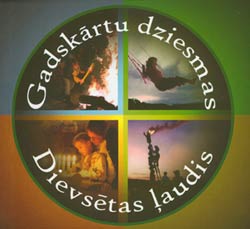
The number of Latvian folk music recordings seems to be growing almost as quickly as wild mushrooms after a rainy summer. Some recordings have specific themes, such as war songs or lullabies, while others cover songs from a certain holiday such as Jāņi or the winter solstice. Until now, I have not been aware of a single recording that attempts to incorporate music of the entire Latvian calendar with all of its holidays. A group of Latvian-Americans has filled exactly this shortcoming. An informative new compact disc, Gadskārtu dziesmas, has recently been released by Dievsētas ļaudis (the folks of Dievsēta).

For 30 years a group of Latvians with a keen interest in folk traditions has been gathering at Dievsēta, a property owned by the Latvju dievturu sadraudze in central Wisconsin, to celebrate holidays—not just the popular Jāņi, but also lesser known ones such as Mārtiņi and Meteņi.

The booklet that accompanies the CD is a treasure trove of information. Its 64 pages include English and Latvian language descriptions of the seven holidays represented by songs on the CD, lyrics and notes for all 43 songs, as well as a number of beautiful photographs from Dievsēta. Each song is also described in one or two succinct sentences in English. The following holidays are represented on the recording: Meteņi (5 songs), Lieldienas (5 songs), Ūsiņi (2 songs), Jāņi (7 songs), Apjumības and Miķeļi (7 songs), Mārtiņi (7 songs) and Ziemassvētki (10 songs).

Glancing at the list of individuals who participated in the CD recording, I noticed names of people who have sung or currently sing with folk ensembles based both in the United States and Latvia. Thus, the quality of the music on the recording is actually quite good. The CD contains a variety of a cappella songs by just one person or a group, as well as songs accompanied by a number of different instruments.

One of the things that I love most about some Latvian songs is the imagery. This is most evident in songs about the sun. The fifth track is a Meteņi song called “Saule savus kumeliņus.” As beautifully summarized by the liner notes, “At sunset the sun takes her horses to the sea to swim, while she herself sits at the top of the hill with the golden reins in her hand.” This song has a simple yet lovely melody. On the CD the song is sung a cappella by just one female, which unfortunately makes it sound a bit too plain. But, with more than three dozen songs on the recording, I did find quite a few songs that I greatly enjoyed.

Many listeners might find track 11, “Tumša nakte, zaļa zāle,” of interest. Listeners might assume this song to be a familiar one, as it is the title of a popular folk song that many children learn in school. Yet, one needs to remember the great diversity in Latvian folk music and thus not be surprised that the melody and—indeed—most of the lyrics of this song are different than the one many people will know.

The seven Jāņi songs have a nice variety of melodies. Anyone who ever tries to sing songs at Jāņi could learn something from these. It seems that most Latvians know only one overused, tired melody for līgo songs. One of the Jāņi songs is sung by children, reminding the listener of the importance of passing traditions down to the younger generations.

Two other songs I greatly enjoyed were “Rudzu druva lielījās” (track 20), a song about work sung at Apjumības, and “Laid iekšā, saimeniece” (track 34), a Ziemassvētki song with a great, party-like tempo and sound.

Many Latvians have never celebrated a holiday such as Miķeli, therefore most songs on the recording will be new to listeners. Even as someone who sings with a Latvian folk ensemble and has participated in a number of folklore activities at 3×3 camps, the majority of songs on this CD were unfamiliar to me. This might be a turnoff for some people, as many individuals seem to prefer the familiar to the unfamiliar. Precisely that is the frustrating thing about Latvian folk music: it is ironic that so many Latvians are familiar with only a couple dozen tunes when the wealth of Latvian folklore is in its folk songs, most of which unfortunately go unsung and unheard.

Because these songs have such specific purposes, this is also probably not the type of CD one would listen to over and over again. However, if one has an interest in Latvian folklore and its traditional holidays and in the diversity of Latvian folk music, and has always wondered how a holiday such as Mārtiņi is celebrated, then Gadskārtu dziesmas will be a wonderful addition to one’s music collection.

Details

Gadskārtu dziesmas

Dievsēta ļaudis

Lauska,  2007

ISBN 978-9984-39-187-8

Where to buy

Purchase Gadskārtu dziesmas from BalticShop.

Note: Latvians Online receives a commission on purchases.

U.S. visa waiver is closer, but hurdles remain

Latvians citizens may have moved a tiny step closer to gaining visa-free travel privileges to the United States thanks to an agreement in Congress on improving homeland security. However, Latvian officials still have several hurdles to jump—including reducing the rate of refusal for U.S. visas to just 10 percent.

The U.S. Senate in an 85 to 8 vote on July 26 approved a conference report on the Implementing Recommendations of the 9/11 Commission Act of 2007, a wide-reaching bill that seeks to shore up homeland security in the wake of the Sept. 11, 2001, terrorist attacks in New York and Washington, D.C. The House of Representatives followed on July 27, approving the conference report 371 to 40. President George Bush, despite having some objections over contents of the legislation, is expected to sign the bill once it reaches his desk.

As part of the bill, the Visa Waiver Program is modernized through several measures that eventually could lead to Latvian travelers gaining visa-free entry into the United States. Currently, only 27 countries are included in the program.

Among factors to be considered in allowing a country into the revamped Visa Waiver Program is whether the rate of refusal for nonimmigrant visas is not more than 10 percent during the previous full fiscal year. Under current law, the rate of refusal must be 3 percent or less. The new, higher threshold is balanced with tougher security measures.

In fiscal 2006, Latvia’s rate of refusal stood at 21.6 percent, according to U.S. State Department figures. Estonia’s was 7.1 percent, while Lithuania’s was 27.7 percent.

Both the Senate and House considered bills to implement the 9/11 Commission’s recommendations about homeland security. The Senate’s version, tagged S. 4, prevailed in the conference committee.

The legislation had the grudging support of the American Latvian Association, which the previous week issued an “action alert” asking Latvian-Americans to contact conference committee members to push for the visa waiver language. However, in June the ALA had said it favored another bill over the Senate’s version of the 9/11 Commission bill. The association, in a June 6 statement by ALA Director of Public Affairs Valdis Pavlovskis, objected to the rate of refusal language in the Senate bill.

“This is an excessively high rate and effectively excludes the Baltic countries and most of the new European Union countries from the program,” Pavlovskis wrote of the 10 percent barrier.

The ALA would have preferred H.R. 1543, the Visa Waiver Modernization Act. Introduced March 15 by Democratic Rep. Rahm Emanuel of Illinois, the bill was referred March 19 to the Subcommittee on Border, Maritime and Global Counterterrorism and has not been seen since. Rather than a specific rate of refusal figure, the bill called for evidence there is “sustained reduction in visa refusal rates for aliens from the country and conditions exist to continue such reduction.”

The original language of the Senate bill set no limits for the modernized Visa Waiver Program, but like H.R. 1543 sought sustained reduction in visa refusal rates. However, in February the Senate adopted an amendment proposed by Democratic Sen. Dianne Feinstein of California that imposed the 10 percent barrier.

Calling the Visa Waiver Program “the soft underbelly of our national security,” Feinstein told her colleagues in the Senate how several terrorists, including Zacarias Moussaoui (the “20th hijacker” of Sept. 11) and “shoe bomber” Richard Reid, could easily travel to the United States from France and the United Kingdom with just a passport.

She noted that 13 of the 19 countries that had signed Visa Waiver Roadmap agreements with the United States—including Latvia—had visa refusal rates well above 10 percent.

Latvia and the U.S. government in 2005 agreed to a roadmap to visa-free travel. Under the roadmap, the Latvian Ministry of Foreign Affairs agreed to broaden its information campaign about requirements for travel to the United States, as well as to work closely with the U.S. embassy in Rīga to share information and review progress.

Latvia and six other Eastern and Central European nations have hired lobbyists Dutko Worldwide of Washington, D.C., to press their case in Congress. Latvia’s cost for the lobby firm is about LVL 15,000, according to the Ministry of Foreign Affairs.

Foreign Minister Artis Pabriks has said one of the chief missions of new Ambassador Andrejs Pildegovičs is to see to it that Latvia gets accepted to the Visa Waiver Program.

Spokespersons for the ALA and the Embassy of Latvia in Washington were not available for comment.

Andris Straumanis is a special correspondent for and a co-founder of Latvians Online. From 2000–2012 he was editor of the website.

Survey asks diaspora about dual citizenship

Officials in Rīga are asking Latvian organizations abroad to weigh in on whether granting dual citizenship is the way to encourage closer ties to the homeland and even return migration.

The Secretariat of the Special Assignments Minister for Social Integration on July 24 electronically distributed a five-question Latvian-language survey that asks for input on a proposal to reinstate aspects of dual citizenship. Responses to the survey are due July 30 and the secretariat expects to have the results ready by Aug. 1.

Results from the survey will be considered as the government discusses what its next steps will be on the dual citizenship question, Zane Lielķikute, public relations director for the integration secretariat, told Latvians Online in an e-mail.

Under Latvian law, dual citizenship is not allowed. Up until July 1, 1995, exile Latvians and their descendants were able to reclaim citizenship without having to give up citizenship in their host countries. According to the Office of Citizenship and Migration Affairs, a total of 30,793 individuals reclaimed citizenship, 40 percent of them in the United States.

In recent months the dual citizenship question has been raised because of the thousands of Latvian citizens who have emigrated to Ireland and other Western European nations in search of work. Many, officials and observers fear, are unlikely to return as they put down roots and start families.

Ainars Baštiks, minister for children and families, has proposed that one way to encourage return migration is to grant Latvian citizenship to children born abroad to Latvian citizens. Under the current system, a child born of Latvian parents in Ireland would have Irish citizenship, but not—apparently—Latvian.

The proposal is one of several discussed by a task force set up by the integration secretariat to examine how to encourage return migration.

“The minister for children and families believes that, looking globally and considering Latvia’s future, every Latvian citizen is important,” Viesturs Kleinbergs, Baštiks’ chief of staff, wrote in an e-mail. “For that reason it is important to insure that a child born to Latvian citizens abroad would have the opportunity to gain Latvian citizenship regardless of which nation they were born in.”

The formula, Kleinbergs said, is very simple: “A citizen is born to a citizen.”

In an interview with the official government newspaper, Latvijas Vēstnesis, Baštiks acknowledged that few children might want return to Latvia, but at present they are not allowed to return at all.

Baštiks’ proposal in recent days has received public support from Artis Pabriks, Latvia’s foreign minister, and Gaidis Bērziņš, the justice minister.

“Because Latvian law does not allow dual citizenship, the parents of children often are forced to renounce Latvian citizenship,” Pabriks said in a July 23 statement, “and after that it hard for our nation to defend the interests of these children.”

Pabriks said consideration should be given to slightly liberalizing the citizenship law to allow children to have dual citizenship in cases where one parent is a Latvian citizen but the other parent is a citizen of one of the other member states of the European Union.

Complications

Complicating the matter appear to be differing interpretations of Latvia’s citizenship law. The Ministry of the Interior, which has responsibility for citizenship affairs, is withholding comment on Baštiks’ proposal, said Laura Karnīte, director of the ministry’s press office.

But she pointed out that the law already grants Latvian citizenship to children born to Latvian citizens regardless of where the birth takes place. Section 2 of the citizenship law states that in cases where both parents are Latvian citizens, the child is considered a Latvian citizen regardless of where the child is born. Section 3, which applies to cases in which just one parent is a Latvian citizen, also allows for the child to be considered a citizen.

The difficulty, Karnīte said, comes when encountering Section 9, which prohibits dual citizenship. The Office of Citizenship and Migration Affairs, she said, has chosen to interpret the law to mean that dual citizenship is not allowed in cases of naturalization. A person wanting to become a Latvian citizen would have to renounce their citizenship in another state.

Also awaited is the outcome of a case now before the Constitutional Court. Marks Locovs, who in 1994 reclaimed his Latvian citizenship under the pre-1995 dual citizenship clause, is challenging the constitutionality of the citizenship law. His daughter, who was born in Israel, is not allowed to receive Latvian citizenship without giving up her Israeli citizenship. Locovs, according to a press release from the court, argues that the citizenship law is counter to the Latvian constitution, which guarantees equal rights for all citizens regardless of where they live.

Preparations for the case are scheduled to be ready by Aug. 22.

Questions

The integration secretariat’s survey asks five questions:

  • In which country do you live or work?
  • Are you aware of the secretariat’s task force’s recommendations for how to encourage Latvian migrants to return to the homeland?
  • Do you agree that it is necessary to grant dual citizenship to children born of Latvian citizens abroad?
  • Would granting dual citizenship encourage participation in Latvia’s democratic processes, such as elections?
  • Would granting dual citizenship in some way encourage return migration?

Results of the survey are expected to be added to a report presented to the Cabinet of Ministers by the task force. The report, assembled by the task force in June, includes more than 20 suggested activities that could help encourage return migration, according to a press release from the integration secretariat.

The report identified six major categories of activities, including analyzing reasons for migration and return; public-private partnerships to support business initiatives among Latvian residents; improving the job market in Latvia; improving information sources for Latvians abroad; educating Latvian society and stimulating positive thinking, and reducing barriers to legal, financial and insitutional ties to Latvia.

Andris Straumanis is a special correspondent for and a co-founder of Latvians Online. From 2000–2012 he was editor of the website.