Latvian churches abroad well represented on the Web

Latvian Ev. Lutheran Church in Sydney

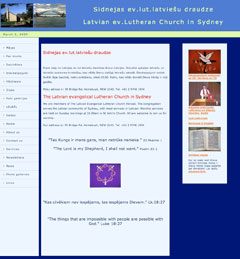
The Web site of the Latvian Ev. Lutheran Church in Sydney provides Bible quotes and the church newsletter.

Latvians who have ended up in other parts of the world, either voluntarily or involuntarily have more often than not established their communities with the focal point being the church. In many cities the church community has founded Latvian schools, camps, folk dancing groups and other organizations. Over the years the role of the church as the hub may have changed slightly but its primary role—as the place for Latvians to be able to go and worship God in the style that they are accustomed to—has remained to this day. Even if congregation numbers are dwindling, the communities will still do their utmost to support a pastor and ensure that regular services are offered to those who wish to attend.

Dozens of Latvian churches are scattered around the world and a sizeable proportion of them have a Web site informing congregation members and the wider community of their work. Quickly skimming through the sites you get a good insight into what each community values and deems important informationwise. But it is important to bear in mind that the flashiest or most professionally designed and structured church Web site does not necessarily mean the congregation is a more caring community and the pastor is far better than others. It just may mean the congregation has steered its funds towards other service-oriented priorities. By the same token, a site that takes pride in mentioning recent christenings, shows plenty of photos featuring happy occasions in the church calendar and provides directions on how to get to the church may be a more outreach-focused church than one that focuses on the history and origins of the congregation. Each bit of information is important but in a balanced way. Nor does it necessarily mean that if the information on a particular church is in English and Latvian that the church is less focused on the Latvian language in services.

Here’s a quick summary of features on some church Web sites. By no means have we tried to list every bit of information available—or every site. Most of the sites are in Latvian, but some provide English content as well.

In Australia, the Web site of the Latvian Ev. Lutheran Church in Sydney provides Bible quotes for certain times of need, as well as a downloadable church newsletter. The site also notes all sermons are recorded on compact disc and can be ordered from the pastor.  The Church of the Holy Cross in Melbourne also has both its newsletter and monthly bulletin available for downloading and informs of the latest events and service calendar.

In Canada, St. Andrew’s Congregation in Toronto, has a few newsletters available for download as well as a video of the African Childrens Choir that recently performed at the church. We experienced some difficulty viewing and downloading these files because we were not using a Windows computer and Microsoft Internet Explorer.

In the United Kingdom, visit the Web site of the United London Latvian Lutheran Church and you won’t have an excuse for missing the next service: A popup message reminds visitors. The site allows vistors to download the latest newsletter and MP3 files of sermons and songs. A link takes visitors to a forum where they can discuss church-related and broader Latvian issues.

In the United States, the New York Latvian Ev. Lutheran Congregation takes pride in its various church properties as well as the summer camp in the Catskill Mountains. The church Web site provides information and photographs of these properties. The site also has MP3 audio files of various services by various pastors in 2007. Visitors also can download a membership application form and a donation form.

The Web site of the Latvian Ev. Lutheran Church of Washington D.C. is in English and Latvian and has instructions on how to get to the church. The local Latvian school founded by the church also gets a mention.

St. John’s Latvian Lutheran Church in Philadelphia wins hands down as the Web site with the most colorful introduction. The site has a service and events calendar followed by the school calendar, showing that school events are coordinated with the church calendar.

We tracked down the Latvian Evangelical Lutheran United Church of Kalamazoo within www.saites.org, a portal for Latvians in Michigan. We found the church pages to be very limited informationwise. The Saginaw Latvian Ev. Lutheran Church had more news but it unfortunately was slightly outdated. The site contains an invitation to pay church dues and to donate money to the congregation’s sister church in Latvia.

The Latvian Ev. Lutheran Church of Indianapolis, which is included in the Indylatvians.com portal, has a brief paragraph informing of its location and services.

The biggest surprise was hearing a Latvian worship song and seeing a scrolling announcement at the top of the site of the Chicago Latvian Zion Ev. Lutheran Church. The availability on the site of the church bulletin, the annual report and dozens of photos of church events all show that this is a community with many helping hands.

The Minneapolis-St. Paul Latvian Ev. Lutheran Church has a well-structured and visually appealing site with information on the church and its school, choir, folk dancing group, ladies auxiliary, library and more. The site also has a personal touch: announcements of latest christenings.

The Boston Latvian Ev. Lutheran “Trimda” Congregation site has plenty of photos of members at various functions and events, showing the community is a fairly active one. The structure and design of the site are easy on the eye. This is the only site that informs visitors how to reach the church by public transport.

Three more broad sites are worth a mention:

  • The Latvian Evangelical Lutheran Church in America (LELBA) is the umbrella organization for all the previously mentioned churches in the United States. LELBA puts out two publications, the magazine Ceļa biedrs and the newsletter LELBA Ziņas. Tables of contents and summaries are available online for Ceļa biedrs, while the newsletter is available as Adobe Acrobat PDF files. LELBA’s Web site also lists the various divisions of the board and the work each division is involved in.
  • The recently unveiled Union of Latvian Baptists in America site provides brief information on the various Latvian Baptist churches in this region.
  • The Latvian Ev. Lutheran Church in Germany site has a church and pastor list and service calendar for the various churches scattered throughout central Europe, including Germany, Belgium, Denmark, the Czech Republic and the Netherlands.

Details

Daina Gross is editor of Latvians Online. An Australian-Latvian she is also a migration researcher at the University of Latvia, PhD from the University of Sussex, formerly a member of the board of the World Federation of Free Latvians, author and translator/ editor/ proofreader from Latvian into English of an eclectic mix of publications of different genres.

Estonian media group buys Delfi portals

The publisher of a leading Estonian daily newspaper has acquired the popular Delfi group of Web portals, including Latvia’s delfi.lv, for EUR 54 million.

The Tallinn-based Ekspress Group announced the deal Aug. 8. The company, whose properties already include such media outlets as the Eesti Ekspress newspaper, is adding AS Delfi to its stable. Delfi runs seven Internet portals, including Estonian and Russian versions in Estonia, Latvian and Russian versions in Latvia, delfi.lt and centras.lt in Lithuania, and delfi.ua in Ukraine.

“This transaction will allow Ekspress Group to become the Baltic market leader in the most rapidly evolving sphere of business in Europe—online advertising—and to also gain a foothold in the Ukrainian market,” Hans H. Luik, the major shareholder of Ekspress Group, said in a press release.

Delfi began in November 1999, according to its Web site, combining elements of several other Web sites. In 2004, Delfi was acquired by the Swedish search engine company Findexa, which has been operating the portals through its Interinfo branch. The portals are among the most popular in their respective countries. Latvia delfi.lv, for example, during the fourth week of July boasted between 1.3 million and 1.6 million page views daily Monday through Friday, and about half that during the weekend.

Delfi this year is expected to generate profit of EUR 2.68 million on turnover of EUR 7.54 million. Ekpress Group said the portals also are expected to increase their turnover at a rate of 30 percent per year with profit margins of 35 percent to 40 percent.

The other big commercial Internet portals in Latvia are TVNET and Apollo.

Ekspress Group said it is financing the Delfi purchase from money raised from its recent public share offering and from a bank loan.

The Delfi deal still needs approval from the Estonian Competition Board.

Andris Straumanis is a special correspondent for and a co-founder of Latvians Online. From 2000–2012 he was editor of the website.

The resurgence of Latvian youth in Australia

To read the Australian Latvian press somedays, it would seem that the local Latvian jaunieši are a pretty hopeless lot—rarely turning up to events, often innapropriately dressed, and totally lacking any notions of Latvian grammar or punctuation. Yet if we really are so disinterested in the whole matter of being Latvian, why do we score such frequent mentions?

It is often said that jaunieši (youths) these days are not active enough in Latvian society, and yet I recently had a conversation with someone from the so-called “middle generation” who believes the current generation of jaunieši is in fact more active than jaunieši were when she was our age. I wasn’t quite ready to believe her at first. In some old newspaper clippings from the seventies and eighties I saw pictures of youths marching in rallies to protest the Soviet occupation of Latvia and could not help feeling that the current level of political awareness and activism among my friends came nowhere near previous generations. While this may yet be true, perhaps with Latvia free for so long now the current generation of jaunieši simply engages with the homeland on a different level.

In the past five or so years in Australia there seems to have been a sort of resurgence of youth activity. In 2003 a group of jaunieši from Adelaide hosted the first Jaunatnes dienas (Youth Days) in many years. This festival culminated with the reestablishment of the Latvian Youth Association of Australia (Latviešu Jaunatnes apvienība Austrālijā, or LJAA), which has in turn led to more frequent events being organised by jaunieši, for jaunieši, around Australia. Similarly, in the last five years a number of new youth musical ensembles of various styles have been established. Sydney Latvian youth choir Jaunais vējš celebrates its fifth anniversary this year, alongside the Adelaide folk music ensemble Bārdas tiesa.

Who can say what the reasons are for this resurgence? I would hazard a guess that it is in no small way due to the influence of many within the middle and older generations, such active people as Viktorija Mačēns and Aldis Sils who have not only the energy to organise concerts and run ensembles, but have managed to exert a positive and exciting influence on the jaunieši involved in the process. Similarly, initiatives by organisations such as the Latvian Federation of Australia and New Zealand to help involve talented and inspiring individuals from Latvia such as Arturs Uškāns of Laimas muzykanti, and musical groups such as Iļģi, Ceiruleiši and Vilkači, in events such as Kultūras dienas, the summer high school and 3×3 have helped spark a new enthusiasm for and interest in various aspects of Latvian culture. These efforts also have established friendships and new points of contact with Latvia outside of the outdated textbook images often encountered in Latvian Saturday schools.

So now we find ourselves in the curious situation of a newly active generation of Latvian youth looking for opportunities to make their mark on society and shape its future direction, cornered by an older generation who wants us to be more involved while simultaneously being resistant to change. The number of times I have heard jaunieši deploring that nothing they do ever seems good enough! In one instance a group of girls went to perform at a Latvian function and were reprimanded for wearing short skirts. At the next concert they made an effort to dress more conservatively and were told it was unladylike to wear pants. In another instance two violinists were told they should have performed in folk costumes. Although they find the stiff collars, loose sleeves and large brooches of tautas tērpi uncomfortable for playing the violin, they felt unable to explain this fact for fear of the responses they would receive. In both cases, the performers’ attire received stern criticism in the reviews while the musical performances went completely unmentioned.

Perhaps the people who make such comments are unaware how much they are taken to heart. Sometimes it is possible to take these remarks lightly. The youth choir Jaunais vējš once made a point of performing in thongs (flip-flops) after a member was told off for wearing thongs on stage, despite the fact that her long pants made them barely visible to the audience. In the majority of cases, however, the comments can be disheartening, even to the point where they discourage people from becoming involved.

On my more pessimistic days I wonder why any of us bother. The older generation is rarely satisfied and the younger generation seems increasingly apathetic. Most of the time, however, I can look around and see all the wonderful things being achieved. Many of my friends have recently had extended stays in Latvia, I have noticed them speaking Latvian amongst themselves more frequently and their language in general improving. Others of my friends are taking on leadership roles within Australian Latvian society, from running folk dancing and musical ensembles to positions within larger organisations such as Daugavas Vanagi and the Latvian Federation of Australia and New Zealand. Then there are the various concerts and festivals, from the upcoming Jaunatnes dienas in Melbourne and Saules svētki in Brisbane, to the cultural workshops run by LJAA last year and the Jāņi celebration hosted by folk dancing ensemble Jautrais pāris in Sydney this year—which was called the best ever by some who attended.

And so we return to the perception that jaunieši are not involved enough in Latvian society. Perhaps it is merely a matter of reevaluating the ways in which we are involved.

Maybe there were not many youths in the audience of a particular concert, but look around: there’s one at a committee meeting, two on stage, a few more are currently planning the next youth concert, another is visiting her vecmāmiņa and learning to make pīrāgi while others have just celebrated Jāņi with friends and family in Latvia. I don’t think the situation is so bad after all.